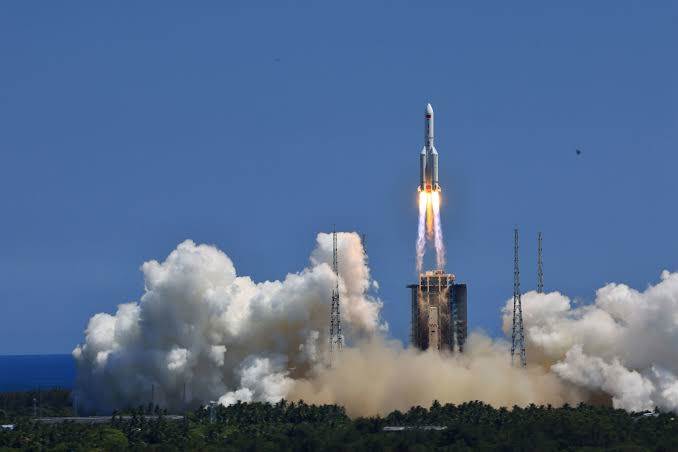
A sizeable portion of the enormous rocket that was used to launch the third module of China's Tiangong space station has uncontrollably crashed back to Earth, forcing Spain to close its airspace and causing hundreds of flight delays.
According to European and US space agencies, the Long March 5B (CZ-5B) rocket broke up in large pieces as it re-entered the Earth's atmosphere at 10.01 UTC, four days after it took off from southern China.
The Long March 5B (CZ-5B) rocket, which had launched four days earlier from southern China, reportedly disintegrated into numerous fragments as it re-entered the Earth's atmosphere at 10.01 UTC. Enaire, Spain's air navigation authority, put limitations on the airspace above the country's northeastern regions, including Catalonia and the Balearic islands, as a result of the object's re-entry.
In a statement, Enaire said: 'Given the uncontrolled entry of remains from the Chinese space object CZ-5B in a descending orbit crossing our national territory, Enaire established an airspace exclusion zone. A further update stated that the flight delays were due to the airspace shutdown, which occurred on Friday from 9.37am to 10.17am. 300 of the 5,484 flights booked across Spain's 46 airports, according to airport operator Aena, were impacted.
Since its initial launch in May 2020, the Long March 5B has made four flights. On its maiden launch, the rocket's fragments impacted on Ivory Coast, where they damaged a number of structures but caused no known injuries.
While fragments from the third flight fell into the Sulu Sea in the Philippines, debris from the second trip harmlessly landed in the Indian Ocean. Zhao Lijian, a spokesperson for the Chinese foreign ministry, stated that the rocket's re-entry into the atmosphere was a standard international practise during a regular briefing on Friday.

