Check Case Sensitive Password in SQL Server Using Collate Clause
Collate is a clause that can be applied to a database definition or a column definition to define the collation, or to a character string expression to apply a collation cast.
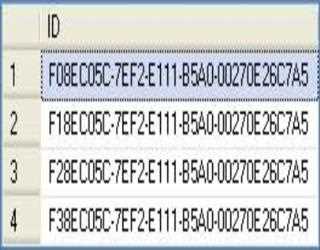
Usage of $ROWGUID and $IDENTITY in SQL Server
$ROWGUID The point of setting the ROWGUIDCOL property is to enable you to use $ROWGUID instead of the column name in a SELECT list. That means we can use $ROWGUID for access ROWGUIDCOL from table if ROWGUIDCOL is used.
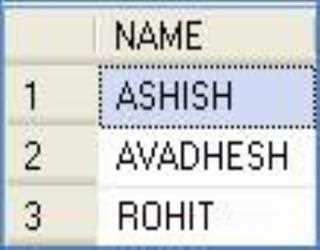
Top with Index and Order of Result set in SQL Server
Here we used TOP keyword for selecting records from table in SQL server using Index and Order By statement. First we create a table and insert some values.
Linking Tables and Views between Access and SQL Server
Linking lets you connect to data without importing that information, so that you can view and edit the latest data both in the SQL Server database and in your Access database without creating and maintaining a copy of the data in Access.
How to Recover from a Corrupted Database in SQL Server 2000
Make sure that the database being restored is from the same Product level as the server you are restoring to. I once faced an issue when trying to restore a database from an SP4 to a non-SP4 database server.
Checking IF…ELSE condition in Stored Procedure SQL Server
SQL IF...ELSE Statement used to test a condition. IF...ELSE Statement using in execution of a Transact-SQL statement (Store Procedure or T-SQL) and Trigger.
SQL Server Security Tips
Some of these tips are quick and easy, others with take longer to implement. Not all of them will apply to your particular environment, and some apply to some types of server more than others. They do however apply to all versions of SQL Server.
REPLACE in an UPDATE statement
This article covers using the REPLACE function to selectively replace text inside a string in SQL Server. The REPLACE function is easy to use and very handy with an UPDATE statment.
Tricks to Replace SELECT * with Column Names
You might have heard many times that one should not use SELECT * as there are many disadvantages to the usage of the SELECT *. I also believe that the
Transaction in SQL Server
In .NET environment we can define transaction boundary by Transaction object. 1. If you are using SqlClient (namespace System.Data.SqlClient) Managed
CURSOR in SQL Server
A Cursor is a database object that represents a result set and is used to manipulate data row by row. When a cursor is opened, it is positioned on a row and that row is available for processing.
Stored Procedure in SQL Server
Stored procedures are a powerful part of SQL Server. They can assist programmers and administrators greatly in working with the database configuration and its data.