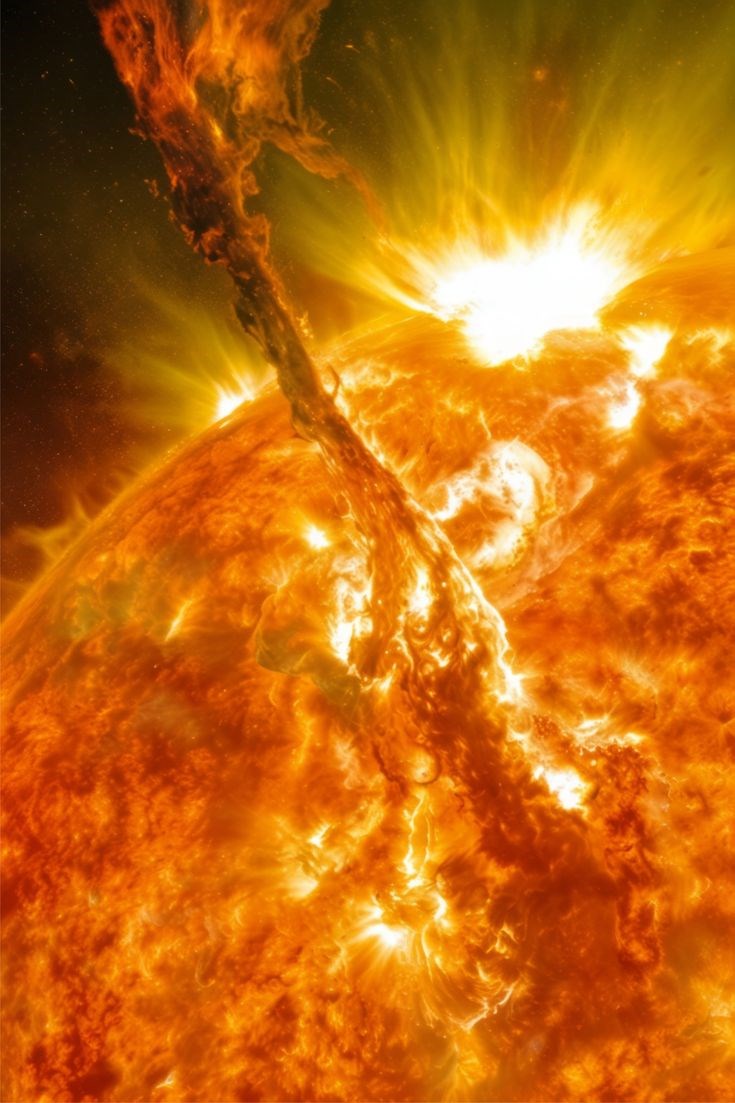
A solar storm is an extremely powerful phenomenon coming from the Sun; it can cause disruption to life on Earth. These storms are the result of the solar flares and coronal mass ejections (CMEs) released by the Sun. They produce such amazing auroras, but they can also be menacing to satellites, power grids, and communication systems. They are increasingly important because of the impact solar storms are having on modern technology.
What Causes a Solar Storm?
The Sun is magnetic and it causes solar storms. Sunspots are formed from constant magnetic fluctuations in the photosphere or the Sun’s surface. Magnetic fields of this type become unstable and release energy in the form of solar flares or CMEs. These explosives send into space charged particles and radiation that can head in our direction and interact with Earth's magnetic field to produce geomagnetic disturbances.
Types of Solar Storms
Three types of solar storms are solar flares, coronal mass ejections (CMEs) and geomagnetic storms. Solares flares represent a very intense source of radiation, whereas CMEs are large clouds of solar plasma shot away in space. CMEs or solar wind interact with Earth’s magnetosphere when geomagnetic storms occur. Geomagnetic storms pose the biggest threat to technological systems, but delivery varies in application and impact.
Impact on Earth
The power of the solar storms can be inspiring and destructive. On the upside, they produce the breathtaking auroras to be seen in the polar regions. Yet, the effects of the negative impact are huge. As per now, they can affect satellite communications, GPS systems and power grids, resulting in blackouts. In the worst kind of cases, solar storms can destroy spacecraft and endanger astronauts. Being able to understand and predict these events is the basis of mitigation of their consequences on a rapidly technology-dependent world.
Historical Solar Storms
The Carrington Event of 1859 was one of the most notable solar storms in history. It triggered fires, and caused massive geomagnetic storms which failed telegraph systems. In fact, an 1989 Quebec blackout was caused by a solar storm and left millions without power. In the light of these events, solar storms are serious risks to our critical infrastructure and suggest the need for a highly vigilant and prepared monitoring capability.
Monitoring and Prediction
Advanced tools such as the Solar and Heliospheric Observatory (SOHO), and the Parker Solar Probe are used by scientists in monitoring solar activity. Using sunspots, solar flares and CMEs to predict solar storms, they are these kinds of instruments. Government and industry can take preventive measures of an alarm of early warnings, like shielding satellites or stabilizing power grids. It is crucial to continue research and development of new technologies to get better and better at forecasting – and reacting – to solar storms.
Conclusion
Solar storms are an interesting and at the same time a potentially dangerous natural event. We see them, shining down in our skies with auroras, but they can also not be ignored as their ability to fry modern technology. We remember the Sun has massive power through historical events like the Carrington Event or even more modern issues. Investing in monitoring systems, as well as preparing for their appearance, will allow us to mitigate their impact and keep exploiting the boost bestowed by our technological progress. It’s not science curiosity, it’s a solar storm insurance policy for the future or else our treasure will boil.


Leave a Comment