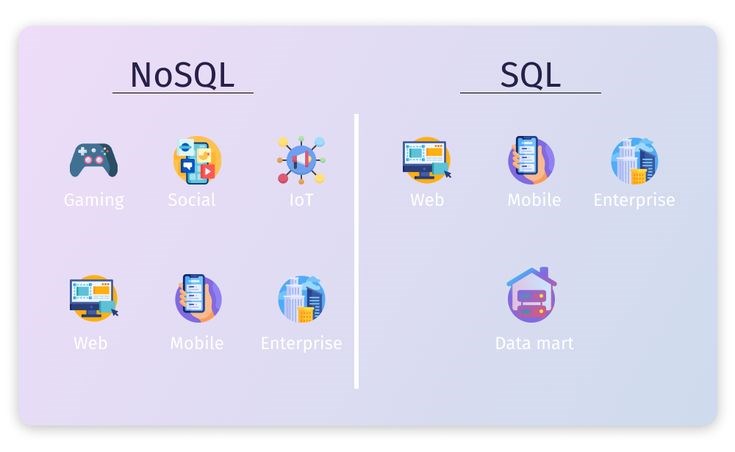
Choosing a database for modern applications — SQL (Structured Query Language) or NoSQL (Not Only SQL) — is an imperative. Depending on project requirements (i.e. scalability, flexibility, data structure), both provide their own advantages. SQL databases provide high structure and work well for storing data in transactional systems, but NoSQL databases are great if you are storing unstructured data and good for scalability across distributed systems. Knowing the major distinctions between SQL and NoSQL databases will facilitate your ability to pick which database option is best for your application’s budget and growth potential.
Data Structure
Data structure is the most important difference between SQL and NoSQL databases. Relational SQL databases store data into tables, which are rows and columns. Data is assumed to follow a predefined schema, and so they rely on this. On the other side, key features of NoSQL databases are their flexibility with the ability to accommodate unstructured, semi-structured or structured data in formats of keys and values, documents or graphs. NoSQL databases because of this flexibility can deal with any form of data in its database and the strategies used to store it in the database are flexible enough to adapt to dynamic or changing data in the application.
Scalability
Another great factor between SQL and NoSQL databases is scalability. SQL databases like almost all servers are ultimately vertically scalable because they can add more hardware capabilities of the server like CPU or memory. This works well for most smaller applications but as that data volume grows it grows far more complex and expensive. However, as opposed to NoSQL databases, these databases are horizontally scalable and can spread its data across many servers. NoSQL databases are better for large scale applications which are supposed to grow fast and deal with a huge amount of data on even distributed data.
Flexibility and Schema
Since SQL databases are built to follow a fixed schema, they cannot resist changes that violate this schema. With large datasets or the fact that your app is live and changing the schema can be a bit of a chore. While NoSQL databases are schemaless in nature, this means that they don't require the fixed schema; instead, it allows developers to modify their data in flight without affecting existing information. NoSQL is good for projects in which the data model is assumed to evolve overtime. Although data integrity is provided in a rigid manner by SQL databases, the NoSQL databases sacrifice some consistency to achieve greater flexibility and faster development cycles.
Performance and Speed
NoSQL databases tend to perform better than SQL databases in regard to performance because of their Read and Writes speed. In SQL databases, because they are more structured, you can get performance bottlenecks when you are running a large number of queries, a complex join, etc. As a design, noSQL databases are designed for speed and are capable of handling large scales of simple queries at lower latency. In addition, their capacity to scale horizontally means that they can handle well as the data grows, which makes NoSQL databases a smart choice for applications with high availability and low latency performance.
Use Cases
SQL and NoSQL databases work best for particular cases. Applications that require a lot of complex queries, transactions, and transactional consistency along with the compliance of the ACID traits (Atomicity, Consistency, Isolation, Durability), banking systems, or inventory management are highly suitable SQL databases. Unlike NoSQL databases, the SoQL database excels at applications that work with large amounts of unstructured data, such as social media platforms, content management systems and real time analytics. SQL vs NoSQL decisions tend to be about whether some constraints like query or access patterns — or data volume and possibly data structure or how hard you need consistency — do not exist.
Conclusion
SQL and NoSQL databases are both strong and weak for their own reasons, and the selection between those two depends mainly on what the application needs. For transactional systems, SQL databases are the way to go because they are stable, consistent, and of course, structured. Yet, these NoSQL databases are flexible, scalable and can match high performance to applications that process huge quantities of unstructured data. Knowing the differences between the two types of database will help businesses make decisions more wisely and pick out the best database solution based on that.


Leave a Comment