iOS : SQLite Database is a Software Library
Previously: we learn about SQLite and standard SQLite commands : iOS : SQLite engine SQLite Database Engine is a software library that provides a Rel
iOS : Collection View Controller
The UICollectionView operates in a similar way to UITableView. While UITableView manages a collection of data items and displays them on screen in a s
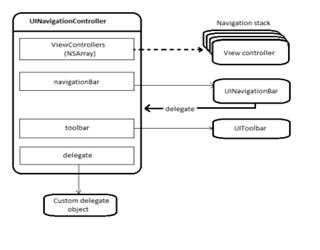
iOS : Navigation Controller
A Navigation Controller is a special kind of view controller that manages a stack of view controllers and their corresponding views. It's an ideal way to display hierarchical data.
iOS : Core Data Framework
The Core Data API allows developers to create and use a relational database, perform record validation, and perform queries using SQL-less conditions.
iOS : SQLite Engine
SQLite is an in-process library that implements a self-contained, serverless, zero-configuration, transactional SQL database engine. It is the one dat
iOS : Notification
Notifications give people information and functionality that’s important right now. People can get notifications in various contexts, such as on the lock screen, while they’re using apps, and when they visit Notification Center....
iOS : IBAction of UI element
Previously we learn about IBOutlet elementiOS : IBOutlet of UI element As early as 2004 (and perhaps earlier), IBAction was no longer necessary for a
iOS : IBOutlet of UI Element
An IBOutlet connection is usually established between a view or control and its managing view controller (this is often done in addition to any IBActi
iOS : UIView class of UIKit Framework
View class defines a rectangular area on the screen and the interfaces for managing the content in that area. At runtime, a view object handles the rendering of any content in its area and also handles any interactions with that content.
iOS : UIKit Framework
Previously we learn to iterate over a collection using fast enumeration : Objective-C : Fast enumeration While the Foundation framework defines class
Objective-C Foundation Framework
The Foundation framework defines a base layer of ObjC classes, Foundation framework includes the root object class, classes representing basic data types such as strings and byte arrays, collection classes.....
Objective-C : Attributes of @Property Directive
@property offers a way to define the information that a class is intended to encapsulate. If you declare an object/variable using @property, then that