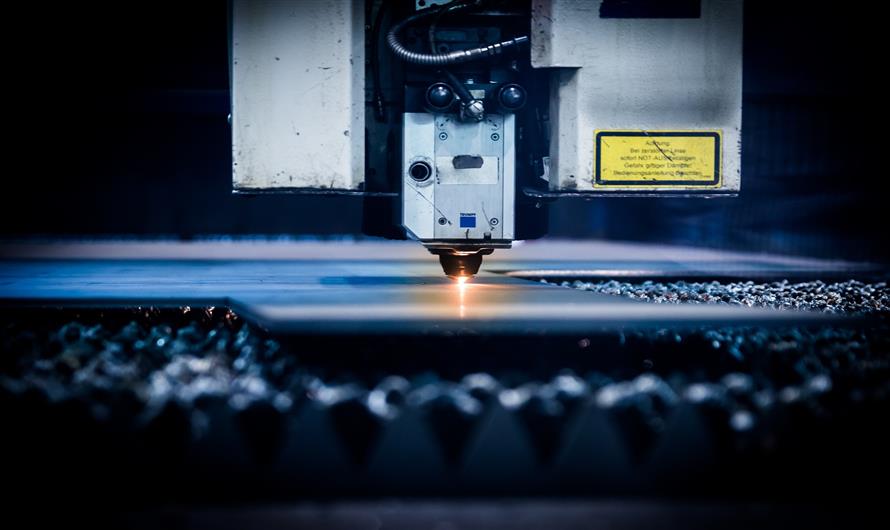
Manufacturing is much easier with laser tools. Precision cutting ensures high-quality, timely operations. Anyone interested in upgrading their team’s equipment should be aware of the importance of laser cutting for custom fabrication designs. New technologies could transform daily operations, enhance product quality and give businesses an advantage over their competitors.
How Laser Cutting Works
Laser cutting tools are advanced resources that provide efficient and precise fabrication for a wide range of materials. Technology enhances a company’s accuracy and timeliness by utilizing lasers that can engrave, mark or cut objects.
Teams create plans for the objects they want to make, such as aerospace equipment or medical device components. After uploading their design to their laser tool’s software program, employees can focus on other tasks. The software’s computer numerical control (CNC) uses automated controls to guide lasers along the uploaded cutting plans.
Manufacturing professionals can retrieve their custom items once the laser program has finished the design. The automated attention to detail reduces the chance of remaking the object due to operational mistakes.
Types of Available Lasers
Company owners interested in laser cutting machinery will find a variety of options available. Manufacturers depend on them for various reasons. Comparing the power source behind each laser will guide teams to the right tool for their fabrication process, such as:
- Fiber:Laser cutting can use fiber-optic cables to cut through metals like aluminum and stainless steel. The fast results and low maintenance make it an appealing option for large-scale production.
- CO2: Carbon dioxide gas powers lasers while they engrave or cut through materials like textiles, acrylic, plastic and wood. CO2 ensures equal speed and efficiency for the selected production supplies.
- Nd:YAG: Neodymium-doped yttrium aluminum garnet (Nd:YAG) can power lasers that weld or cut thicker metals. The tool is slower, but it maintains accuracy with some of the most challenging manufacturing materials.
Finding the right fabrication laser will depend on each company’s budget and specialty. Comparing each type ensures that professional teams get the computer-controlled systems they need to improve their operations.
Benefits of Laser Cutting for Custom Fabrication
Investing in a new cutting machine will require financial consideration. Laser cutting is both an expense and an opportunity. Company owners can review its benefits to understand why it generates a positive return on investment (ROI).
Improved Cutting Accuracy
Computers are less likely to make mistakes than humans. Lasers can also apply pinpoint precision compared to traditional tools like angle grinders or saws. More accurate cutting enhances the quality of each product. Teams can also reduce their need for secondary machinery to fine-tune finalized products before shipping them.
Complex Geometric Possibilities
CNC guidance requires custom designs. Teams can get creative with more complex outlines because the advanced computer systems easily handle complicated shapes. Latticework and internal corners pose no issues for lasers that can access areas where human hands and larger equipment cannot fit.
Companies could improve their product line options by offering more elaborate cutting or detailing than their competitors. This is possible if their operations rely on machinery that works within one quadrillionth of a second for ultimate control.
Minimal Heat Zone
Heat often warps the materials closest to the affected area. Some equipment has broad impact areas, but laser machines apply heat directly to designated spots. The accuracy minimizes distortion that would ruin the desired product. Teams preserve the structural integrity of their chosen materials, improving quality control with minimal effort.
Depending on their selection, professionals can adjust settings to further minimize potential heat damage. Settings like pulsed modes could give them more control over what they need to make.
Better Kerf Compensation
Manufacturing professionals understand that the width of material removed during cutting can affect the product’s quality. That kerf measurement is easier to control with precise lasers. A laser fabrication machine optimizes material use by accurately targeting desired cut lines. Anyone using the tool will ensure there is enough compensation in each of their product plans.
Faster Production Processes
Teams making fewer mistakes with materials can maintain faster production schedules, and lasers support that effort. Rapid production cycles are no issue for automated lasers and CNC software. Company leaders who want to conduct limited-time marketing campaigns could create new products within a quick time frame to support those efforts.
Improve Operations With Precise Lasers
Laser cutting strengthens production processes in numerous ways. Teams can benefit from more accuracy, better material accommodation and improved kerf compensation by upgrading their tools. Company leaders should compare the various types of lasers to determine the most suitable machinery for their manufacturing needs.


Leave a Comment