Deep learning is a subfield of machine learning that uses artificial neural networks to model and solve complex problems. It is a type of AI that has gained popularity due to its ability to learn and solve problems without being explicitly programmed. In this blog, we will explore deep learning and how it works.
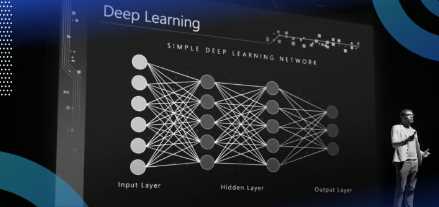
Deep learning is based on the concept of artificial neural networks, which are inspired by the structure and function of biological neurons in the human brain. These networks consist of multiple layers of interconnected nodes or neurons, with each layer learning to extract higher-level features from the input data.
The input data is fed into the first layer of the network, which processes the data and passes it onto the next layer. Each subsequent layer processes the output of the previous layer, extracting more complex and abstract features from the data. This process continues until the output layer produces a final prediction or classification based on the input data.
The learning process in deep learning involves adjusting the weights of the connections between the neurons to minimize the difference between the predicted output and the actual output. This is done through a process called backpropagation, where the error in the output is propagated backwards through the network, and the weights are updated accordingly.
Deep learning can be used for a wide range of applications, such as image recognition, natural language processing, and speech recognition. In image recognition, deep learning can be used to classify images based on their content, such as identifying objects or faces in the image. In natural language processing, deep learning can be used to understand and generate human language, such as translating between different languages or generating text.
One of the key advantages of deep learning is its ability to learn from large amounts of data. This is known as training, where the network is fed a large dataset and learns to extract features and make predictions based on that data. The more data that is used to train the network, the better its performance will be.
Another advantage of deep learning is its ability to generalize to new data. Once a network has been trained on a particular task, it can be used to make predictions on new data that it has not seen before. This is known as inference, where the network takes in new input data and produces an output based on its previous training.
Despite its advantages, deep learning also has some limitations. One of the main limitations is the requirement for large amounts of data to train the network. This can be a challenge in some applications where data is scarce or difficult to collect. Another limitation is the computational resources required to train and run deep learning models. Deep learning models can be computationally intensive and require specialized hardware such as GPUs or TPUs.
In recent years, there have been several advances in deep learning that have improved its performance and scalability. One of these advances is the use of convolutional neural networks (CNNs) for image and video processing. CNNs are designed to take advantage of the spatial relationships in images and are highly effective at recognizing patterns and features in visual data.
Another advance is the use of recurrent neural networks (RNNs) for sequence modeling and natural language processing. RNNs are designed to process sequential data, such as text or speech, and can learn to generate coherent and meaningful sequences of words or phrases.
Conclusion
Deep learning is a powerful subfield of machine learning that uses artificial neural networks to model and solve complex problems. It is based on the concept of learning from large amounts of data and can be used for a wide range of applications such as image recognition, natural language processing, and speech recognition. Although it has some limitations, recent advances in deep learning have improved its performance and scalability, making it a highly promising technology for the future.


Leave a Comment