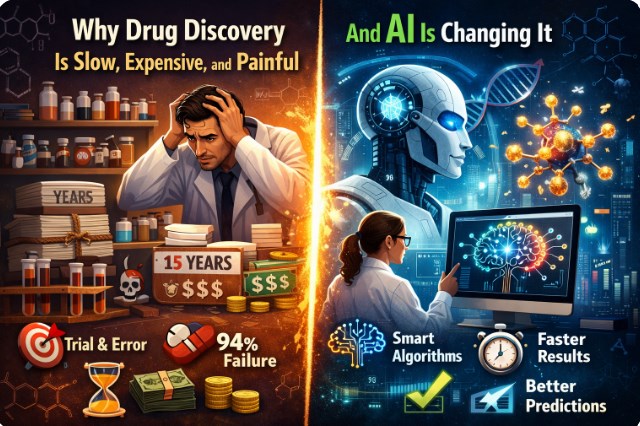
Let us imagine the new drug discovery in the old-fashioned way.
Step 1: Find a target that causes disease.
Step 2: Testing thousands of molecules.
Step 3: Spend years and years in laboratories.
Step 4: Conduct lots of clinical trials
Step 5: By Hope it may work.
Step 6: But it fails. 😭
I am not exaggerating. Traditional drug discovery is the most difficult scientific journey ever created.
According to Jessica Vamathevan and colleagues (2019) in their research Applications of Machine Learning in Drug Discovery and Development, the actual success rate of drug development, from Phase I clinical trials to approval, is 6.2%. Means out of 100 potential drugs, 94 fail somewhere along the way.
Imagine studying for 15 years to crack an exam and having only 6% chance of passing. That is what drug discovery feels like for the scientists.
Why is it so hard that we need reason?
Biology is so complicated to understand. Really complicated believe me.
Actually Our bodies contain:
- billions of cells , thousands of proteins and millions of molecular interactions.
Now we are going to add diseases, genetics, lifestyle, and environment into the mix and shake it well. Suddenly, finding a drug feels like trying to solve a puzzle with millions and millions of moving pieces.
Analyzing this massive amount of information by using traditional methods are too difficult. As Vamathevan et al. (2019) explain, the pharmaceutical industry is drowning in high-dimensional biological data because humans cannot efficiently analyze this alone.
This is where the story start to gets exciting.
Pharmaceutical companies are started to asking an important question:
👉 What if computers could help us discover drugs?
Rise of powerful computers,
graphics processing units (GPUs),
deep learning algorithms,
artificial intelligence start to moved science fiction into real pharmaceutical laboratories.
Nowadays, AI is not just helping scientists also they are becoming research partner for scientists.
Along this partnership scientists changing the future of medicine.
What are the Modern science produces? They produces enormous amounts of data to understand these puzzles.
Researchers collect data of:
- Genomic data 🧬(understand gene influence in disease)
- Medical images 🧠(which helps to study about tissues and organs)
- Clinical trial results 📊(patients responds for treatment)
- Wearable health data ⌚(This for examine heart rate, physical activity, sleeping patters.)
This sounds amazing right … but there also some problem.
There is not less but too much of data.
Where Does AI Fit in Drug Discovery Pipeline?
Before we talk about AI saving the world, we have to understand that where it actually helps the drug discovery.
Drug discovery is not a single task. It is a long pipeline. Where each stage passes the baton to the next stage.
Simplified journey of a drug is:
1️⃣ Identifing the disease target
2️⃣ Designing the molecule to affect the target
3️⃣ Testing thousands of molecules in labs
4️⃣ conduct Test in animals
5️⃣ Conduct clinical trials in human.
6️⃣ Approval and production
This whole process usually takes 10–15 years. Which costs billions of dollars.
Now we imagine the adding AI into every stage of this pipeline.
This is what researchers are doing today.
According to Vamathevan et al. (2019), machine learning can be applied at each and every single stage of drug discovery, from early research to clinical trials.
Let us explore how 👇
1️⃣ Target Identification who is the villain (target) in the Story?
Every drug (hero) needs a target to fight.
Usually, this may be target protein or gene that plays a major role in a disease.
Think of disease is a movie.
Target is the villain we need to stop him.
But among the bad persons finding the right villain is extremely difficult.
Scientists should analyze:
- genetic data (identifying disease causing mutation)
- protein interactions (how molecules behave inside the cell)
- disease pathways (how disease develop and respond)
- patient data (how different people respond for treatment)
Actually this is a massive puzzle for Humans it takes take years to connect all the pieces.
Here comes Machine learning changes this completely.
Nowadays Researchers use AI models to analyze the genomic and biological data to predict correct drug for targets. For an example, Jeon et al. (2014) used machine learning to identify 122 potential cancer drug targets, They found that many of them where known as cancer targets.
scientists get shortlist of suspects instead of searching them in the whole city.
AI not able to replace scientists instead it help them with a powerful starting point.
2️⃣ Drug Design which Creating the Perfect Molecule
Once scientists find the target their challenge begins:
👉 Design a molecule that can be interact with a target.
Traditionally, the scientists test thousands of molecules and sometimes millions in laboratories. This takes years to complete.
Now deep learning is changing this steps.
According to Elton et al. (2019) the deep learning models can do:
- predict that how the molecules behave
- generate a new drug similar to molecules
- optimize the drug properties
The coolest real-world examples are 👀
In 2020, Zhavoronkov et al. He used AI to design a drug candidate in 46 days.
Normally, this stage takes several years but he rocked in 46 days.
This moment the scientific community where shocked and proved that AI can dramatically speed up the early drug discovery.
3️⃣ Protein Structure Prediction by Understanding the Lock
Designing the drugs requires understanding the structures of protein.
But proteins are incredibly in complex 3D shapes.
For decades to determining the protein’s structure could take years in the laboratory.
Next breakthrough was
Jumper et al. introduced AlphaFold In 2021, an AI system that predicts protein structures with perfect accuracy.
This was a huge scientific achievement. Researchers called it a revolution in biology.
Why does this matter lot?
Because knowing the shape of a protein and designing drug became much easier.
It feels like finally seeing the lock clearly before making the key.
4️⃣ Predicting Drug Success which Avoiding Expensive Failures
Now we Remember the scary statistic above I mentioned?
Only 6.2% of drugs was succeed.
Clinical trials are more expensive stage of drug development. That was changed by AI.
AI is now helping scientists:
- predicting drugs toxicity
- identifying the side effects
- finding the right patients
- discovering biomarkers
Machine learning models are used to analyze patient data. They predict who is most likely to respond to a drug. This helps scientist’s to create personalized medicine.
Instead of producing “one drug for everyone,” we move toward to
👉 “the right drug for the right patient.”
This could save billions of lives and dollars
What Does This Mean?
AI is not able to replace scientists.
It is helping by:
- speeding up research that save time.
- reducing costs saves dollars.
- improving success rates saves lives.
- opening new possibilities new doors
Nowadays AI is become a powerful partner in the most challenging fields of science.
And honestly the truth is?
Now only We are just getting started.
Perfect 😄 let us continue the article further.
What are the Challenges of AI in Drug Discovery (Yes… AI Also Struggles)
So far my words shows that AI sounds like a superhero in a lab coat 🦸♂️
But we know that like every superhero movie, there are plot twists.
Researchers including Jessica Vamathevan et al. (2019) clearly mention in his research papers AI in drug discovery still faces serious challenges.
Ok let us talk about the reality 👇
1️⃣ The Biggest Problem is Data or lack of data.
AI depends on data AI loves data, needs data, survives on data.
But in drug discovery data is:
- very expensive
- lot of messy
- incomplete also
- sometimes secret also hide by companies (pharma companies don’t always share)
Machine learning models work are best, when it is trained on large, high-quality datasets.
But in biology, it is not that easy getting such data is difficult and costly.
Researchers often say that:
80% of the ML work is data cleaning only, we use only 20% for modelling.
Yes believe me scientists spend more time for cleaning data than training AI 😅
Without good and proper data, even the smartest AI becomes confused.
2️⃣ There was a Black Box Problem
One of the biggest concerns in AI is.
Deep learning models often provides answers for us like:
👉 “This drug might work.”
But when the scientists ask the question:
👉 “Why?”
The AI answer:
👉 “Trust me bro.”
Not very convincing 😄am I right.
In medicine, understanding why something works is extremely important this “why” leads us still now:
- Doctors need explanations for each work
- Regulatory agencies need evidence for all work
- Patients need trust to take drug.
A drug cannot be approved just because a computer suggested it.
The major barrier is lack of interpretability.
3️⃣ Reproducibility Issues by AI
There is a another surprising problem:
AI does not give the same result twice.
Machine learning models are depend on the:
Random initialization, training order and parameter tuning
Sometimes two models trained working on the same data may produce different type of predictions.
Imagine two AI systems suggesting different drug targets 😬How confusing it is?
That is so scary for pharmaceutical companies which investing billions.
4️⃣ Now about Data Bias
AI learns from the past data.
But what happen if past data is biased?
Then AI also learns the bias.
For example:
- Clinical trial data may not includes the diverse populations
- Some diseases have more data than the others
- Rare diseases often lacks the data
This means that AI may perform better for some diseases and worse for others.
Conclusion: The Future of Drug Discovery is
Traditional drug discovery will always need scientists, experiments, and clinical trials. That will never disappear from us.
But the way we started the journey is changing now.
Artificial intelligence is helping scientists for their research:
- ask better questions for their research
- test smarter ideas to implement
- avoid costly failures best for companies
- move faster toward life-saving medicines for saving lives
AI is not for replacing scientists.
It is becoming their most powerful partner for them.
And this partnership shorten the 15-year journey of finding drugs.
reduce billion-dollar costs and save lives
and most importantly, bringing new and right medicines to patients faster.
The future of medicine will not be humans vs AI. It will be humans + AI working together.
And honestly the truth is?
We are only at the beginning of this story. To be continue…..


Leave a Comment