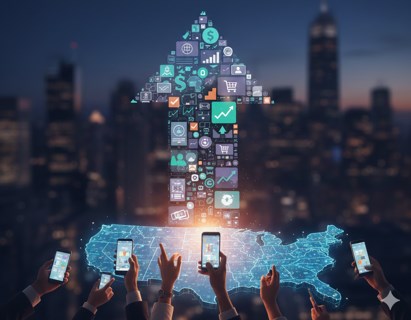
Think about the last time you bought something, booked a ride, or checked your bank balance. Chances are, you didn't reach for a laptop; you reached into your pocket.
Most of us live on our phones now, which creates a massive problem for businesses stuck in the "desktop-first" mindset: if you aren't where your customers are, you’re invisible.
The solution is simple!
Build your entire business around the mobile screen first, rather than trying to shrink a website down to fit it later.
What Defines a Mobile-First Business?
A mobile-first business model isn't just about having a responsive website. It means your entire service, from the way you market to how you handle payments, is designed specifically for a smartphone user.
If a customer can’t complete their entire journey, from discovery to checkout, using just one thumb, it’s not truly mobile-first.
In the US, this shift has been driven by the fact that over 15% of American adults are now "smartphone-only" internet users. These people don’t have home broadband; their phone is their only gateway to the economy.
A mobile-first business acknowledges this by prioritizing speed, location-based features, and vertical content.
It also aligns with mobile-first indexing, where search engines like Google primarily use the mobile version of a site's content to rank pages. If your mobile experience is an afterthought, your search engine visibility will be, too.
Key Advantages: Agility, Reach, and User Experience
The biggest problem with traditional business models is friction. Filling out long forms or navigating tiny menus kills conversions.
Mobile-first businesses solve this by using mobile-centric user experience design principles. This means using biometrics (like FaceID) for instant logins and digital wallets (like Apple Pay) for one-tap purchases.
The advantages are clear:
- Agility: Mobile apps allow businesses to send push notifications, reaching customers instantly rather than hoping they open an email.
- Reach: With nearly 310 million smartphone users in the US, the "storefront" is now everywhere the customer goes.
- User Experience: By utilizing smartphone-first digital transformation trends, companies can use GPS to offer hyper-local mobile marketing strategies for retail. For example, a store can send a discount code the moment a customer walks within a block of their physical location.
For startups, these mobile-first business model benefits for US startups are game-changing because they allow smaller players to outmaneuver legacy brands that are bogged down by old infrastructure.
Major Industries Disrupted
Two areas have been completely flipped upside down: e-commerce and on-demand services.
In e-commerce, "m-commerce" is no longer a sub-category; it is the category. US mobile retail sales are expected to exceed $700 billion by 2025.
Apps like Instagram and TikTok have turned social scrolling into a direct shopping mall, proving that mobile consumer behavior is moving toward "discovery-based" shopping rather than "search-based" shopping.
On-demand services like Uber, DoorDash, and Instacart wouldn’t exist without a mobile-first approach. These businesses solve the problem of "I need this right now" by using real-time data.
They rely on current mobile app market trends in North America that prioritize the "gig economy" and instant gratification. If you had to log into a desktop to book a ride, the convenience would vanish, and the business model would fail.
Impact on Consumer Behavior and Expectations
The problem today is that consumers have zero patience. If an app takes more than three seconds to load, 53% of users will leave.
This has forced a shift in understanding US mobile consumer behavior patterns. Customers now expect every business to know their location, remember their preferences, and offer a "one-click" solution to their problems.
This shift has also changed how we search. Since Google switched to mobile-first indexing, the best practices for mobile-first indexing optimization have become a survival requirement. Businesses can no longer hide "thin" content on mobile; the mobile site must be the "main" site.
This has led to a rise in demand for a specialized mobile app development company in San Francisco or other tech hubs to help brands bridge the gap between a simple website and a high-performance app.
Success Stories and Future Predictions
Look at Starbucks. They aren't just a coffee company; they are a mobile-first powerhouse. By integrating rewards, payments, and ordering into one app, they solved the problem of long morning lines. Today, mobile orders account for about 30% of their total US transactions.
Another success story is Chime. While traditional banks were forcing people to visit branches, Chime built a mobile-first bank that focused on the pain points of younger US consumers: no fees and early access to paychecks. By focusing on a "mobile-only" audience, they became one of the most valuable fintechs in the country.
What’s next?
As we look forward, the mobile app market trends suggest a move toward "Super Apps" and AI integration. We will likely see:
- AI-Integrated UX: Apps that predict what you want to buy before you even search for it.
- Augmented Reality (AR): Retailers using AR to let customers "try on" clothes or see furniture in their room via their phone camera.
- Voice-First Navigation: As voice assistants improve, the "mobile-first" experience will move from fingers to voice commands.
How to Adapt
If you are running a business and your mobile experience feels like a "smaller version" of your website, you are losing money. The goal is to stop thinking about the screen size and start thinking about the user’s context. They are likely on the go, distracted, and in a hurry.
To win in the US market, you need to follow mobile-centric user experience design principles: simplify the navigation, use big buttons, and make the checkout process invisible. Whether you are a small retail shop using hyper-local mobile marketing strategies for retail or a tech startup, the phone is your primary handshake with the customer.
The "digital age" talk is over. We are now in the mobile-only age. Companies that embrace this will thrive, while those waiting for people to go back to their desks will find themselves left behind in an empty office.


Leave a Comment