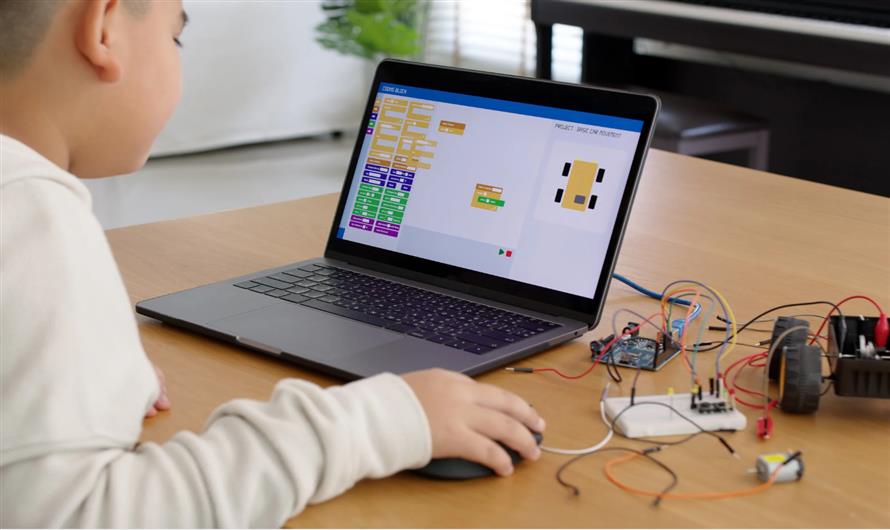
Wanting kids to appreciate science need not seem like rocket science. It is very natural for young learners to inquire about why and how everything in the surrounding world works; hence, elementary school years are ideal stages to develop scientific thinking. Yet, most parents fear that their children will not succeed in science concepts as they progress in their schooling.
Recent studies provide evidence that 73 percent of the students who took part in online tutoring succeeded in improving their target subjects in only 8 weeks. This great percentage of success illustrates that science could be turned into an adventure instead of a challenge for elementary students, provided the proper method is adopted.
Understanding the Foundation of Science Learning
A strong foundation in science begins long before formal lessons start. Children naturally explore the world through observation, questioning, and experimentation, key components of scientific thinking. Elementary online science tutoring platforms capitalize on these instincts by nurturing curiosity and turning everyday moments into meaningful learning experiences.
To take an example, a child who poses a question such as: Why do leaves change color in the fall, is already a scientific inquiry. A good tutor takes such opportunities to learn simple ideas about photosynthesis and changing seasons in an age-suitable and appealing to the vision methodology. Relation to real-life situations makes learning more likely to be retained and generate a long-term interest in the subject.
The second important science component of learning at the elementary level is vocabulary development. They are suggested to introduce words such as hypothesis, experiment, and conclusion. These words could be emphasised by a tutor with games, stories, or with practical work, showing that scientific language is not an ordeal but an open arena.
Besides, basic science teaches the kids how to develop skills, which may be used even outside the base scientific interest, such as logical thinking, critical reasoning, and data analysis and interpretation competencies. As students learn how to ask the correct questions and to think their way through a problem step by step, they improve as learners in all facets of the classroom.
Lastly, young people could be introduced to science early enough to remove the fear or anxiety that some children develop with regard to STEM methods as they grow up. By setting a positive and interactive learning environment early in the game, tutors will be able to create a feeling of confidence that will transfer to the middle school years and beyond.
Creating Engaging Learning Experiences
Science just stays in the mind when it is interactive and enjoyable. The most effective tutoring sessions provide a sense that tutoring is not that much work, but more of a pla,y which involves enrollment of students in a session that makes them acquire the relevant skills.
1. Experiments and Practices
A few experiments can do miracles with elementary students. Science activity could be entering the world of crystals or constructing basic machinery or witnessing chemical reactions using harmless household substances. Such activities enable the students to witness science as opposed to reading about it.
Effective tutors design several brief exercises and not a single lesson. Different minds learn differently, and so variety in activities captures the brand of attention young attention spans have. Some students are tactile learners, optic learners, and many are kinesthetic learners.
2. An Effective Use Of Technology
The use of modern devices in the tutoring process to supplement, not to substitute, direct learning is encouraged. Educational apps, online simulations, and virtual microscopes can all take learning a step further than is afforded by traditional materials alone.
Use of technology is, however, effective when it promotes active learning and not passive consumption. These are the best programs that employ the use of tech tools to record experiments or areas of research, or communicate with other young scientists.
3. Early Science Training
There is a tremendous benefit to starting science early in the academic progression of a child. The list of benefits of science learning is much longer than memorizing some facts about plants and animals.
Science instills in students the concept of questioning, reasoning, and making conclusions. They can apply the skills in other lessons and in life in general. Thinking scientifically, students are organized problem solvers, whose critical evaluation of information is reciprocally dependent.
The logic of science makes young minds solve problems in general better than before. They get to learn how to experiment with ideas, explore possible solutions, and learn that making a mistake is frequently a promise of success.
4. Building Confidence in STEM Fields
Good experiences in early childhood with science can influence later career interests. When students feel successful in elementary science, they will take up more advanced STEM coursework in high school and later.
This confidence-building is a slow process, and by means of small achievements and praise. When the students accomplish an experiment or learn new things, they can have a growth mindset concerning studying difficult courses.
5. Customizing Approaches for Different Learning Styles
There are students who study better by the visual demonstration of learning, others by the manipulation of objects enabling their understanding, and others by oral and informative exchange. Some good science tutoring suggestions to use are to alternate teaching during a session.
Drawing, model, experiment, and storytelling may all be incorporated in a single lesson by tutors. This diversity keeps the students entertained and it also makes sure that there are various learning styles catered.
6. Achievable, Realistic Goals and Expectations
The most appropriate goals of the elementary science tutoring are specific and attainable. Succinct programs, instead of attempting to teach as much as possible, follow the route of developing interest and a rudimentary scientific understanding of the world.
Efforts are made in gradual steps, and parents ought to rejoice in small wins. Even when a student is unable to master complex concepts, the fact that he or she started to ask more questions about natural phenomena marks great progress and can be deemed successful.
7. Real-World Connections
That method, which begins with things that we know best, is the quickest. To children, learning is meaningful when they see how explanations that are provided by science can be relevant in their daily lives.
An ordinary trip outside can give rise to talking about weather conditions, the life of plants, or animal activity. Students learn to think critically as a natural bent on programs that embrace these real-life links, and such programs are supported by the science programs.
Teachers who are smart utilize other objects that can be found at home to illustrate science. Cooking becomes science, planting starts to be biology and simple blocks show simple physics. Such correlations allow for solidifying abstract notions to young minds.
8. Building Scientific Vocabulary Gradually
The young learners require time to develop scientific language. Successful tutoring also presents vocabulary using context and repeated practice instead of cramming with complicated terminology. Instead of just learning long lists of words using memory skills, students are shown how to add new words as hypotheses and observations, through activities.
Such a comprehensive method is aimed at making students not only acquire facts about science, but also start to think like scientists. Young Minds tutoring also acknowledges that the acquisition of vocabulary occurs spontaneously when students are involved and practice with scientific concepts.
Moving Forward With Science Success
Tutoring in elementary science onset the paths to continuous learning and perception. Early positive engagement in scientific thinking introduces children to challenges easier to accept, and to solve problems confidently. It is important to keep in mind that any child is inherently curious to find out more about the surrounding world.
Great tutoring merely offers the resources and advice to convert that curiosity to useful learning experiences. It does not matter whether it is done through basic experiments or outdoor exploration or technology-assisted adventures; the objective set is the same: to encourage the young minds to question, explore, and discover.
Common Questions About Elementary Science Tutoring
1. What can be involved in making science lessons interesting?
Make lessons practical experiments, be active rather than passive, go outside and teach learning, utilize humor and anecdotes, and use age-specific books so that scientific concepts and generalizations are explained by examples that are familiar to children.
2. What is the youngest age to start science tutoring?
Science tutoring may begin as early as preschool because young children are innately curious to explore their world and query their surroundings. The trick is to fit activities with developmental stages and remain play-based.
3. Why is elementary science tutoring not like other subjects?
Science tutoring focuses on the practical learning experience, the relevance, and the way of thinking with science, compared to the recall of the information. It involves additional materials and acting and provides greater possibilities for creative activity.


Leave a Comment