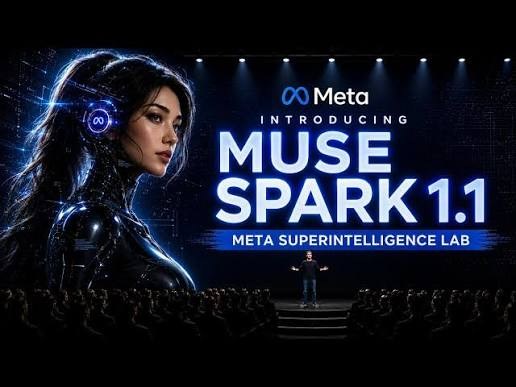
Meta has officially introduced Muse Spark 1.1, the latest version of its advanced AI model designed for coding, reasoning, and agentic workflows. The release marks another major step in Meta's AI strategy as it competes with leading AI companies such as OpenAI, Anthropic, and Google. The model is available through a public developer preview using the new Meta Model API.
Built for Modern Software Development
Muse Spark 1.1 is designed to help developers solve complex programming tasks. Unlike traditional code completion tools, the model can understand large codebases, generate code, debug applications, explain existing code, and perform multi-step software engineering tasks with minimal human guidance. Meta also says the model has improved multimodal reasoning, enabling it to work with text, images, and other inputs.
Key Features of Muse Spark 1.1
Some of the major capabilities include:
- Advanced code generation
- Code debugging and optimization
- Multi-file project understanding
- Agentic task execution
- Text and image understanding
- Video analysis support
- Tool and computer-use improvements
- Large-context reasoning for complex projects
Public API Now Available
Alongside the model launch, Meta introduced the Meta Model API in public preview. Developers can experiment with Muse Spark 1.1 using free credits before moving to usage-based pricing.
According to Meta, the pricing starts at:
- $1.25 per million input tokens
- $4.25 per million output tokens
New developers also receive $20 in free API credits during the preview period.
Competing in the AI Coding Market
The release places Meta directly in competition with AI coding assistants from OpenAI, Anthropic, and Google. As AI-powered software development becomes increasingly important, companies are racing to provide models that can write code, automate workflows, and assist developers throughout the software lifecycle.
Part of Meta's Larger AI Vision
Muse Spark 1.1 is being integrated across Meta's AI ecosystem. The company plans to use the model to power experiences in Meta AI and expand its capabilities across products and developer tools. The launch also reflects Meta's broader investment in AI infrastructure and commercial AI services.
Conclusion
With Muse Spark 1.1, Meta is making a stronger push into the AI developer ecosystem. Its focus on coding, multimodal reasoning, and agentic capabilities positions it as a significant new option for developers building modern applications. As competition in the AI market intensifies, Muse Spark 1.1 demonstrates Meta's ambition to become a leading provider of AI models for both consumers and enterprises.