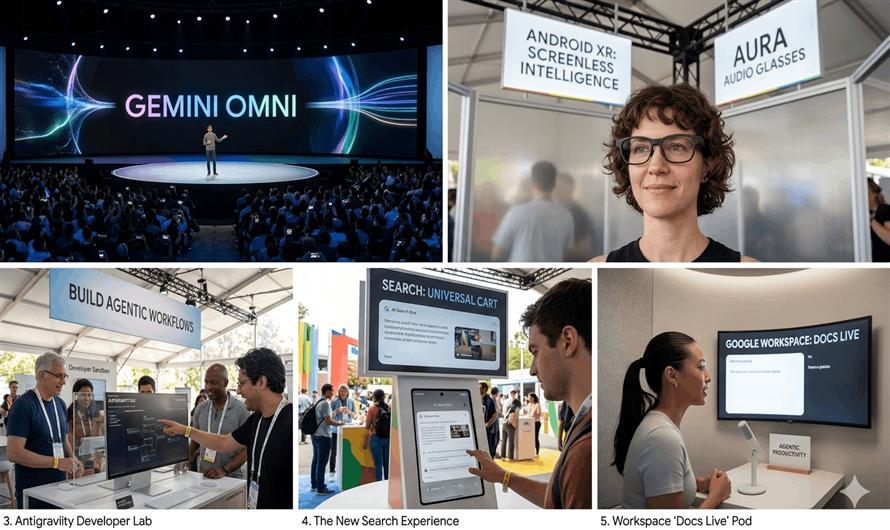
Google I/O 2026 marked a massive shift from assisting users to deploying autonomous AI agents. Held on May 19–20, 2026, the event focused entirely on "agentic workflows", next-generation multi-modal AI models, radical software overhauls, and screenless augmented-reality hardware.
Frontier AI: Gemini 3.5 Flash & Gemini Omni
Google unveiled its latest frontier model infrastructure, aiming for unparalleled speed and cross-media intelligence:
- Gemini 3.5 Flash: Outperforms Gemini 3.1 Pro across major benchmarks while generating data four times faster than competing frontier models. It serves as the high-speed engine powering Google's new automated workflows.
- Gemini Omni: A new model capable of generating any creative output from any input type. It seamlessly merges core Gemini intelligence with Google’s proprietary generative video and media models.
- Neural Expressive Redesign: The mobile Gemini app received a complete UI face-lift featuring streamlined bottom sheets for quick uploads and dedicated modules for Deep Research, Canvas, and Personal Intelligence.
Developer Tools: Antigravity 2.0 & AI Studio
For developers, Google moved aggressively into "vibe coding" and parallelized agent architectures:
- Antigravity 2.0: A brand-new, standalone agent-first desktop application. It acts as a central hub where developers can orchestrate multiple sub-agents to execute tasks in parallel.
- Antigravity CLI & SDK: Lightweight tools allowing instant agent creation straight from the terminal or custom hosting on independent server infrastructures.
- Google AI Studio Updates: Developers can now build high-quality Android apps with just a simple text prompt and publish them directly to testing tracks on the Google Play Console.
Consumer Ecosystem: Search, Workspace & Android 17
Google's core consumer platforms received their most dramatic AI overhauls to date:
- The AI Search Box: Reimagined as the largest search upgrade in 25 years. The search box dynamically expands to accept text, videos, active Chrome tabs, or complete files as inputs.
- Information Agents: Launching for Google AI Pro and Ultra subscribers, these agents allow users to build and run personalized, automated web monitors for hyper-specific interests.
- Docs Live & Universal Cart: A new voice-powered integration in Workspace that lets users "brain-dump" continuous thoughts for Gemini to format into documents, emails, or notes. Meanwhile, Universal Cart allows instant shopping directly from Search, YouTube, or Gmail interface.
- Android 17 Roadmap: Coming this summer with deeply integrated "Gemini Intelligence" for full cross-device task automation and custom AI-generated widget building.
Hardware: Android XR & Project Aura Eyewear
Google signaled a major hardware return to the extended reality space through strategic partnerships:
- Screenless Audio Glasses: Co-developed with Samsung, this "intelligent eyewear" form factor features no display screens. Instead, it uses built-in cameras, directional microphones, and audio speakers to let users navigate environments through real-time audio interaction with Gemini.
- Project Aura: Partnering with Xreal, Google previewed supercharged smart glasses running a specialized build of Android XR, scheduled for an official rollout this upcoming fall.