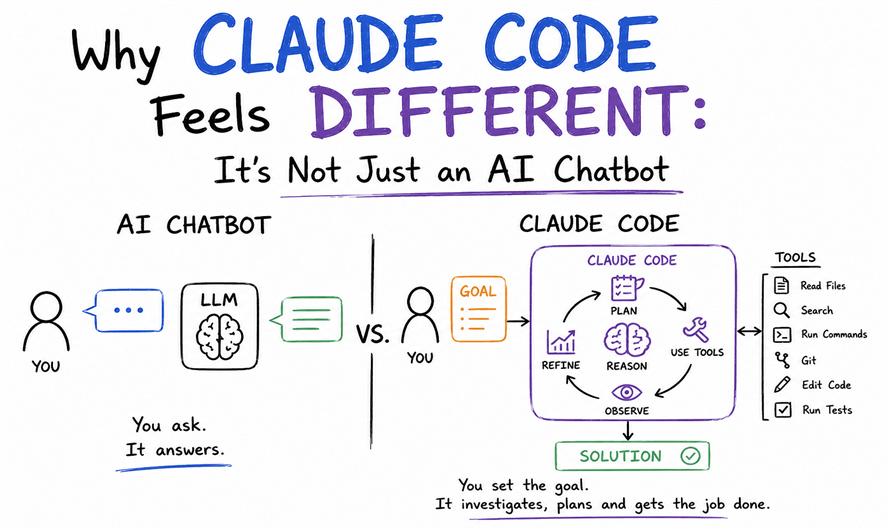
The Shift from Chatbot to Agentic Peer
Remote coding has always carried a quiet isolation — and standard chat-based AI tools only paper over that problem. You paste code in, receive a suggestion, and paste it back. That loop is useful, but it isn't collaboration. Claude Code breaks that pattern entirely by operating as an agentic partner that reads your files, runs your terminal commands, and tracks your project's context across sessions.
The difference shows up quickly in practice. As one developer described the experience: "Working with Claude didn't feel like typing into a machine. It felt like mentoring a fast-learning developer — one who misunderstood the problem a few times, asked no ego-driven questions, iterated rapidly, and documented everything beautifully." That mentorship quality removes the social friction that makes traditional remote pairing exhausting — no scheduling conflicts, no bruised egos, no waiting on a colleague in a different time zone.
For teams figuring out how to code a remote workflow that actually scales, this matters enormously. Claude introduces a model that maps naturally onto agile development best practices — short feedback loops, continuous iteration, and shared context — without requiring a second human in the room. Understanding exactly how that works mechanically is where things get genuinely interesting.
The Mechanics of Claude Code Remote Control
Claude Code operates at a fundamentally different level than any browser-based AI tool — it's a specialist agent that can navigate your file system, read and write files, and execute terminal commands directly within your development environment.
That architectural difference is what makes Claude Code Remote Control genuinely useful for distributed teams. Rather than copying a function into a chat window and pasting the result back, a developer can delegate an entire sub-task — refactor this module, run the test suite, fix the failing build — and Claude handles the execution chain autonomously, asdocumented in the Claude Code architecture.
Here's how that capability breaks down in practice:
- File system navigation — Claude reads project structure, locates relevant files, and makes targeted edits without manual copy-paste
- Terminal execution — Commands run in your actual environment, so output reflects your real dependencies and configuration
- Remote pairing mode — A remote developer can connect Claude to a shared or cloud environment, enabling asynchronous collaboration across time zones
- Context retention — Claude tracks changes across a session, maintaining awareness of what's already been modified
Bold callout: Claude Code doesn't just suggest changes — it implements them, which means security guardrails aren't optional, they're essential.
In practice, Claude operates within configurable permission scopes, requiring explicit approval before executing destructive or irreversible commands. This human-in-the-loop model aligns naturally withiterative delivery workflows, where incremental changes are reviewed before merging. Thefull walkthrough on remote usage shows how these guardrails function without disrupting flow.
That performance under real-world constraints raises an important question: how reliably does Claude actually solve the problems it's handed? The answer comes down to benchmark accuracy — and the numbers are worth examining closely.
Why Accuracy Matters: The 92% Benchmark
Raw benchmark numbers rarely translate to real-world value — but Claude 3.5 Sonnet's 92% zero-shot pass accuracy on the HumanEval coding benchmark is one that genuinely does.
Zero-shot accuracy means Claude solves coding problems correctly on the first attempt, without being shown examples first. For a human developer working alone, a wrong first attempt is a minor setback. For a remote pair programming session, however, a hallucinated function or confidently wrong implementation can cascade — burning 30 minutes of synchronous debugging time that distributed teams simply cannot afford.
High first-pass accuracy is the foundational requirement for any AI assisted agile pair programming workflow. When teams operate across time zones with limited overlap, every context-switch back to an AI suggestion that needs rewriting chips away at sprint momentum. The practical gap between 92% accuracy and, say, a 70–75% rate isn't a modest improvement — it's the difference between an AI that drafts production-viable code and one that drafts plausible-looking code you have to rewire. Competing approaches in the LLM space have shown strong results on narrow benchmarks but consistently lag on the generalized, unseen problems that characterize real sprint work, asthis breakdown of Claude's coding performance illustrates.
This accuracy level also reshapes the human-in-the-loop model that responsible AI adoption requires. Rather than acting as a line-by-line verifier catching frequent errors, the developer shifts into a higher-order role: reviewing architecture decisions, catching edge cases, and guiding intent. That's a more sustainable cognitive load — and, asiterative agile cycles demand faster feedback loops, it's exactly where human attention should be focused. The result is a pairing dynamic that actually accelerates pull request throughput — which is where the next measurable impact on distributed teams becomes visible.
Boosting PR Velocity in Distributed Teams
Agentic pair programming delivers measurable throughput gains — and the numbers from inside Anthropic's own engineering teams make that case hard to ignore. According to data reported via collinwilkins.com, engineers using Claude Code saw a 67% increase in merged pull requests per day. For distributed teams where review cycles can stretch across time zones, that kind of velocity shift isn't incremental — it's structural.
"A 67% increase in merged PRs per day" isn't a productivity hack. It's evidence that Claude Code compresses the feedback loop between writing code and shipping it — eliminating the bottlenecks that typically stall distributed teams.
Documentation and testing are where human pair programmers often lose momentum. Writing test coverage after a feature sprint feels like a tax, and inline documentation rarely survives deadline pressure. Claude handles both without complaint — generating test suites from function signatures, writing docstrings in context, and flagging edge cases before they reach code review. What was previously the "boring half" of pairing becomes automatic.
Real-time debugging during production sprints is where Claude shifts from useful to indispensable. Rather than context-switching to Stack Overflow or waiting on a senior engineer, developers can surface a failing stack trace directly in the terminal and get a reasoned diagnosis within seconds. This keeps sprint momentum intact — a critical advantage when your team is distributed across three time zones and synchronous help isn't available.
That shift in dynamic — from assistant to collaborator — is precisely what practitioners describe as moving frompair to peer programming. As explored in one developer's reflection on the experience, Claude stops feeling like a tool you're directing and starts functioning like a contributor with genuine context about your codebase. Understanding how that dynamic fits intoiterative development cycles is what separates teams that get marginal gains from those that redesign their workflow entirely — which is exactly where the next consideration begins.
Integrating Claude into Agile Remote Workflows
Structured AI integration — not ad hoc prompting — is what separates teams that benefit from Claude from those that merely dabble with it.
The 80/20 rule applies directly here: roughly 80% of your productivity gains come from 20% of your interactions — the structured, context-rich prompts where Claude has enough information to act autonomously. According to research from PromptLayer, Claude Code can independently implement or fix code 64% of the time when paired with the right tools, but that rate drops sharply when prompts are vague or context-free.
Establishing a repeatable sprint ritual is the first practical step. Teams usingiterative, sprint-based approaches get the most from Claude by treating it as a standing team member — assigned tasks at sprint kickoff, checked in with during standups, and reviewed at the end of each cycle. This mirrors the pair programming contract from the Stack Overflow engineering blog: the navigator-driver model still applies, even when your navigator is an agent.
In the terminal, prompt engineering is everything. The Claude 3.5 Sonnet coding benchmark performance holds in practice only when developers provide scoped, specific instructions — not open-ended questions. A common pattern is to prefix terminal prompts with explicit constraints: target file paths, expected output format, and acceptable side effects. What typically happens without this scaffolding is that Claude optimizes for the wrong success criteria, producing code that compiles but misses the architectural intent.
Managing the feedback loop remotely adds one extra layer: async review. Unlike in-person pair sessions, distributed teams benefit from Claude generating inline comments alongside code changes — a habit well-documented in practice — so reviewers can assess AI reasoning without a synchronous call. This keeps velocity high without sacrificing code quality or team alignment.
Taken together, these workflow habits form the foundation of what you need to know before committing to Claude as a core part of your engineering practice.
The Bottom Line: What You Need to Know
Remote pair programming with AI has moved from experimental novelty to a genuine competitive differentiator — and Claude Code is the clearest proof point available right now.
The five things worth keeping front-of-mind:
- Claude Code is an agent, not a chatbot. It reads and writes files, runs terminal commands, and navigates your codebase autonomously. That distinction — covered in depth by theofficial docs on how Claude Code works — is what separates it from every chat-based assistant that simply suggests code for you to copy.
- Remote Control bridges distributed environments. As explained in practical walkthroughs of the Remote Control feature, Claude can connect to a development environment running on any machine, making geography irrelevant for async collaboration.
- 92% accuracy on HumanEval means fewer review cycles. Less time correcting AI output translates directly into more time shipping features — a meaningful gain for any team operating across time zones.
- PR velocity can increase by up to 67% when Claude is treated as a peer contributor rather than an on-demand snippet generator.
- Agentic pair programming is now a foundational team skill. For distributed teamsscaling with external talent, embedding this workflow into sprints is no longer optional — it's a baseline expectation for high-output engineering.
The takeaway is simple: teams that treat Claude as a peer, not a tool, consistently outship those that don't. That realization naturally raises one more question — how do you build a remote dev stack that stays ahead as this technology keeps evolving?
Future-Proofing Your Remote Dev Stack
The developers who thrive in the next decade won't be those who automate the most — they'll be those who collaborate most intelligently with AI. That distinction matters. Claude Code isn't a replacement for engineering judgment; it's an amplifier of it. The pair programming model only works when a capable human stays in the loop — reviewing output, catching context drift, and steering toward outcomes that actually serve the user. Removing that oversight doesn't accelerate delivery; it creates technical debt at machine speed.
From an engineering culture standpoint, the shift worth making is attitudinal. Teams that treat Claude as a disposable autocomplete engine extract a fraction of its value. Teams thatevolve their agile practices to treat it as a genuine peer — assigning it context, giving it feedback, holding it accountable to standards — consistently report faster cycles and cleaner codebases. As one developerdescribed the transition: moving from pair to peer changes what you ask for, and what you get.
The most practical advice is also the simplest: bring Claude Code into your next sprint deliberately. Pick one feature, define clear acceptance criteria, and treat the collaboration as an experiment worth measuring. The remote capabilities that make async pairing viable mean geography stops being a constraint. Distributed teams can finally operate with the same creative momentum as co-located ones. That's not a minor upgrade — it's a structural change in how modern engineering teams can be organized. The question isn't whether AI-assisted development belongs in your stack. It's whether you're ready to build the habits that make it work.


Leave a Comment