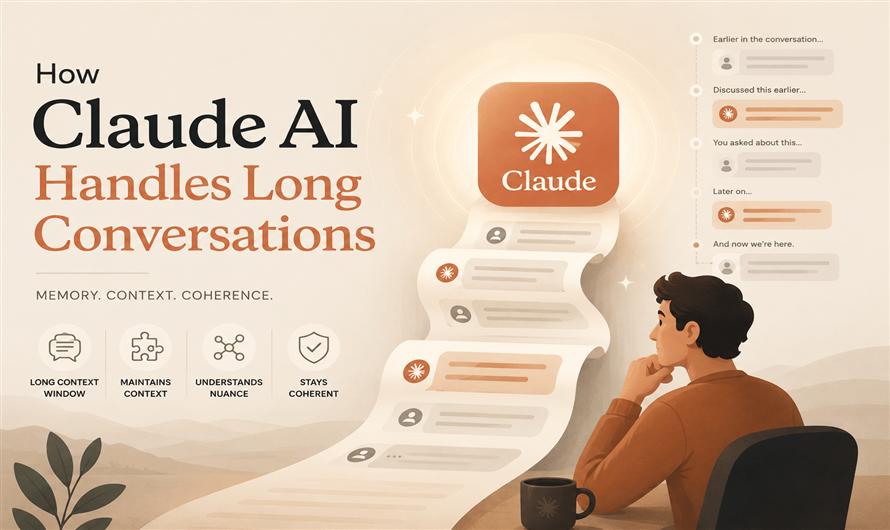
Artificial Intelligence models are becoming increasingly powerful, but one major challenge still affects many systems: handling long context efficiently. As businesses and developers work with massive documents, long conversations, large codebases, and enterprise knowledge systems, the ability of an AI model to remember and reason across large amounts of information becomes critical.
Among modern AI assistants, Claude by Anthropic has gained significant attention for its exceptional long-context capabilities. Unlike many traditional AI models that struggle with memory limitations and context loss, Claude is specifically designed to process and understand extensive inputs more effectively.
What Is Long Context in AI?
In AI systems, “context” refers to the information the model can read and remember during a conversation or task. This includes:
- User prompts
- Uploaded documents
- Previous conversation history
- Source code
- Reports and datasets
The larger the context window, the more information the AI can analyze at once.
Traditional AI models often struggle when conversations or documents become too long. Earlier details may be forgotten, responses may become inconsistent, and reasoning quality can decline. This limitation creates challenges for enterprise applications that rely on large-scale information processing.
Claude addresses this problem with advanced long-context handling capabilities.
Large Context Window Advantage
One of Claude’s biggest strengths is its massive context window. Modern Claude models can process hundreds of thousands of tokens in a single interaction. This allows users to upload:
- Large PDFs
- Research papers
- Legal contracts
- Technical documentation
- Entire code repositories
Instead of splitting information into smaller chunks, users can work with complete datasets or documents in one prompt. This improves efficiency and reduces information fragmentation.
For enterprises, this capability is extremely valuable because business workflows often involve lengthy documents and interconnected information.
Better Memory Retention Across Conversations
Many AI models begin to lose track of earlier instructions during long conversations. Claude performs better because it maintains context consistency over extended interactions.
For example, in a long technical discussion:
- Claude remembers earlier requirements
- Maintains logical continuity
- Preserves conversation structure
- Avoids repetitive or conflicting responses
This makes Claude particularly useful for:
- Multi-step workflows
- Enterprise support systems
- Long research sessions
- AI coding assistants
Its ability to retain relevant information creates more natural and productive interactions.
Superior Document Understanding
Claude excels at understanding long-form content. It can analyze relationships between different sections of a document and generate accurate summaries or insights.
Common enterprise use cases include:
- Contract review
- Compliance analysis
- Policy summarization
- Financial report analysis
- Research document interpretation
Instead of only focusing on nearby text, Claude can reason across the entire document. This improves answer accuracy and reduces the risk of missing critical information.
Strong Performance in Code Analysis
Developers increasingly use AI assistants for software engineering tasks. Claude’s long-context handling is especially beneficial for large codebases.
Developers can provide:
- Multiple source files
- Backend architecture
- API documentation
- Configuration files
- Database schemas
Claude can then:
- Understand dependencies
- Explain architecture flow
- Detect bugs
- Suggest optimizations
- Generate consistent code improvements
This is particularly useful for enterprise applications built with technologies such as:
- ASP.NET Core
- Microservices
- Cloud-native systems
- Enterprise APIs
Enterprise Benefits of Long Context AI
Claude’s long-context capability offers several advantages for organizations:
- Improved Productivity
- Employees can analyze large datasets and documents without manually splitting content.
- Better Decision-Making
- AI can process broader business context before generating recommendations.
- Reduced Information Loss
- Important details remain available throughout the interaction.
- Enhanced Automation
- Complex workflows become easier to automate using AI-powered systems.
- Faster Research
- Researchers and analysts can review extensive material more efficiently.
Why Long Context Matters for the Future of AI
As AI adoption grows, businesses increasingly need models that can understand entire workflows rather than isolated prompts. Long-context AI is becoming essential for:
- Enterprise copilots
- Knowledge management systems
- Legal technology
- Healthcare analysis
- Financial intelligence
- Software development
Claude represents a major step toward AI systems that can reason more like humans by maintaining awareness across large amounts of information.
Final Thoughts
Claude stands out from many AI models because of its ability to process, retain, and reason across extremely large contexts. Its large context window, strong memory retention, and advanced document understanding make it highly effective for enterprise applications, technical workflows, and large-scale information analysis.
As organizations continue integrating AI into business operations, long-context models like Claude are likely to play a central role in building smarter, more reliable, and more productive AI systems.


Leave a Comment