The Real Reason Your Team Needs CI/CD in Azure
Manual deployments are a liability, not a process — and every team that has survived a Friday-night hotfix already knows this. The question isn't whether automation matters; it's why so many teams still delay adopting it.
A common thread in developer communities is a deceptively simple question: Why do we actually need this? The honest answer is that azure devops ci/cd isn't about following industry trends. It's about eliminating the gap between writing code and validating it. As the Microsoft Azure Architecture Center puts it: "The goal of CI/CD is to provide a consistent and automated way to build, package, and test applications." Consistency is the operative word. Manual handoffs introduce human error, undocumented steps, and bottlenecks that compound over time.
The hidden cost is wait time. When a developer merges a change and then waits hours — or days — for a human to validate, package, and deploy it, the pipeline becomes the product's slowest component. Automated validation collapses that wait to minutes. Builds trigger on commit, tests run in parallel, and failures surface immediately rather than in production.
What CI/CD actually replaces isn't effort — it's uncertainty. Teams stop asking "did someone remember to run the tests?" and start trusting that the process ran them automatically. That shift, from manual handoff to automated validation, is the foundation that everything else builds on — including the tooling that makes it work at scale.
Azure Pipelines: The Engine of Cross-Platform Automation
Azure Pipelines sits at the heart of the Azure DevOps suite, serving as the automation layer that connects source code to production environments without the fragility of manual handoffs. Where earlier sections outlinedwhy automated delivery matters, this section gets into the mechanism that makes it practical at scale — the azure ci/cd pipeline infrastructure that removes platform constraints from the equation entirely.
Cloud-hosted agents are the defining infrastructure advantage. According to Microsoft Learn, Azure Pipelines provides cloud-hosted agents across all three major platforms with no infrastructure provisioning required:
- Linux agents — optimized for containerized workloads and open-source toolchains
- macOS agents — essential for iOS and cross-platform mobile builds
- Windows agents — built for .NET, PowerShell, and enterprise application pipelines
Managing your own build servers is a hidden cost most teams underestimate. Patching, scaling, and maintaining self-hosted infrastructure pulls engineers away from shipping features. Cloud-hosted agents eliminate that burden entirely — capacity scales with demand, and Microsoft handles the maintenance overhead.
Parallel execution takes this further. Teams can run simultaneous builds across all three agent types in a single pipeline run, catching platform-specific failures before they reach production. The result is genuine cross-platform confidence, not just a checkbox.
Once you understand the infrastructure advantage, the natural next question is how this translates into measurable developer output — which is exactly where the data gets compelling.

Quantifying the Impact on Developer Productivity
Automation doesn't just speed up deployments — it fundamentally changes what developers can accomplish in a day. Understanding what is CI/CD in Azure means recognizing that the value extends far beyond faster releases; it directly shapes developer output, morale, and the financial health of the product organization.
The data here is compelling. According to the DORA State of DevOps Report, high-performing DevOps teams using automated CI/CD pipelines deploy code 208 times more frequently than low-performers — and recover from incidents 2,604 times faster. That gap isn't incremental; it's transformational. Teams on the wrong side of that divide aren't just slower. They carry compounding risk with every manual step. Meanwhile,Forrester Consulting found thatorganizations using Azure DevOps for CI/CD report a 22% increase in developer productivity — a figure that translates directly to reduced labor costs and faster time-to-market.
Lead time for changes is one of the four core DORA metrics, and it's where pipeline investment pays off most visibly. When a code commit can move through automated build, test, and staging stages in minutes rather than days, the business responds faster to customer needs and competitive pressure. Delays in that cycle aren't neutral — they accrue as lost revenue and engineering burnout.
Integrating testing directly into the build pipeline amplifies this further. Automated unit, integration, and security tests catch defects at the cheapest possible moment — before they reach production. Tools like static code analysis embedded in your pipeline enforce quality gates without adding manual review overhead, turning what was once a bottleneck into a background process. The ROI compounds: fewer production incidents, shorter on-call rotations, and developers who spend their time building rather than firefighting. These productivity gains don't happen in isolation, though — they depend on a well-designed pipeline architecture that connects every stage deliberately.
Designing a Baseline Architecture for Azure Pipelines
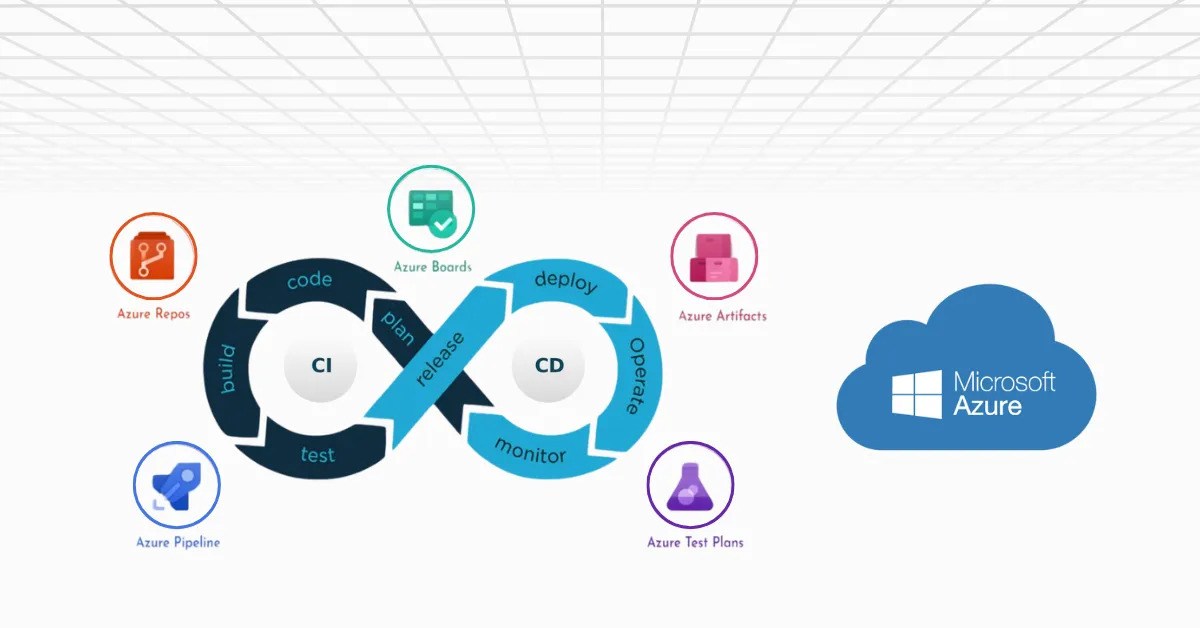
A well-structured pipeline architecture is the difference between a DevOps strategy that scales and one that quietly accumulates technical debt. To understand what a solid ci/cd pipeline azure devops example looks like in practice, it helps to map the flow from source to deployment before writing a single line of YAML.
The standard flow moves through four logical stages:
- Source control — code lives in Azure Repos (or a connected GitHub repository)
- Build stage — Azure Pipelines compiles, packages, and runs unit tests automatically on each commit
- Artifact publishing — a verified build artifact is stored and versioned, ready for release
- Deployment targets — the artifact is promoted through environments (dev → staging → production) via release gates
Azure's integration with GitHub Actions extends this model into hybrid workflows. Teams already using GitHub for source control can trigger Azure Pipelines directly, reducing lead time and supporting the high-frequency deployment model that DORA research tied to Microsoft's platform consistently highlights as a top-tier performance driver.
Skipping the baseline architecture phase is where most pipeline sprawl begins. Without a documented, repeatable structure, individual teams build one-off pipelines that diverge over time — creating maintenance burdens that compound with every new service.
Data pipelines deserve a separate mention here. Unlike application pipelines, CI/CD for data workflows must account for schema validation, data quality checks, and environment-specific dataset management — concerns that don't map cleanly onto standard build-and-deploy stages. Treating them identically to application pipelines is a common architectural misstep.
Getting this foundation right sets the stage for the advanced practices — from YAML-as-code to deployment gates — covered next.
Best Practices for Scalable Azure CI/CD Workflows
Following azure ci/cd best practices from day one prevents the kind of pipeline sprawl that makes scaling painful and expensive.The teams that get the most from Azure Pipelines aren't necessarily the ones with the most complex setups — they're the ones that treat pipeline design with the same discipline they apply to application code.
YAML-based pipelines are the single most important structural decision you can make early. Defining your pipeline logic in YAML files stored alongside your application code means every change to the pipeline is version-controlled, reviewable, and reversible. As BrowserStack's CI/CD pipeline guide notes, treating infrastructure configuration as code is fundamental to maintaining consistency across environments.
Automated testing placement matters more than most teams realize. A common mistake is front-loading builds and deferring tests to a final validation stage. In practice, integrating unit, integration, and security tests throughout each pipeline stage — not just at the end — catches failures where they're cheapest to fix. According to Forrester Consulting, automating manual handoffs and embedding testing directly into the build pipeline is what meaningfully reduces wait time between commit and deployment.
Secret management deserves explicit attention at the architecture level. Azure Key Vault integration lets pipelines retrieve credentials and certificates at runtime without ever storing sensitive values in plain text within the YAML definition — a critical safeguard as pipelines scale across teams and environments.
Deployment gates and manual approvals add a necessary human checkpoint before production releases. However, the goal isn't to reintroduce the friction that automation eliminated — it's to enforce deliberate sign-off on high-stakes changes while keeping lower environments fully automated. Balancing automation with controlled release governance is what separates mature DevOps practices from pipelines that simply move fast.
Getting these fundamentals right sets the stage for the broader strategic outcomes that Azure Pipelines makes possible — outcomes worth reviewing as clear, consolidated takeaways.
Key Takeaways for Azure DevOps Success
Azure Pipelines is not optional for teams serious about modern DevOps — it is the structural backbone that converts deployment ambition into measurable, repeatable results.
The sections above walked through architecture decisions, scalability patterns, and workflow best practices. Before moving forward, it's worth consolidating what those insights mean in practice. Four core principles stand out as non-negotiable for teams building on Azure.
- CI/CD is a performance multiplier, not a convenience. Research consistently shows that high-performing engineering teams deploy 200 times more frequently than low performers. Continuous integration and continuous delivery are the mechanism that makes that frequency sustainable — not heroic manual effort.
- Cross-platform flexibility is a genuine competitive edge. Azure Pipelines supports Linux, macOS, and Windows through cloud-hosted agents, meaning teams are never locked into a single environment or constrained by local build infrastructure. That flexibility matters as product stacks diversify.
- Eliminating manual handoffs drives measurable productivity gains. In practice, teams that automate approval gates, testing, and release steps see productivity increases exceeding 20%. Every manual touchpoint is a delay, a potential error, and a hidden cost.
- A well-defined baseline is essential for complexity at scale. Whether managing microservices, data pipelines, or enterprise app deployments, architecture clarity prevents the drift that turns maintainable pipelines into fragile, undocumented systems.
These principles don't operate in isolation. The real payoff comes when they work together inside a coherent strategy — which is exactly the transformation the next section addresses.
Building Your Future on Azure Automation
The shift from manual deployments to fully automated DevOps pipelines is one of the most consequential technical transformations a software team can make. Throughout this article, the pattern has been consistent: teams that invest in structured CI/CD workflows through Azure Pipelines ship faster, break less, and recover quicker when things go wrong. That is not a coincidence — it is the direct result of removing human bottlenecks from processes that machines handle more reliably.
Navigating that transformation is rarely straightforward. Tooling choices, pipeline architecture, environment parity, and security gate configuration all demand deliberate planning. MindStick specializes in guiding development teams through exactly these decisions — helping organizations move from ad hoc deployment scripts to production-grade Azure DevOps workflows without the costly trial-and-error that typically accompanies self-directed adoption.
The most practical path forward is also the least intimidating one: start small. Pick a single, low-risk service or repository and build one pipeline end to end. Validate your triggers, confirm your artifact publishing, and run a real deployment to a staging environment. That pilot becomes your template — and your proof of concept for stakeholders who need to see results before committing to broader rollout. According to Microsoft's Azure Pipelines documentation, the platform supports any language and any cloud target, which means your pilot architecture scales without being rebuilt.
The future of DevOps belongs to teams that treat automation as infrastructure, not as a project. Explore the full range of Azure DevOps capabilities available today — and take that first step toward a pipeline foundation your team can build on for years.


Leave a Comment