Evolution of Software Product Development in India
India’s software development and IT industry is one of the world’s biggest and successful information technology industries.
The static Keyword: The static methods
Consider the example of the ball game described in here section. A player may be given the choice to select the colour of the balls. This colour choice will be applied to all the balls he creates during the game.
Structure of Java Source Files and Import Statements
We have learned enough from the examples given in previous posts so far to get started writing Java programs. Now, let’s discuss the complete structure of a Java source file.
The final keyword: final classes and variables
So far we have discussed how to inherit from an existing class. However, what if we do not want anybody to inherit from our custom class? We can restrict other developers from extending our classes with the help of the final keyword.
Inheritance in Java: Calling the super Constructor
To understand how the super keyword is used for calling the superclass constructors, let’s add the constructors to our class hierarchy here
Inheritance in Java: Writing a Multi-level Inheritance Program
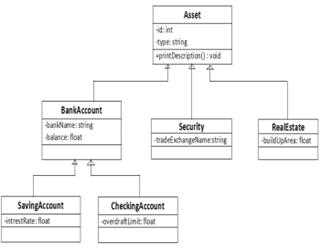
The application discussed in the previous post is based on the asset management classes we have studied so far. We will now look at the concepts of multilevel inheritance with the help of program code.
Inheritance in Java: Single-level and Multi-level Inheritance
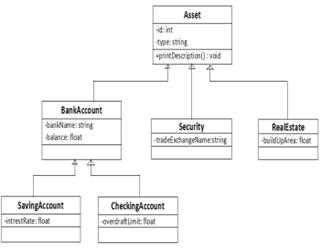
When a class inherits from a single class, as in the case of BankAccount inheriting from Asset, it is called single-level inheritance or simply single inheritance.
Arrays in Java: Determining Class of an Array (Part-8)
In previous posts, we have learnt how to find the length of the arrays and how to clone an array. Now here we learn how to find out the class of an array.
Arrays in Java: Non-Rectangular Arrays (Part-5)
So far we have seen the declaration and use of rectangular arrays. Java allows us to create non-rectangular arrays.
Arrays in Java: Multidimensional Arrays (Part-4)
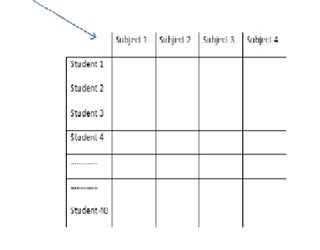
Multidimensional arrays, as the name suggests, contain more than one dimension. You can create two-dimensional, three-dimensional, and n-dimensional arrays in Java (where n is any natural number).
Arrays in Java: Array Initializations (Part-2)
In my previous post, we have already learned how to declare an array, allocate the space for its elements, and how to modify and access its elements. Now we learn how to initialize a java array.
Arrays in Java: The for-each loop (Part-3)
In my previous posts, we have seen how to declare an array, allocate the space for its elements, and how to modify and access its elements.