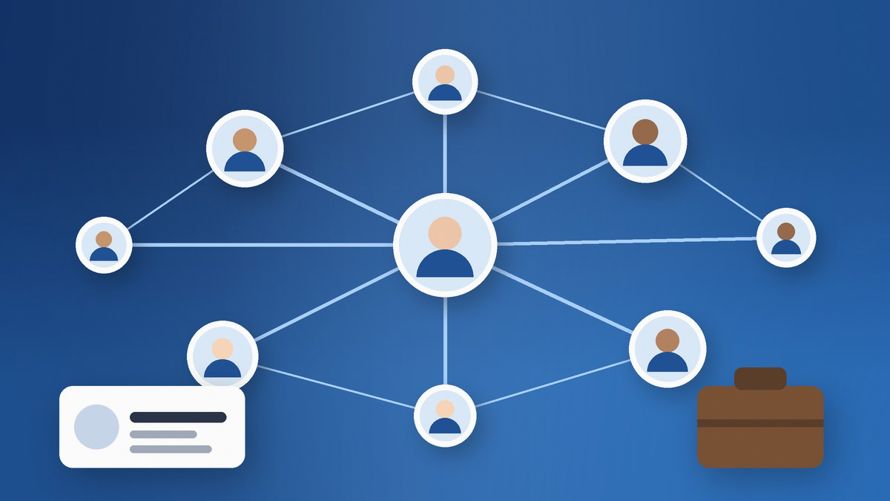
Before LinkedIn, building a career network meant business cards, phone calls, and introductions at conferences. Finding a new job often depended on who you happened to know. LinkedIn’s idea was to put those professional relationships online, where they could be searched, kept up to date and used to open doors.
Started in a Living Room
LinkedIn was founded in late 2002 by Reid Hoffman, with co-founders from his network including Allen Blue, Konstantin Guericke, Eric Ly and Jean-Luc Vaillant. Hoffman had worked at Apple and Fujitsu, started an early social site called SocialNet, and served as an executive at PayPal. When PayPal was sold to eBay, he used the proceeds to start something new.
The site launched in May 2003. Growth was slow at first. In its first month, it reportedly added only a few thousand members, mostly people invited by the founders and their contacts. Unlike consumer social networks, LinkedIn had no photos of parties or games to make people return daily. Its value only became clear when many professionals were on it.
Patience Over Hype
LinkedIn’s early years were about building trust. Users created profiles that looked like online CVs, connected with people they actually knew and could ask for introductions through mutual contacts. Features such as recommendations from colleagues and the ability to upload address books helped the network grow.
The company found a working business model earlier than many social startups. It became profitable in 2006 and developed three main revenue lines that still matter today: tools for recruiters to find and contact candidates, premium subscriptions for individuals, and advertising aimed at professionals. Recruiters were especially valuable because LinkedIn gave them access to people who were not actively looking for jobs but might be open to the right offer.
Going Public and Growing Up
LinkedIn listed on the New York Stock Exchange in May 2011, one of the first major social networking companies to go public in the US, and its shares jumped sharply on the first day. Jeff Weiner, who joined as chief executive in 2009, led a long period of growth focused on making the platform more useful daily, adding a news feed, articles, groups and learning courses.
Not every move worked. Critics complained about aggressive email invitations and spammy messages, and a large password breach in 2012 hurt trust. LinkedIn responded by strengthening security and tightening some growth tactics.
The Microsoft Deal
In 2016, Microsoft agreed to buy LinkedIn for about 26.2 billion dollars, its largest acquisition up to that point. Many wondered whether the two cultures would fit. Instead, LinkedIn kept considerable independence while connecting more closely with Microsoft’s Office and business software. Over the following decade, its revenue grew several times over.
Where LinkedIn Stands in 2026
LinkedIn is now a major business inside Microsoft. In the fiscal year that ended in June 2026, its revenue rose about 11 percent to roughly 19.8 billion dollars, with growth across all its business lines. In October 2026, Microsoft chief executive Satya Nadella said the network had more than 1.4 billion members. From its September 2026 quarter, Microsoft stopped reporting LinkedIn revenue as a separate line, folding it into broader categories in its financial reports.
Video content and AI tools are now central to the platform. Video ads have grown quickly, and LinkedIn has introduced AI features that help recruiters screen candidates, write messages and manage hiring tasks, along with writing aids for members. For job seekers, it remains one of the most important places to be seen.
The challenges include keeping the feed genuinely useful rather than full of self-promotion, protecting members from fake profiles and scams, and showing that AI hiring tools are fair to candidates.
How LinkedIn Makes Money
LinkedIn has one of the most balanced business models of any social network. Talent Solutions sells tools to recruiters and HR teams, letting them search profiles, send messages to candidates and post jobs. Marketing Solutions sells advertising aimed at professionals by job title, industry, company size and seniority, which is especially valuable for business-to-business marketers who struggle to reach decision-makers elsewhere. Premium subscriptions give individuals extra features, such as seeing who viewed their profile, sending messages to people outside their network and using AI writing tools. LinkedIn Learning adds online courses sold to individuals and companies. Sales Navigator, a tool for salespeople to find and track prospects, is another important line. Because these income streams depend on different customers, a slowdown in hiring can be partly offset by stronger advertising or subscriptions. That mix has helped LinkedIn grow steadily through several economic cycles.
Lessons for Founders
LinkedIn shows that some networks grow slowly before they grow fast, and that patience can pay off when the value depends on scale. It also shows the strength of having more than one way to earn money: when advertising slowed, recruiting and subscriptions often carried the business. Most importantly, it proves that trust is a product feature. People share career details only on a platform they believe is serious and safe.
A site that once struggled to sign up a few thousand people has become the default online CV for more than a billion professionals. Its success came from solving a dull but essential problem better than anyone else.