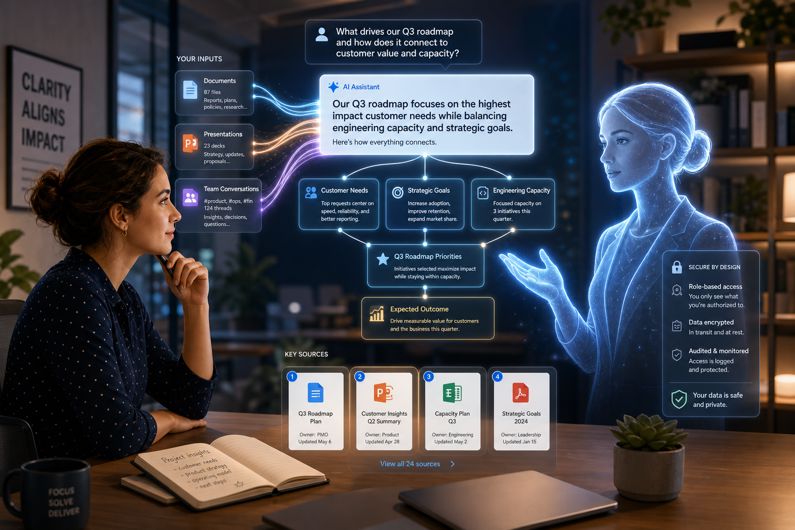
A new employee asks a straightforward question: why did the team change its pricing last quarter? The answer may be scattered across a Slack discussion, a planning document and a presentation nobody remembers naming. Finding the files is only half the job. Understanding which explanation is current takes longer.
Glean has built its business around that problem. Founded in 2019 by a team including former Google engineer Arvind Jain, the startup began with workplace search and expanded into an enterprise AI assistant. Its appeal is practical: help employees use information their company already has, without asking them to move everything into another system.
The product gets more useful when it understands the company
Glean connects to workplace applications and helps employees find information or ask questions across them. Its enterprise search connectors bring material from different tools into a searchable environment, while its AI assistant can assemble answers with references to source documents.
That makes it different from simply giving staff a general-purpose chatbot. A useful answer about an internal sales process depends on the company’s documents, terminology and access rules—not just a model’s general knowledge.
Permission-aware enterprise search is central to the proposition. An employee should not gain access to a confidential HR document merely because an assistant can retrieve it. Glean says its platform respects source-system permissions. Buyers still need to examine how those permissions are synchronized and whether existing access settings are appropriate.
Why this is a credible startup business
Glean’s customer library includes organizations such as Duolingo and Confluent. Those published deployments are stronger evidence of commercial adoption than a polished demonstration, although vendor-selected case studies cannot establish profitability or show the experience of every customer.
The business model is enterprise software: organizations purchase access for employees, with pricing handled through sales. A buyer is not just paying for generated text. The purchase also covers connections to internal systems, administration, retrieval and security capabilities.
Several characteristics make the opportunity attractive:
- A recurring problem: Company information keeps changing, so finding reliable answers is not a one-time project.
- Use across departments: Engineering, sales, support and operations can all need answers from the same underlying knowledge sources.
- Room to expand: A deployment can begin with one team and grow if employees find it useful enough to return.
None of these guarantees strong economics. Enterprise sales, implementation work and AI inference costs can be expensive. Glean’s private-company status also limits how much outsiders can independently assess its margins and retention.
The difficult part is trust, not the chat box
For customers, enterprise AI data security and source-grounded AI answers matter more than an impressive first conversation. An assistant that confidently repeats an outdated policy can create additional work rather than save time.
Successful deployment therefore involves internal knowledge management: identifying authoritative documents, retiring obsolete material and assigning responsibility for updates. Software can make information easier to retrieve; it cannot automatically make every document correct.
Glean also faces competition from Microsoft and Google, which can place assistants inside applications customers already buy. Its case is strongest where a company needs answers across a mixed collection of tools rather than within one vendor’s suite.
The useful lesson for founders is specific: enterprise AI adoption depends on solving the surrounding workflow. Connecting systems, preserving access controls and helping users verify an answer can be as commercially important as the model generating it.
Sources: Glean’s official product overview, customer stories and security information. Customer outcomes and product capabilities described by Glean should be read as company-reported information, not independent financial verification.