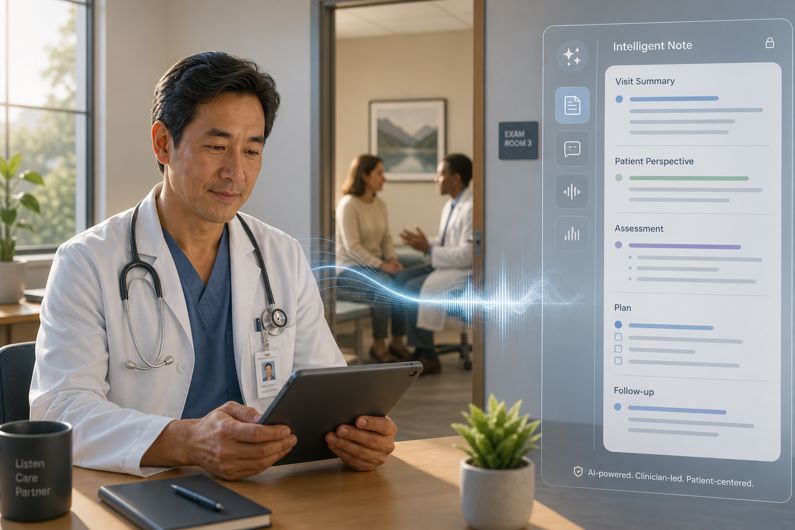
A medical appointment does not end when the patient leaves. Someone still has to turn the conversation into a clinical record. That documentation burden is the opening Abridge has built its business around: software that listens to a consultation and produces a draft note for a clinician to review.
Founded in 2018 by cardiologist Shiv Rao, AI researcher Zachary Lipton, and entrepreneur Sandeep Koncham, Abridge is a useful startup to study because it tackles a specific, recurring task rather than selling an all-purpose assistant. Its progress also offers a practical lesson: in healthcare, a capable model is only part of a sellable product.
The evidence behind its traction
Two publicly announced milestones make Abridge stand out. In February 2024, it announced a $150 million Series C led by Lightspeed Venture Partners. In August 2024, Kaiser Permanente announced that Abridge’s technology was available to physicians and other clinicians across its 40 hospitals and more than 600 medical offices in eight states and Washington, D.C.
The second milestone is especially meaningful. Making software available across a large health system requires much more than a convincing demonstration. It involves procurement, security review, training, and decisions about how the product fits existing clinical work.
These are dated indicators of funding strength and enterprise adoption—not proof of profitability. Availability also does not mean every eligible clinician uses the product. Still, they provide a firmer basis for assessing the business than investor enthusiasm alone.
Why the workflow matters more than the transcript
Abridge operates in the market for ambient clinical documentation. With appropriate patient consent, its software captures the conversation and generates a structured draft rather than simply handing the clinician a transcript.
That distinction matters. A conversation may move between symptoms, medication history, family concerns, and treatment decisions. A useful medical note must organize those details without inventing findings or confusing who said what.
Abridge has emphasized electronic health record integration, including work within Epic workflows, and features that connect generated content to supporting portions of the underlying encounter. The commercial purpose is straightforward: reduce the effort of producing and checking documentation without forcing clinicians into another disconnected application.
Clinician review remains essential. A generated note can omit a detail, misinterpret speech, or misstate a plan. This is documentation assistance, not an independent medical decision-maker.
The buyer needs more than saved minutes
Abridge sells into organizations that must evaluate both clinical usefulness and operational risk. For a health system considering enterprise healthcare software, the purchasing questions extend beyond whether the draft reads well:
- Does it reduce total work? Time saved drafting a note is less valuable if extensive corrections are required.
- Will clinicians keep using it? Sustained adoption matters more than an enthusiastic pilot.
- Can it satisfy patient data privacy requirements? Consent, access controls, retention practices, and contractual safeguards affect deployment.
- Does it fit daily practice? Specialty-specific language and existing documentation habits can determine whether the product helps or interrupts.
These requirements make health system procurement slow and demanding. They can also make a well-integrated product harder to replace, although competitors can pursue the same integrations.
The startup lesson is not simply “apply AI to healthcare.” It is to find an expensive, repeated task, fit the product into the place where that task already happens, and give the buyer ways to assess results. For Abridge, the durable business case depends on clinical workflow adoption and medical documentation accuracy, not just the quality of a polished demo.
Source basis: Abridge’s February 2024 Series C announcement and Kaiser Permanente’s August 2024 deployment announcement. Company information and announcements are available through Abridge and Kaiser Permanente. The milestones discussed here are historical, not a statement of current financial performance.