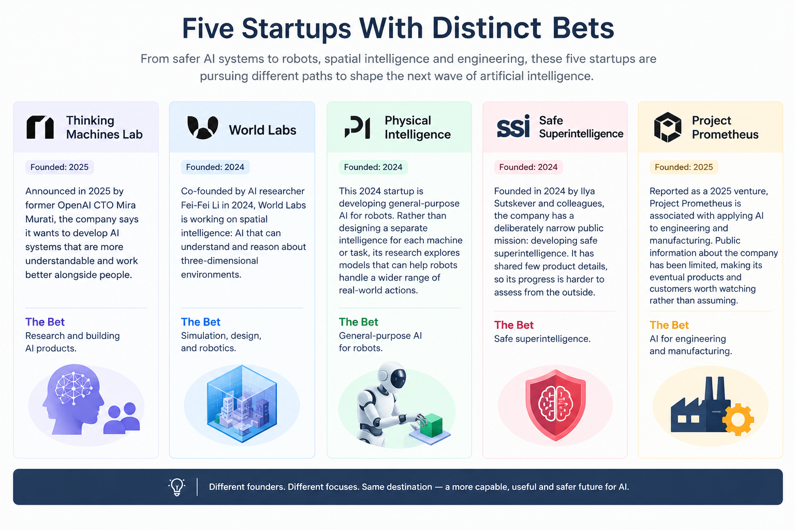
Several AI startups that emerged in 2024 and 2025 are taking different paths: some are building models for robots or 3D environments, while others are aiming at advanced AI research or industrial work. Here’s a quick look at five of them, based on their publicly described goals. This is a dated snapshot, not a live directory; early-stage companies can change direction quickly.
Five startups with distinct bets
- Thinking Machines Lab — Announced in 2025 by former OpenAI CTO Mira Murati, the company says it wants to develop AI systems that are more understandable and work better alongside people. Its public focus is on research and building AI products.
- World Labs — Co-founded by AI researcher Fei-Fei Li in 2024, World Labs is working on spatial intelligence: AI that can understand and reason about three-dimensional environments. That capability could matter in areas such as simulation, design, and robotics.
- Physical Intelligence — This 2024 startup is developing general-purpose AI for robots. Rather than designing a separate intelligence for each machine or task, its research explores models that can help robots handle a wider range of real-world actions.
- Safe Superintelligence — Founded in 2024 by Ilya Sutskever and colleagues, the company has a deliberately narrow public mission: developing safe superintelligence. It has shared few product details, so its progress is harder to assess from the outside.
- Project Prometheus — Reported as a 2025 venture, Project Prometheus is associated with applying AI to engineering and manufacturing. Public information about the company has been limited, making its eventual products and customers worth watching rather than assuming.
These companies are not all chasing the same market. World Labs and Physical Intelligence are exploring how AI can work with physical or simulated spaces; Thinking Machines Lab and Safe Superintelligence are more directly tied to advanced AI research; Project Prometheus is aimed at industrial applications. For anyone tracking new startups, the useful question is not just how ambitious a mission sounds, but what the company can demonstrate as its research turns into products.

