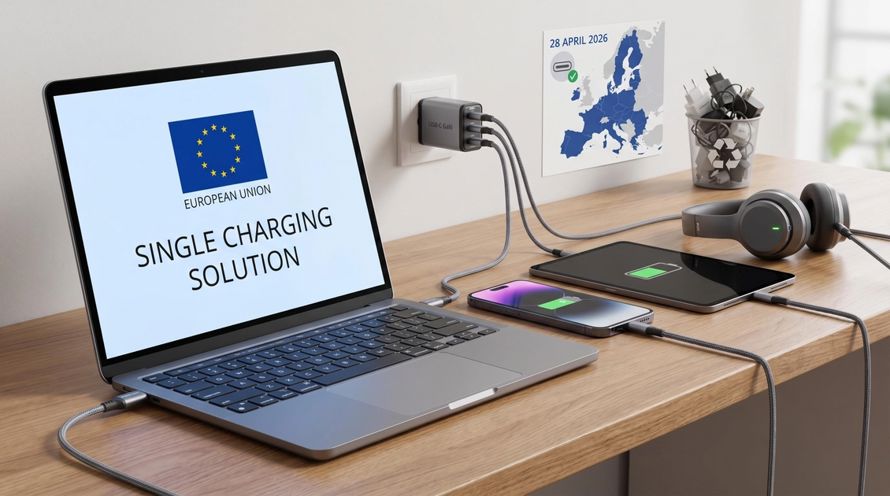
As of April 28, 2026, the European Union’s common-charger rules extend to laptops, requiring covered new models placed on the EU market to include a USB-C charging port. The change brings laptops into a policy that already applies to several smaller electronic devices.
For buyers, the practical aim is straightforward: a compatible USB-C charger can work across more devices, reducing the need to keep a separate power adapter for every product. Manufacturers can still offer their own adapters and charging features, but the required port gives consumers a widely shared alternative.
What the rule asks manufacturers to do
Covered laptops must support charging through USB-C. For devices that support charging above 15 watts, the rules also require USB Power Delivery, the common charging standard intended to make fast charging work across compatible devices. A company can continue to offer a proprietary fast-charging system, provided it does not prevent USB Power Delivery from functioning.
The regulation also gives buyers a charger-free purchase option where applicable and calls for charging information to be shown clearly, helping people check what a device needs before buying. These requirements apply to products newly placed on the EU market; they do not mean that people must replace laptops they already own.
A change with a wider reach
The rule is an EU requirement, not a blanket mandate for laptops sold worldwide. Still, companies selling across multiple markets may choose to standardize product designs rather than maintain separate versions, so the effects could reach buyers beyond Europe. Whether that happens will depend on individual manufacturers and product lines.
USB-C does not make every charger interchangeable in every situation: charging speed depends on the laptop, charger, cable and supported power levels. But the new requirement establishes a common port and charging baseline for covered models, making it easier to reuse a suitable charger and compare charging needs when shopping for a new laptop.