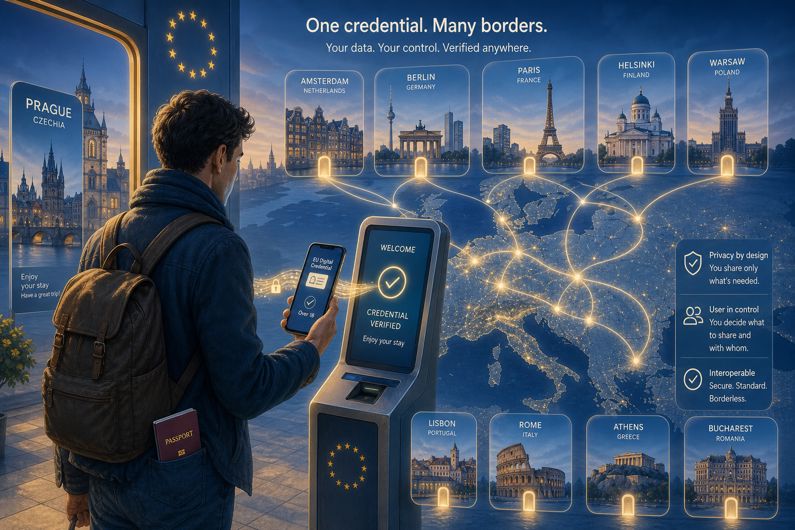
The European Union’s plan to give residents a digital identity wallet is approaching a major delivery deadline. Under the EU’s published implementation timetable, member states are expected to make wallets available by the end of 2026, moving a long-running digital identity project toward everyday use.
The aim is broader than putting an identity card on a phone. A European Digital Identity Wallet is intended to let people identify themselves, store verified credentials and share selected information with public bodies and businesses across the EU. Potential uses include proving a qualification, accessing a public service or demonstrating that someone meets an age requirement without handing over an entire identity document.
With the deadline approaching, the practical questions are becoming more pressing: who issues the credentials, where will wallets be accepted, and will a wallet from one member state work reliably with a service in another?
A common framework, not one EU-issued app
The legal foundation is Regulation (EU) 2024/1183, which updated the EU’s existing electronic identification and trust services framework, commonly known as eIDAS. It entered into force in May 2024. Subsequent implementing rules established technical and operational requirements, underpinning the Commission’s timetable for wallet availability by the end of 2026.
There will not necessarily be a single application that every European downloads. Member states can provide wallets directly, arrange for them to be provided under a public mandate or recognise independently provided wallets that satisfy the framework’s requirements.
That distinction matters. The project depends on separate national implementations being able to participate in a shared trust system. A credential issued in one country must be understandable and verifiable when presented to an eligible service elsewhere.
For users, successful cross-border digital identification should feel straightforward. Behind it sits a more complicated set of relationships between wallet providers, credential issuers, services requesting information and the authorities responsible for oversight.
The privacy promise is about sharing less
One of the framework’s most consequential features is selective disclosure of identity data. Instead of repeatedly uploading scans of passports or identity cards, a person should be able to present the particular information a transaction requires.
An age check illustrates the difference. A service might need to know that a user is above a particular threshold, but not need their full date of birth, home address or document number. A suitably supported wallet interaction could supply the necessary proof without exposing all of those details.
That is an intended capability, not a guarantee that every service will immediately offer it. The result depends on the credentials available, the technical implementation and what information the receiving service is entitled to request.
The framework also makes wallet use voluntary. People who do not use a wallet are not supposed to be disadvantaged in accessing public or private services, employment or business activity. Alternative identification and authentication routes therefore remain important, particularly for people without compatible devices or those who prefer not to use a phone for identity checks.
Those safeguards will matter as much as the interface. A convenient app would not, by itself, resolve concerns about excessive data requests, tracking or the consequences of losing access to a device.
Availability will not mean universal acceptance overnight
The end-of-2026 milestone concerns member states making wallets available. It should not be read as a promise that every bank, university, retailer and government portal will support every wallet function on the same day.
The regulation distinguishes between public-sector acceptance, obligations affecting certain private services and requirements for very large online platforms. The scope and timing vary. In particular, some private-sector acceptance requirements operate on a longer implementation timetable than the obligation to provide wallets.
This creates an adoption challenge: a wallet becomes more useful as more organisations issue credentials and accept them, but those organisations need working infrastructure and clear requirements before committing resources.
A university qualification, for example, requires more than storage space in an app. The institution must issue a verifiable credential, the wallet must support it, and a prospective employer or another institution must be able to check its authenticity and relevance. The same coordination problem appears with professional qualifications and other official records.
What technology teams should be checking
For organisations likely to issue or accept credentials, the immediate task is not simply to add another sign-in button. Wallet integration changes how identity information is requested, verified and retained.
- Acceptance obligations: Establish whether the organisation falls within a mandatory acceptance category and which implementation dates apply. A national rollout announcement is not a substitute for that legal assessment.
- Data requests: Identify the minimum attributes needed for a transaction. Recreating an existing document-upload form inside a wallet flow could miss the privacy benefits of the system.
- Credential validation: Plan how to verify the issuer, authenticity, validity and, where applicable, revocation status of a credential.
- Account recovery: Decide how customers can regain access when a device is lost, replaced or compromised, without introducing a weaker route around the identity check.
- Alternative access: Maintain usable options for people who cannot or choose not to use a wallet.
These are operational decisions as well as software requirements. Customer support teams will need to distinguish between a failed wallet interaction, an expired credential and a service that does not yet accept the requested evidence.
Organisations will also need to keep authentication separate from authorisation. Establishing who someone is, or confirming a qualification they hold, does not automatically establish their right to access a particular account, record or service.
The real test comes after launch
The EU’s initiative is significant because it seeks to make verified digital credentials useful beyond the organisation or country that issued them. Existing identity apps often work well within a limited system; achieving dependable recognition across national borders is a harder proposition.
As the rollout deadline approaches, the most meaningful signals will be concrete: certified wallets becoming available, useful credentials being issued, services accepting them and people completing transactions without unnecessary data disclosure.
A download link will mark a launch. Reliable acceptance, understandable consent screens and workable recovery procedures will determine whether people keep using the wallet.
Reporting scope: This article examines the published EU legal framework and end-of-2026 rollout timetable. It does not independently verify the current availability of individual national wallets or report a newly announced launch. Further official background is available from the European Commission’s European Digital Identity Wallet overview.