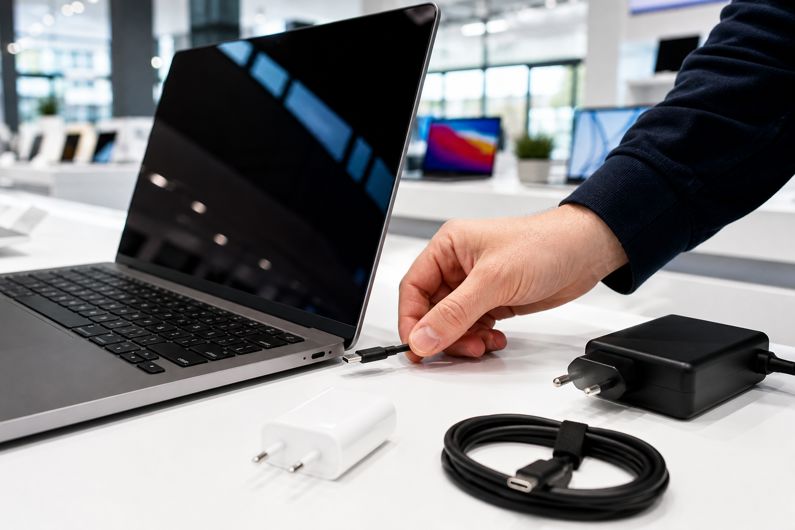
The European Union’s common-charger requirement has reached laptops, extending a policy already familiar to smartphone buyers into a market where proprietary power connectors have long been routine. The laptop provisions took effect on 28 April 2026, following the earlier rollout for phones, tablets and other portable electronics.
For buyers, the change is about more than the shape of a socket. The rules bring together USB-C charging, compatible fast-charging technology, clearer information about power requirements and the option to purchase covered equipment without a bundled charger. For manufacturers, they make charging compatibility a product-compliance issue rather than simply a feature to advertise.
The deadline comes from legislation adopted in 2022, not a newly announced EU measure. Its significance now is practical: laptops newly placed on the EU market fall within the common-charger framework, making charging specifications a more consequential part of the purchasing decision.
What changed for laptops
Under Directive (EU) 2022/2380, covered laptops capable of wired charging must have the required USB Type-C receptacle and support charging through compliant cables. The same legislative package applied to its other listed device categories from 28 December 2024; laptops received a longer transition period.
The requirements concern equipment placed on the EU market. They do not require owners to replace an existing laptop, retrofit an older charging connector or discard a working power adapter. Nor should shoppers assume that every older model remaining in a retailer’s inventory suddenly became unlawful on the deadline: when a particular unit was first placed on the market matters.
That distinction separates the regulation from an overnight replacement programme. The policy changes the requirements for products entering the market, while the installed base of older hardware will continue to be used for years.
It also does not mean manufacturers must remove every alternative charging connection. A compliant USB-C charging connection can coexist with another power connector. The practical change is the availability of the standardised charging route, not necessarily the disappearance of all manufacturer-specific hardware.
A shared connector does not make every charger equivalent
The most likely source of confusion is power. A small USB-C phone adapter and a laptop power supply may have matching sockets while delivering very different amounts of electricity.
The legislation addresses this through requirements for USB Power Delivery where the specified voltage, current or power thresholds are exceeded. It also requires any additional charging protocol not to prevent the full functionality of the mandated USB Power Delivery implementation. The intent is to stop a familiar connector from concealing a charging system that works properly only with one brand’s accessories.
Even so, USB-C charging compatibility does not guarantee that any USB-C adapter will run any laptop at full performance. An underpowered adapter may charge a machine slowly, charge it only under lighter workloads or fail to provide enough power while the computer is busy. The cable’s supported power rating matters too.
That is especially relevant when moving between a phone charger, a compact travel adapter and a workstation setup. A connector that physically fits is only the first check. Buyers still need to compare the laptop’s charging requirements with the output available from the charger and the capabilities of the cable.
Multiport adapters add another wrinkle: their advertised maximum output may be shared across connected devices. Plugging in a phone can reduce the power available to a laptop, depending on the adapter’s design. The EU requirement does not remove the need to read that specification.
The packaging changes may be just as useful
The common-charger framework also requires information about charging capabilities and whether a charging device is included. Its charging label identifies the relevant minimum and maximum power requirements and indicates USB Power Delivery support where applicable.
That gives shoppers a more concrete basis for deciding whether an adapter they already own is suitable. A familiar-looking port is not enough; a stated wattage requirement is far more useful when comparing accessories.
Another provision addresses the purchase itself. Where an economic operator offers covered equipment together with a charging device, it must also offer the option to acquire that equipment without one.
This is an unbundled purchase option, not a blanket ban on chargers in laptop boxes. It does not guarantee a particular price reduction either. Manufacturers and retailers still determine pricing, but buyers should not have to acquire another adapter solely because they want a new computer.
For someone replacing an older laptop with a proprietary charger, a new adapter may still be necessary. For a household or office that already has suitable USB-C power supplies, the option could avoid another redundant accessory.
Why IT departments should look beyond the port
For organisations buying laptops in volume, standardised charging creates an opportunity to simplify spare equipment, shared desks and travel kits. A pool of appropriately rated adapters can be easier to manage than separate supplies for several laptop families.
But USB-C laptop procurement still requires a specification check. Charging support does not automatically establish compatibility with an office’s monitors, docking stations or high-speed storage.
The common-charger rules do not make every USB-C port a Thunderbolt port, guarantee a particular USB data rate or require identical external-display capabilities. Those functions share a connector shape but remain separate purchasing questions.
A sensible procurement review therefore distinguishes three things: the power a laptop needs, the power an adapter or dock can supply, and the data and display functions the organisation requires. Treating “has USB-C” as a complete answer risks replacing one compatibility problem with another.
The EU’s stated objectives include reducing electronic waste and the inconvenience of incompatible chargers, as explained in the European Commission’s common-charger guidance. The laptop extension broadens that effort, but its real-world benefits will depend on how often people can reuse suitable equipment rather than buying another adapter by default.
For the next laptop purchase, the useful question is no longer simply whether the machine has USB-C. It is whether its stated charging requirements match the power equipment already on the desk—and whether the seller offers the computer without another charger when that equipment is sufficient.