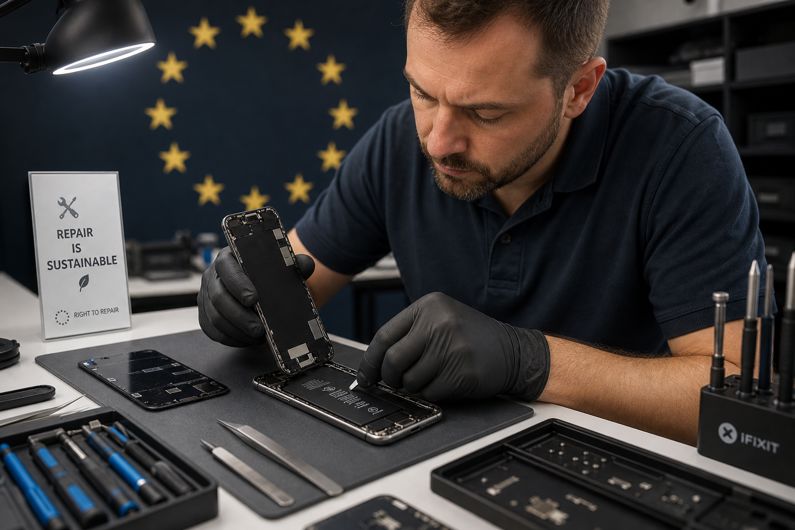
The European Union’s right-to-repair push has moved beyond adoption of a new law and into the harder question of how it works for customers. With the 31 July 2026 deadline for national implementation now passed, attention is turning to whether people can obtain repairs for covered products, including smartphones, without unnecessary restrictions or costs that make replacement the only practical choice.
The change matters to a technology market in which a damaged screen, worn battery or unavailable component can shorten the useful life of an otherwise functioning device. The EU’s repair directive is intended to address part of that problem by placing repair obligations on manufacturers of specified products and strengthening the incentive to repair goods rather than replace them.
There is a significant distinction, however: an EU implementation deadline is not proof that every member state has introduced identical, fully operational procedures. Customers and businesses still need to check the national law that applies. The directive establishes the framework; national legislation, enforcement and available remedies determine how people use it.
What changes for a broken phone?
Directive (EU) 2024/1799 creates a repair obligation for goods covered by the EU repairability requirements listed in its Annex II. Smartphones are among the relevant product categories, alongside certain household appliances and other equipment. This is not a universal obligation to fix every electronic product ever sold.
For covered goods, the manufacturer must provide a repair service when a consumer requests it, subject to the directive’s scope and conditions. Repair must be free or offered at a reasonable price and completed within a reasonable period. A manufacturer is not obliged to carry out a repair that is impossible.
That framework is particularly relevant when a defect falls outside the seller’s existing liability under the legal guarantee. A phone that is no longer covered by that guarantee does not automatically become a device its manufacturer can simply decline to service.
Nor does the law promise free battery replacements indefinitely. The distinction between the right to request a repair and a warranty entitlement remains central. Consumers may still face a repair bill; the policy aims to make a functioning repair route available under the specified conditions.
Where the manufacturer is established outside the EU, the directive sets out a chain of responsibility involving an authorised representative, importer or distributor, as applicable. That provision is intended to prevent the repair obligation from disappearing merely because the company that made the product is based overseas.
Software restrictions become part of the repair debate
For technology companies, some of the most consequential language concerns the barriers surrounding a repair rather than the repair itself.
The directive restricts contractual terms and the use of hardware or software techniques that impede repairs to covered goods, unless justified by legitimate and objective factors. Intellectual property protection is one example recognised in the text. It also says manufacturers cannot refuse a repair solely because another repairer or another person previously worked on the product.
Those provisions put software restrictions on repairs under closer scrutiny. Modern devices can use authentication, calibration and component-identification systems that affect whether a replacement part functions correctly. Such systems may serve genuine security or safety purposes, but the existence of a technical restriction does not, by itself, settle whether it is justified.
The directive should not be read as a blanket ban on every instance of component pairing. Whether a particular restriction is permissible depends on the rule, its justification and the circumstances. That is likely to make the details of manufacturers’ service procedures important to regulators and independent repair businesses.
Manufacturers that make spare parts and tools available for covered goods must also offer them at reasonable prices that do not deter repair. For an independent shop, access is only part of the equation: a component priced so close to the value of the device that customers routinely abandon repairs can be just as consequential as an unavailable component.
Choosing repair brings a longer protection period
The directive also changes the incentives within the legal guarantee system. Where a consumer chooses repair rather than replacement as the remedy for a lack of conformity, the seller’s liability period is to be extended once by 12 months. Member states may provide a longer extension.
This is different from saying that every paid repair carries an automatic new one-year warranty. The provision concerns the seller’s liability for goods under the relevant consumer-sales framework and the consumer’s choice of repair as the remedy.
For retailers, that distinction needs to be reflected in customer-service scripts, repair authorisations and records. A consumer should not have to decipher the difference between a manufacturer’s commercial warranty, the seller’s legal obligations and an optional insurance policy just to understand the consequences of choosing a repair.
Two sets of rules now shape smartphone repairability
The repair directive operates alongside separate smartphone ecodesign requirements, which began applying in the EU on 20 June 2025. Those product rules address matters including durability, spare-parts availability, repair information and operating-system updates for devices within their scope.
The two measures address different weaknesses in the same market. Product-design rules help determine whether a device can remain usable and repairable. The repair directive addresses the service obligation and consumer choices when something goes wrong.
A repairable design is of limited value if consumers cannot obtain a service appointment or reasonably priced parts. Conversely, a legal repair entitlement cannot compensate for every design decision that makes disassembly difficult. Manufacturers, distributors and repair providers need to consider both sets of obligations rather than treating either as a complete compliance checklist.
For buyers, the EU’s smartphone and tablet energy labels also introduce repairability information into the purchasing decision. That gives repair access a role before a device breaks, not only when a customer is already facing a costly replacement.
What still needs checking locally
The directive required member states to adopt and publish their implementing measures by 31 July 2026 and apply them from that date. Establishing the status of national right-to-repair laws nevertheless requires checking each jurisdiction; the EU text alone does not demonstrate how a particular country has transposed or enforced it.
For consumers assessing a repair request, the practical questions are relatively concrete:
- Is the product covered? The obligation is linked to specified EU repairability requirements, not electronics as a whole.
- Who is responsible? A claim against the seller under the legal guarantee differs from a request to the manufacturer under the repair obligation.
- What will the repair cost and how long will it take? Reasonable pricing and timing matter, but they are not a single EU-wide price list or turnaround guarantee.
- Which national procedure applies? Complaint routes, enforcement arrangements and remedies need to be checked locally.
Another part of the system is still ahead: the directive provides for a European online repair platform, with development scheduled by 31 July 2027. Its purpose is to help consumers find repair services. It should not be confused with a repair-booking service that is already available uniformly throughout the EU.
The immediate test for the technology industry is less about adopting the language of repairability and more about the experience at the service counter. Can a customer obtain a clear quote? Can a repairer source the necessary part? Does a device accept a legitimate replacement component? And is repairing it a credible alternative to buying another one? Those are the points at which the EU’s legal framework will become visible—or fall short—for device owners.
Source: Directive (EU) 2024/1799 on common rules promoting the repair of goods. The implementation dates described above are statutory dates; individual member states’ implementation and enforcement status must be verified separately.