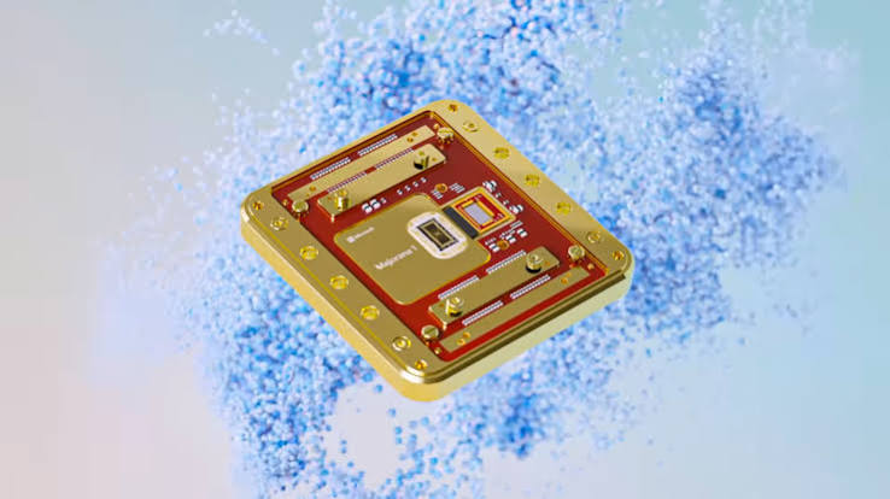
Microsoft says it has taken a significant step toward building a practical quantum computer. On February 19, 2025, the company unveiled the Majorana 1 chip, a prototype built around its approach to topological qubits—a type of quantum bit that Microsoft hopes will be more resistant to the errors that trouble current machines.
The announcement drew attention not only for the hardware, but for the scale of the ambition behind it: Microsoft says its design could eventually support a machine with as many as a million qubits on a single chip. That is a long-term target, not a capability demonstrated by the prototype unveiled at the time.
A different bet on quantum hardware
Most quantum computers in development use qubits that are highly sensitive to their surroundings. Heat, vibration, and other disturbances can disrupt a calculation, so systems need extensive error correction. Microsoft’s strategy is to pursue topological qubits, which are intended to encode information in a way that makes it less vulnerable to local interference.
The company describes the Majorana 1 chip as using a material stack involving indium arsenide and aluminum. In its account, carefully controlled conditions in this structure can produce the exotic states needed for topological computing. If that approach works reliably and can be scaled, it could change how much hardware is required to perform useful quantum calculations.
Why researchers are asking for more evidence
There is a substantial gap between a promising device and a working, fault-tolerant quantum computer. Microsoft’s announcement has therefore been met with cautious interest. Researchers have questioned whether the measurements presented establish the formation and control of the sought-after Majorana states strongly enough to support the company’s broader claims.
That distinction matters. Detecting signals consistent with a theoretical effect is not the same as proving that a device can produce, manipulate, and read out topological qubits consistently. Independent replication and further experimental results will be important before the field can judge how much progress the chip represents.
Microsoft has described the project as a path toward scalable quantum hardware, rather than a finished system ready to solve practical problems. The million-qubit machine remains a goal; the near-term test is whether the underlying device behavior can be demonstrated repeatedly and turned into dependable qubits.
For now, the Majorana 1 announcement highlights both the promise and the uncertainty of this particular quantum approach. The next meaningful milestones will be experimental: clearer demonstrations, outside scrutiny, and evidence that the design can support the operations needed for quantum error correction. Those results—not the size of the long-range target—will show whether Microsoft’s quantum hardware can move from an intriguing research direction toward a scalable computer.