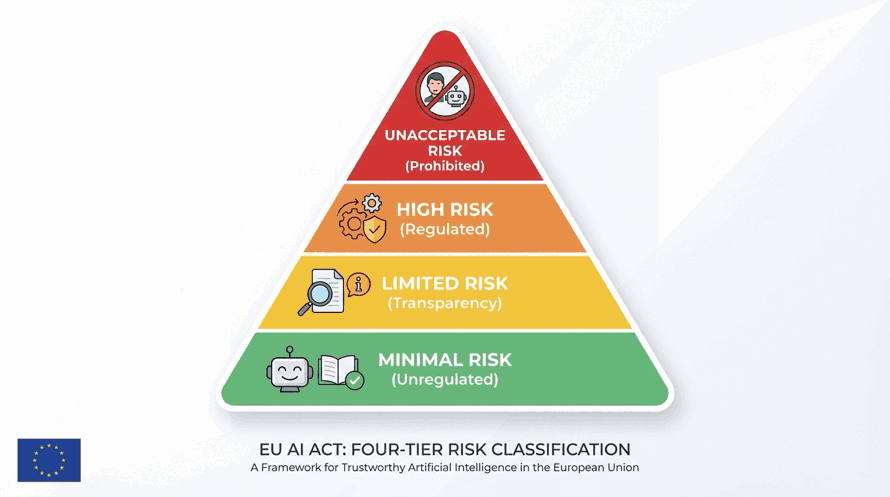
A key phase of the European Union’s AI Act has reached its scheduled application date. Since 2 August 2026, the Act’s requirements for many high-risk AI systems have applied, bringing a broader set of obligations into force for providers and organizations that use these systems in the EU.
The rules cover systems used in areas where an automated decision can have serious consequences for people or public safety. Examples include AI used in recruitment and employment, education, access to essential services, certain law-enforcement tasks, and parts of critical infrastructure. The classification depends on a system’s intended purpose and how it is used; calling a product an “AI assistant” does not, by itself, determine whether it falls into a high-risk category.
What the milestone changes
For providers of covered systems, the Act sets out requirements around risk management, data quality, technical documentation, record-keeping, human oversight, and accuracy and cybersecurity. Some systems must also complete a conformity assessment before being placed on the market or put into service. Organizations deploying high-risk AI have responsibilities too, including using systems according to their instructions and arranging appropriate human oversight.
That means the compliance work is not limited to model developers. A company buying an AI tool for hiring, for example, may need to understand what the system is designed to do, how staff are expected to supervise it, and what information must be retained. Procurement teams, legal departments, and the people responsible for operating the tool may all need a role.
Not every high-risk system follows the same schedule
The August 2026 date does not bring every part of the AI Act into effect at once. High-risk AI that is a safety component of a product covered by specified EU product legislation has a later application date of 2 August 2027. The distinction matters for manufacturers working with regulated products, where AI obligations sit alongside existing product-safety and conformity processes.
The Act’s earlier milestones also remain relevant. Provisions on prohibited AI practices began applying in February 2025, while rules for general-purpose AI models started applying in August 2025, subject to the law’s transition arrangements. Organizations with AI systems should therefore check the rules against each system’s function and applicable timetable rather than treating the August 2026 date as a universal switch.
The immediate practical challenge is turning legal categories into reliable operational processes: documenting where AI is used, deciding whether a system is high-risk, assigning oversight, and keeping evidence that required checks have been completed. The milestone makes those questions more pressing for EU-facing businesses, even as implementation guidance and enforcement practice continue to develop.