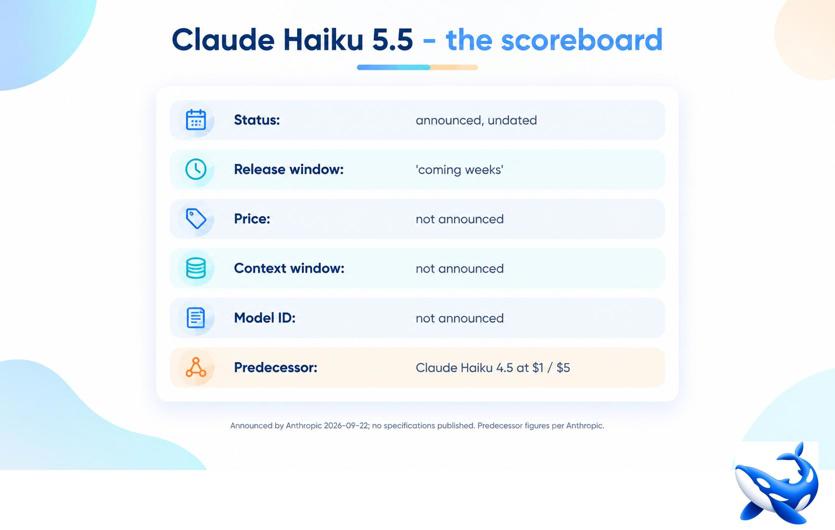
Anthropic has introduced Claude Haiku 5.5, adding a new release to the Haiku line as AI companies compete to make capable models faster and more economical to use. The announcement puts a familiar industry question back in focus: how much performance can a provider deliver in a model designed for speed and efficiency?
Haiku sits within Anthropic’s Claude family alongside its other model offerings. A new version gives developers and businesses another option to assess for everyday workloads, where response time and operating cost can matter as much as top-end capability. Those trade-offs are especially relevant for products that make frequent model calls, such as customer-support tools, assistants and applications that summarize or classify text.
Efficiency is becoming a competitive front
AI competition is no longer limited to the largest, most capable systems. Providers are also trying to make smaller or faster models useful enough for routine tasks, where a slight improvement in latency or cost can affect whether a feature is practical at scale. That makes launches like Haiku 5.5 significant even before they are compared against flagship models.
For Anthropic, the release arrives in a crowded market where model developers are competing across several measures at once: reasoning quality, coding ability, response speed, reliability and price. The best choice will depend on the job. A lightweight model may suit high-volume requests, while more demanding work may still call for a larger system or a combination of models.
What developers will want to compare
The model’s practical value will become clearer as users test it against their own workloads. Useful comparisons include latency under real traffic, output quality on representative prompts, consistency across repeated requests, and the cost of completing a task rather than simply the price of an individual call.
Teams should also check Anthropic’s current documentation for details such as availability, supported features and pricing before planning a deployment. Those specifics can change the calculation considerably, and a model that performs well in a demonstration may behave differently when integrated into a production system.
Claude Haiku 5.5’s introduction adds another option to an increasingly competitive field. The next measure of its importance will not be the announcement alone, but how well it balances speed, capability and cost when developers put it to work.