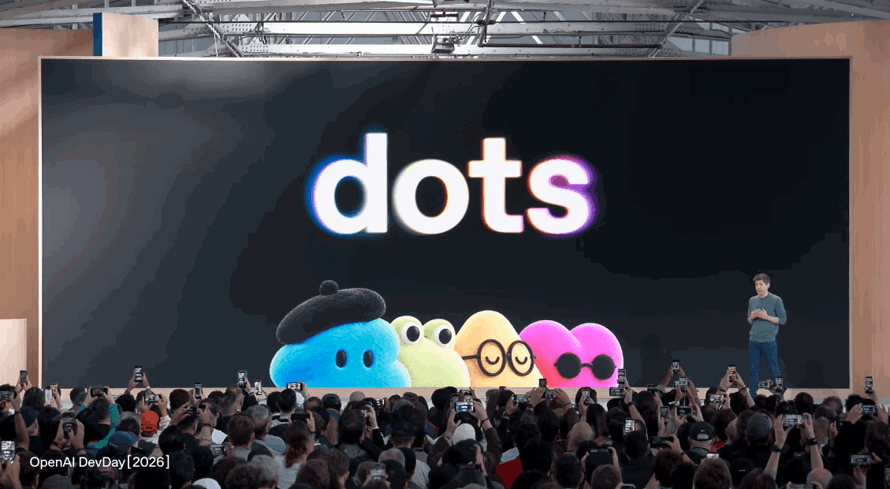
The artificial intelligence space has been buzzing with speculation for months about what comes next after the initial wave of conversational chatbots. Now, OpenAI has officially pulled back the curtain on a project that many in the developer community have been waiting for: a new class of always-on, background-capable AI agents internally codenamed “Dots.” Unlike the typical large language model interaction that requires a user to type a prompt and then wait for a response, these agents are designed to sit quietly in the background, observe contextual signals, and act autonomously when conditions are met.
What makes Dots different from the existing GPT-powered automations is the shift from reactive to proactive behavior. In a technical brief shared with select enterprise partners last week, OpenAI described Dots as persistent micro-agents that can monitor workflows, manage scheduled tasks, and even coordinate between multiple software services without needing a human to initiate every single step. The core idea is to reduce the cognitive load on users by handling routine digital labor in the background, surfacing results only when something requires attention.
How Dots Are Built to Function in the Background
According to the documentation, each Dot operates as an isolated process with scoped permissions. They do not have blanket access to a user’s entire device or cloud account; instead, they rely on an API layer that enforces strict boundaries. When a Dot is assigned a task—say, monitoring a shared project board for deadline changes—it subscribes to relevant data streams, evaluates incoming information against predefined rules, and executes micro-actions such as sending notifications, updating calendar entries, or flagging anomalies.
The architecture leans heavily on what OpenAI calls “contextual grounding.” Before taking any action, a Dot cross-references recent conversation history, recent file activity, and user-defined preferences stored in a lightweight local cache. This prevents the agent from acting on stale information or making decisions based on outdated context. For developers integrating Dots into their own applications, OpenAI has released a preliminary SDK that supports event-driven triggers and rollback mechanisms, ensuring that if an agent makes an incorrect move, the system can revert the change and log the incident for review.
Enterprise Use Cases and Early Adopters
While OpenAI has not publicly named specific companies using Dots in production, the brief highlights three primary scenarios where the technology is already being piloted. The first is customer support triage, where a Dot can read incoming ticket queues, classify urgency based on historical resolution times, and pre-populate response templates for human agents. The second involves research assistance: a Dot can continuously scan internal knowledge bases for policy updates and summarize relevant changes in a daily digest. The third is personal productivity, where a Dot manages email prioritization, travel itinerary adjustments, and expense report reminders.
Early feedback from beta testers suggests that the most significant hurdle is not technical capability but trust calibration. Users need to understand exactly what a Dot is allowed to do before it starts acting. OpenAI appears to be addressing this with a “visibility dashboard” that logs every autonomous action in real time, complete with confidence scores and the reasoning chain that led to the decision. This transparency layer is crucial for adoption in regulated industries such as healthcare and finance, where audit trails are non-negotiable.
Privacy, Security, and the Always-On Debate
The always-on nature of Dots naturally raises questions about privacy. OpenAI has stated that all background processing occurs within an encrypted sandbox, and that no data is used to train public models unless the user explicitly opts in. Nevertheless, the concept of an AI agent watching and waiting is unsettling to some privacy advocates. The company is positioning Dots as an opt-in feature for its ChatGPT Team and Enterprise tiers, with granular controls allowing administrators to disable specific capabilities, such as file access or cross-application communication.
Security researchers have pointed out that persistent agents could become attractive targets for prompt injection or data exfiltration if the sandbox is compromised. In response, OpenAI emphasized that Dots run on a separate execution layer with hardware-enforced isolation, and that any anomalous behavior triggers an automatic quarantine. Whether these safeguards will satisfy enterprise security teams remains to be seen, but the initial architecture suggests a serious attempt to balance utility with risk mitigation.
What This Means for the Broader AI Ecosystem
The launch of Dots signals a strategic pivot for OpenAI from pure conversational interfaces toward ambient computing. If these agents prove reliable at scale, they could accelerate the shift toward “invisible” AI—systems that handle complexity without demanding constant user attention. Competitors in the space, including Google’s Gemini extensions and various open-source agent frameworks, will likely feel pressure to match this level of background autonomy. For now, Dots are available only through a limited preview, but the roadmap indicates a broader rollout to individual subscribers later this year, contingent on safety evaluations and user feedback.
Developers watching the space should keep an eye on the SDK changelog and the accompanying policy updates. The boundary between helpful automation and intrusive surveillance is thin, and how OpenAI navigates that line with Dots will probably determine whether this becomes a standard feature or a cautionary tale in the evolution of personal AI.