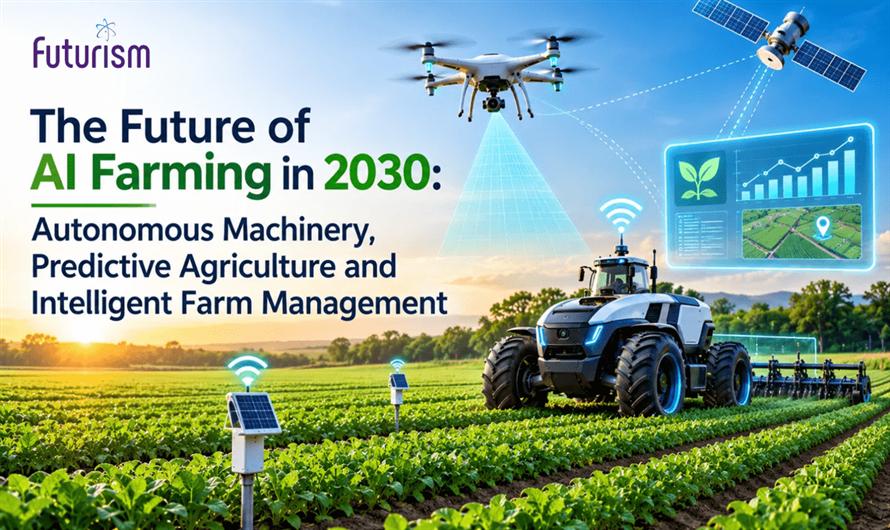
The future of AI farming through 2030 is likely to be shaped by more commercially available autonomous machinery, wider use of AI-based advisory tools, better integration of drone, satellite and sensor data, and cautious but growing use of digital twins. Not every technology will mature at the same pace. Some, such as targeted spraying and AI advisory apps, are already in use at scale. Others, like fully autonomous harvesting across many crops and farm-wide digital twins, remain at earlier stages. This article separates what is deployed today, what is emerging in research and what is projection, so that predictions are not mistaken for outcomes.
The Current Baseline: AI Farming Trends in 2026
Deployed commercially. Targeted spraying is a clear example. John Deere reported that See & Spray was used on more than five million acres in 2025, with an average reduction in non-residual herbicide of nearly 50 percent. Autonomous and driver-optional tractors are now being sold for specific uses. Kubota presented a commercially available autonomous narrow tractor, developed with Agronomy, for vineyards and orchards at CES 2026, and AGCO reported full commercial launch of its Outrun retrofit system for tractors this year. U.S. Sugar was reported in May 2026 to have launched what was described as the largest commercial autonomous tractor fleet in the American sugar industry. In greenhouses, Eternal.ag's autonomous tomato harvesters have been deployed at Van Noord Growers in the Netherlands.
Government and advisory platforms. In India, Kisan e-Mitra had answered more than 93 lakh queries by December 2025, and Maharashtra's MahaVISTAAR app has passed three million downloads, with photo-based pest and disease identification now added. Maharashtra announced an AI agriculture policy for 2025 to 2029 with an allocation of nearly Rs 500 crore. As of February 2026, over 8.48 crore farmers have been given digital IDs under Agri Stack, which links farmers to land records and crops sown.
Research and early deployment. Digital twins, advanced robotic harvesting for delicate crops and generalist farm robots are active research areas with limited commercial use.
Emerging Trends to Watch
AI-Based Crop Monitoring and Disease Detection
Models are becoming more accurate and more practical in the field, but a gap remains between benchmark scores and real-world performance. Expect progress in region-specific datasets, explainable outputs, on-device processing for areas with weak connectivity, and tighter links between detection and advisory systems. Expert confirmation will remain important for treatment decisions.
Autonomous Tractors and Intelligent Machinery
Autonomy is advancing first in structured, repetitive tasks such as tillage, mowing, spraying and grain cart operations, and in specialty crops with consistent row layouts. Retrofit kits suggest a route where existing machinery gets autonomy features, which may broaden access. Adoption on very small, irregular fields will depend on cost, safety rules and suitable machine designs.
Robotic Harvesting and Computer Vision
Harvesting is the hardest problem because robots must perceive ripeness, reach fruit and handle it gently. Greenhouse crops such as tomatoes, grown in controlled and standardized conditions, are leading. Wageningen's fourth Autonomous Greenhouse Challenge in 2024 deliberately used dwarf tomato, a crop well suited to robotic harvesting, which shows how crop design and robotics may develop together. Open-field fruit harvesting by robots is likely to remain limited to specific crops and settings through 2030, though that is a projection.
Integration of Drones, Satellites and IoT
The direction of travel is toward fewer isolated tools and more connected platforms that combine imagery, sensors and machine data. Standards work by bodies such as the ITU/FAO Focus Group on AI and IoT for Digital Agriculture aims to support interoperability and ethical use. Progress will depend on suppliers adopting open interfaces.
Predictive Models for Yield, Weather Risk and Planning
Yield prediction, weather risk analysis and planning tools will continue to improve with more data and better models. FAO's 2026 work on digital solutions for disaster risk highlights AI, satellite monitoring and mobile advisory tools as ways to anticipate risks before they escalate. The caution is that models trained on past conditions can struggle with unprecedented weather, so uncertainty will remain.
Smart Irrigation and Nutrient Management
As water pressure grows, with agriculture accounting for about 71 percent of global freshwater withdrawals, sensor-based irrigation and variable-rate nutrient application are expected to expand, especially in water-scarce regions and high-value crops. Economic reviews note that precision tools gain value as resources become scarcer.
Digital Twins and Simulation
A digital twin is a virtual model of a farm or field kept up to date with live data, used to test scenarios before acting. A 2026 review in Agriculture examines their promise alongside scientific and practical constraints, and a scoping review of AI-enabled digital twins found that most experiments are in controlled environments or small-scale field trials, with long-term evaluations across full seasons being rare. Between now and 2030, expect pilots, research and greenhouse or high-value applications rather than routine use on typical farms.
Livestock Monitoring and Greenhouse Automation
Livestock sensors and computer vision will keep moving from research to commercial tools, with validation across farms as the key hurdle. Greenhouse control by AI has shown promise in controlled trials, where AI-supported teams outperformed human-operated reference greenhouses, and is likely to spread in high-tech protected cultivation first.
Smallholder and Commercial Agriculture: Different Paths
For smallholders, advisory apps, shared drone services, cooperatives and public digital infrastructure are the most likely routes. India's average holding of about 1.08 hectares means shared and service-based models will matter. Commercial farms are more likely to adopt autonomous machinery, integrated platforms and, in some cases, digital twins.
For readers planning ahead, precision agriculture and autonomous farming approaches show how monitoring and machine automation can be combined in stages, which suits both large and growing operations.
Investment and the Agri-Tech Ecosystem
Investment is flowing into agricultural robotics, data platforms and AI advisory services. Maharashtra's conference on AI in agriculture and its policy with partnerships including the World Bank and Wageningen University and Research indicate public-sector interest in building ecosystems, not just apps. Investors and farmers alike should look for evidence of real-field performance, clear business models and data governance.
Challenges Through 2030
- Affordability: upfront costs and subscriptions can exclude small farms.
- Data privacy and ownership: a 2025 review found no legal framework explicitly grants farmers ownership of non-personal farm data.
- Regulation: rules for drones, autonomous vehicles and chemical application vary and may change.
- Connectivity: weak rural networks limit cloud-dependent tools.
- Skills and training: farmers and workers need practical support.
- Reliability and safety: machines must work in messy, variable conditions.
Skills and Education
Demand will grow for professionals who combine agronomy with data, engineering and machine operation: agronomists who can interpret model outputs, technicians who maintain sensors and robots, data specialists who understand farm contexts, and extension workers who can translate digital advice. Agricultural universities and vocational programmes are likely to add or expand courses in these areas, though the pace will vary by country.
Predictions for 2030 (Projections, Not Certainties)
The following are reasoned projections based on current trends, not confirmed outcomes:
- Targeted spraying and AI-based advisory tools will likely be common in mid- to large-scale row-crop farming and in national extension systems.
- Autonomous tractors and retrofit kits will probably expand in orchards, vineyards, sugar and large-scale arable settings, with slower uptake on small, fragmented holdings.
- Robotic harvesting is likely to spread first in greenhouses and specific high-value crops.
- Digital twins are likely to remain mostly in pilot and research stages for typical farms, with growth in controlled environments.
- Climate-resilience tools, including forecasting and risk advisories, will probably become more embedded in agricultural services, but impact will depend on whether farmers can act on the information.
How Agricultural Businesses Can Prepare
- Build a clean, consistent data foundation now.
- Pilot one or two technologies tied to measurable problems.
- Insist on open data formats, clear ownership terms and local support.
- Train staff and name someone responsible for technology.
- Review results each season and update plans, rather than committing to a single long-term bet.
- Watch regulation and standards, especially for drones and autonomous machinery.
Conclusion
The future of AI farming is neither a sudden transformation nor a distant promise. It is a steady expansion of tools that are already proving useful, alongside research that may or may not reach farms at scale. Businesses that prepare their data, test carefully and stay realistic about what is deployed versus projected will be best placed to benefit through 2030.
Frequently Asked Questions
Will autonomous tractors be common by 2030?
They are likely to be more common in structured, high-value or large-scale settings, but widespread use on small, irregular fields is less certain.
What is a digital twin in agriculture?
It is a virtual model of a field or farm that is updated with real data and used to test scenarios. Most current uses are in research and controlled environments.
Which AI farming technologies are already commercial?
Targeted spraying, drone mapping, soil moisture sensing, advisory chatbots and some autonomous tractors and greenhouse harvesters are in commercial use today.
Will AI replace farmers?
No evidence suggests this. Automation changes tasks and skills, but farmers and workers still make strategic decisions, supervise systems and manage exceptions.


Leave a Comment