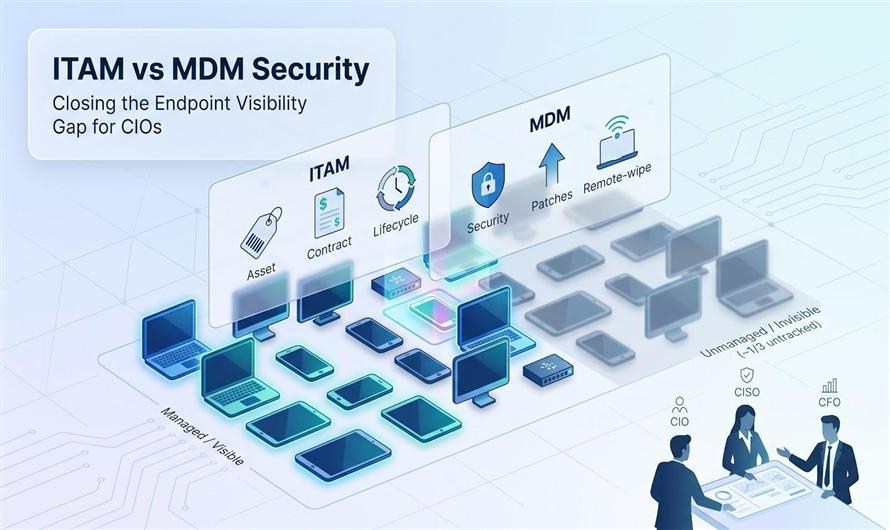
Buying an “all-in-one” security suite feels efficient—until you discover that 32.5 percent of endpoints remain invisible to IT. Palo Alto Networks uncovered that gap in a 27-million-device study. Flexera’s 2025 State of ITAM survey echoes the blind spot: only 43 percent of teams report full asset visibility.
IT asset management (ITAM) and mobile device management (MDM) solve different halves of the problem. ITAM proves what exists and who owns it, while MDM proves each device is configured, encrypted, and enforceable right now. The five questions that follow turn that distinction into a board-ready scorecard.
IT asset management vs. MDM security: 5 questions every CIO must ask
Nearly one-third of the 27 million devices Palo Alto Networks analyzed in 2025 operated outside IT control, and only 43 percent of teams told Flexera they had full visibility across their stacks. Those gaps prove that the first mistake is asking the wrong question, not choosing the wrong tool.
IT asset management (ITAM) answers What do we own, who has it, and where is it in its lifecycle?
Mobile device management (MDM) answers Is this device configured, compliant, and enforceable right now?
Treat them as complements rather than competitors; when you layer them, you unite governance with real-time control. The five questions that follow show where ITAM, MDM, or both belong in your operating model, and where risk still hides.
ITAM vs. MDM security in 60 seconds
In most boardrooms the CFO asks, “Can we prove every laptop exists?” while the CISO asks, “Can we lock any endpoint right now?” Answering both questions starts with knowing the difference between IT asset management (ITAM) and mobile device management (MDM), and why they work better together than apart.
ITAM is the authoritative record of what exists, who owns it, and where it sits in the lifecycle.
MDM is the live control plane that enforces policy, encryption, updates, and remote wipe.
Blend them and you cover governance and real-time defense; miss either layer and security gaps appear quickly.
The matrix below decodes each platform’s strengths and the security outcome you should test.

| Capability | ITAM / lifecycle platform | MDM / unified endpoint management (UEM) | Why it matters |
| Broad asset inventory | Tracks laptops, monitors, docks, contracts | Sees only enrolled devices | One source lists everything; the other confirms what checks in |
| Owner + custody history | Full assignment timeline | Current user only | Auditors need past custodians, not just today’s login |
| Cost, warranty, depreciation | Native fields | Rarely present | Finance still cares after a laptop is wiped |
| Zero-touch enrollment | Orchestrates purchase and shipping | Executes OS-level enrollment | Both steps must finish before an employee logs in |
| Encryption enforcement | Records status | Pushes policy, holds keys | Evidence without control is a paper shield |
| Patch and OS controls | Flags gaps | Installs and verifies updates | Visibility plus action closes the loop |
| Remote lock/wipe | Opens the ticket | Sends the kill command | Proof of wipe needs both the command and the custody record |
| Secure disposal | Stores erase certificates | Can only wipe the drive | Physical destruction still happens in the warehouse |
Every row links a governance requirement to a technical control. When you evaluate vendors, test each pairing end to end; if the chain breaks (for example, the tool wipes but fails to log custody), you know exactly where risk sneaks back in.
Question 1 – Can we account for every device and prove its chain of custody?
Coverage is step one in security. Palo Alto Networks found that 32.5 percent of enterprise devices operate outside IT control, creating dead zones where policy cannot reach. Until that gap closes, every other safeguard plays catch-up.
Start with a strict definition of “device.” It includes the laptop an employee boots, the dock under the monitor, the phone in a contractor’s pocket, the switch at a branch office, and the spare MacBooks in a warehouse. If it can store data or touch your network, it belongs in one authoritative record.
That record lives in ITAM. One serial number equals one immutable entry plus every hand-off that follows: procurement, assignment, repair, return, resale, or certified destruction. Those breadcrumbs turn audit finger-pointing into evidence: Who had this MacBook on April 3? Was it wiped before litigation hold?
MDM alone cannot deliver that history. It sees only what checks in, and stale records vanish after weeks of silence. Unenrolled hardware looks identical to stolen hardware, because both disappear from the dashboard. An effective ITAM solution should plug into the MDM so every laptop keeps a continuous custody record from purchase to zero-touch enrollment and all the way through disposal. Allwhere's IT asset management platform integrates with Intune and Jamf, streamlining procurement, storage, deployment, and retrieval in a single dashboard. Many teams add that kind of lifecycle layer around Intune or Jamf so shipping, retrieval, and disposition events sync back to the MDM without duplicating controls.
Quick diagnostic: pull 100 random asset tags and trace each across ITAM, MDM, EDR, and HR. Tally duplicates, stale entries, and mismatched custodians. If the list surprises you, you do not own your fleet; you only hope you do.
Question 2 – Can the platform enforce security, or does it only report risk?
An unencrypted laptop reports a problem; a capable MDM fixes it by forcing encryption at the next check-in. That action gap decides whether a tool belongs in your security stack or on a shelf.
Picture a lost MacBook in a taxi. ITAM proves the company owns the device, but containment depends on MDM. If the platform enforces FileVault, revokes credentials through conditional access, and issues a remote lock within minutes, the incident stays confined to one laptop, not the finance database. If it only flags missing encryption, you start drafting breach notifications.
Enforcement goes beyond drive encryption. A solid MDM:
- Pushes OS and application patches within defined windows.
- Blocks jailbreaks and rooted phones before they sync corporate mail.
- Applies screen-lock timers that balance security with usability.
- Streams compliance signals into identity platforms so risky devices lose access automatically.
Now turn the lens on the tool itself. An MDM is a privileged control plane; if attackers breach it, they inherit fleet-wide power. Require phishing-resistant MFA, granular roles, just-in-time elevation, and audit logs that never expire. Ask vendors how quickly they patched the CVE-2026-1281 and CVE-2026-1340 Ivanti Endpoint Manager Mobile vulnerabilities, both scored 9.8 critical, rather than how quickly they plan to patch.
Run a tabletop exercise. Declare a laptop missing and track how many clicks, and how many minutes, pass before the endpoint is locked, the user is blocked, and proof lands in your ticketing system. The shorter that loop, the safer your company.
Question 3 – What happens at every high-risk lifecycle transition?
Risk spikes whenever a device changes state: purchase, shipping, hand-off, repair, or retirement. Each hand-off can break both technical policy and physical custody if your systems fall out of sync.
Onboarding. A new hire receives a shrink-wrapped MacBook at home on day one. Procurement tags the serial number. ITAM marks it “in-transit,” and the MDM profile applies the security baseline before the employee opens Slack. When those steps fire in sequence, you start with evidence, not assumptions.
Offboarding. HR sets a termination date. IAM disables credentials at midnight. MDM locks the laptop and wipes corporate data at first check-in. ITAM triggers a return kit, tracks carrier scans, and logs the receipt. An ITAD partner then erases the drive and uploads a certificate. A 2025 Blancco survey found that up to 47 percent of devices destroyed for security reasons were still fully functional, showing how easily the chain can break if processes stall.
Most custody failures occur when one system waits for another. Wire HRIS, ITAM, MDM, and logistics into a single event stream so one employment change ripples through access, configuration, shipping, and evidence in real time. If a vendor needs nightly CSV exports to close the loop, move on.
Field test. Offboard a departing salesperson during a live demo. The laptop should lock, the return label print, and the asset status flip to “in-transit” before the meeting ends. Real platforms treat lifecycle transitions as predefined plays, not post-incident homework.
Question 4 – Can we produce audit-ready evidence, not just a dashboard?
Auditors do not screenshot dashboards; they archive exports. They need to know who owned a device on June 30, when encryption turned on, which admin approved an exception, and how the laptop was wiped before resale.
That proof requires both layers. MDM records technical posture at every check-in, while ITAM preserves the assignment trail, shipment scans, and disposal certificates. Together they satisfy CIS Control 1 and the device-tracking clauses of ISO 27001 Annex A.
Regulation raises the stakes. Under the U.S. SEC cyber-disclosure rule adopted July 26, 2023, public companies must decide incident materiality and, if material, file Form 8-K within four business days. A queryable asset register cuts scoping from days to minutes because investigators can pull all finance laptops touching the breached system instantly.
Evidence also needs staying power. Many MDM consoles purge inactive devices after 90 days to stay responsive; statutory retention can run three years or more. Your ITAM layer should archive indefinitely, or at least meet regional accounting and privacy laws.
Field test for vendors: ask, “Export every Windows and macOS device assigned to finance on June 30—include encryption state, last check-in, and disposal status.” Time how long it takes to receive a tamper-evident file. If the reply involves professional services, custom SQL, or polite apologies, keep shopping.
Question 5 – Will integration reduce risk and cost, or create another stale database?
Swivel-chair sync is expensive. HR terminates an employee, yet the laptop stays active in MDM for weeks. Finance closes the books, but ITAM still lists a five-figure fleet. The root cause is usually a one-way connector that pushes data nightly and never reconciles conflicts.
You need live, bidirectional streams instead. HRIS supplies start dates and terminations; MDM returns compliance status; EDR flags threats; logistics posts carrier scans; ITAM normalizes everything, removes duplicate serial numbers, and fixes field conflicts automatically. Anything less nurtures duplicate records. Stratix’s 2026 State of MDM survey found that only 16 percent of organizations run a single endpoint-management platform; the average is three, so data clashes are the norm. Ask each vendor to diagram its integration model (native connector, low-code workflow, or API only) and to disclose event latency, rate limits, error alerts, and per-call costs. “Open” APIs that bill per endpoint can ruin a budget faster than a breach.
Proof arrives in a pilot. Import a live subset of devices, reconcile records across three systems, and watch for orphans. Simulate a name change, a stolen phone, and a contractor offboard. The winning platform updates everywhere within hours and flags mismatches automatically; losers leave you exporting CSVs on Friday night.
Look past license fees. Total cost includes connector charges, re-enrollment labor, shipping, warehousing, and the manual-fix budget. If a quote hides those lines, expect them later in professional-services hours.
CIO scorecard – how to compare the shortlist
A clear rubric beats gut feel when you need to defend a multi-year contract at the board meeting. The 100-point model below weights each area by its impact on security and cost.
| Criterion | Weight | What you measure |
| Security enforcement depth | 25 | Can the tool lock, wipe, patch, and block access without manual follow-up? |
| Coverage breadth & inventory accuracy | 20 | Are all assets—managed or not—visible and reconciled? |
| Lifecycle & chain-of-custody assurance | 20 | Can you trace every hand-off from purchase to destruction? |
| Audit evidence & compliance support | 15 | Will exported logs satisfy auditors, regulators, and legal counsel? |
| Integration & data quality | 10 | Are connectors live, bidirectional, and self-healing? |
| Three-year TCO & operational usability | 10 | What is the total cost once shipping, storage, and admin time hit the spreadsheet? |
Scoring scale: 0 = absent, 1 = manual, 2 = partial, 3 = meets requirement, 4 = automated, 5 = independently evidenced.
Set non-negotiable red lines. If a platform cannot prove authoritative inventory, enforce encryption, retain historical logs, or protect admin access with phishing-resistant MFA, end the conversation regardless of price.
Run the rubric in a two-week pilot with production data and share the scores. When numbers speak, politics quiet down and the right platform wins on merit, not marketing.
Conclusion: The decision is usually an operating model, not ITAM or MDM
Scorecards often show an inconvenient truth: your two finalists solve different problems. That result is not a failure; it points to the operating model you need.
- MDM-first works for small, corporate-owned fleets that are 99 percent enrolled. Watch the blind spots; peripherals, cost tracking, and offboarding may still live in spreadsheets.
- ITAM-first suits organizations where budgets, contracts, and audit trails drive risk decisions. You gain lifecycle clarity across laptops, servers, and warehouse stock, but without an enforcement layer you cannot lock a stolen laptop on the Newark train.
- Integrated is the norm. Stratix’s 2026 State of MDM survey found that 84 percent of firms use more than one endpoint-management platform, so most enterprises pair ITAM for ownership records, MDM or UEM for real-time control, and identity platforms as the access gatekeeper.
Suites that promise everything under one logo work only when data reconciliation is tested as hard as feature lists. A unified dashboard means little if the macOS agent trails the Windows agent by six months or if lifecycle dates disappear during an upgrade.
Choose the model first, then the tools. Assign clear owners for governance (ITAM), enforcement (MDM/UEM), and identity, and verify the data flows in a pilot. When each owner can prove their link in the chain, security turns into routine rather than a last-minute scramble.


Leave a Comment