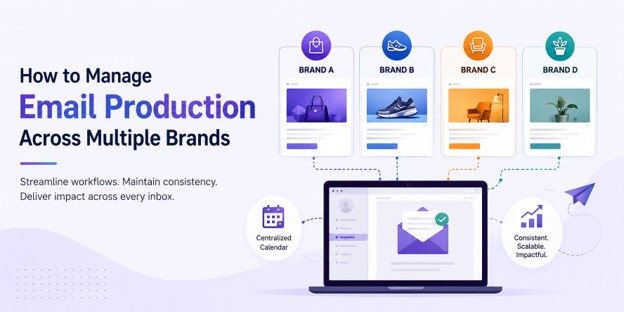
Running one email program well is hard enough for many businesses. No matter whether you run 4 or 10 emails for different brands, each has its own unique voice. Agencies handling email marketing campaigns can relate to how hard it is.
In this blog, we will discuss how to make the correct approach for multi-brand email marketing without losing brand consistency and adapting the best practices that keep things correct in the long run.
Understand the Challenges of Multi-Brand Email Production
It is necessary to understand the significant challenges that brands actually face during multi-brand email production. Understanding this helps you understand why these happen and how they can impact the brand.
| Challenges | Root Causes | Impact On the Brand |
| Inconsistent design | Each brand team builds templates from scratch, in isolation | Subscribers get a different visual experience from every brand |
| Approval bottlenecks | Sign-off routes through different stakeholders for each brand | Campaigns miss send windows and seasonal relevance |
| Scattered data | Separate lists, tools, or platforms per brand | No single view of subscriber overlap or fatigue |
| Resource strain | One production team supports several sending calendars | Rework and rushed QA replace proper testing |
Each of these challenges requires a proper and deliberate operational strategy. When designers need to start building email templates from zero, they actually waste time that could be used to improve email messages and make campaigns work better. Also, when one person has to check emails for different brands, it takes longer to get approvals, which slows down all the campaigns waiting to go out.
When these problems happen over and over for brand calendars, email production management stops being just a small problem. It turns into something that limits growth. This causes campaigns to miss their send dates, promotions to become old, and chances to make money to be lost.
How to Manage Email Production for Multiple Brands
A working system for multi-brand email really comes down to three things. The team managing the campaigns needs one calendar everyone can actually see.
Source - ChatGpt
One template foundation that every brand can easily adapt without starting things from scratch. Similarly, they need another approval path; hence, teams can proceed with the work without waiting for further approval.
Centralize the Brief and the Calendar
Put every brand's send dates, offers, and owners in one shared calendar instead of five separate spreadsheets nobody checks consistently. That single move actually saves most of the last-minute rework, and it finally gives production staff a real view of what's coming before it lands in their inbox unannounced.
A cloud-based approach to campaign scheduling helps here too. Automated scheduling and follow-ups free up additional production time and allow teams to use that time behind multi-brand email campaigns.
Start Working With the Template
When it comes to seamless email workflow management, designers must focus on working on the email templates. Doing it each time from scratch quietly takes away a lot of production workflow hours quietly. This is the problem that the tool Stripo was built to solve. Instead of starting a new template every time, it assists brands by offering brand-specific modules that are pre-designed with headers and footers inside one shared library.
This is an easy-to-use email tool that allows designers to spend their time on what actually changes between brands: the offer, the copy, and the imagery, instead of rebuilding templates from scratch.
Example: Real estate company Engel & Völkers introduced the best-governed marketing templates that allowed local teams to personalize their email campaigns without rebuilding assets or violating brand guidelines. This helped to receive marketing outputs while keeping every asset aligned with the corporate standards.
Set a Clear Approval Matrix
Every brand needs a named approver, a review window with a real deadline, and a backup approver for when the first one is on leave or just slow to respond.
Modern AI-assisted tools can help production teams hold the right tone for each brand without starting research from scratch every time, something covered in more depth in this breakdown of AI-powered email marketing software.
Best Practices for Scaling Multi-Brand Email Operations
When you decide to manage email campaigns across multiple brands, you need to adopt some best practices. It includes ideal delivery methods, one centralized space for everything, and personalization. Opting for these best practices allows teams to connect with the potential customers of a brand while delivering the ideal experience when the email program gets bigger.
Centralize Email Governance with Brand Flexibility
Email workflow management requires an effective approach. Start by creating a shared framework where multiple templates, approval systems, compliance checks, and exclusive design systems can be easily maintained for each brand. This allows you to maintain a unique brand voice, clear messaging, and visual identity. This ensures consistency without sacrificing brand differentiation.
Automate Reusable Workflows and Templates
Automating reusable content and templates that incorporate customer journeys is an easy way to adapt, especially when email campaigns run across multiple brands. This reduces production time while minimizing manual human errors and enables marketing teams to launch campaigns more efficiently.
Scale Gradually While Maintaining List Quality
Increase sending volumes progressively. A genuine allowlist of consumers and controlled scaling improve inbox placement while protecting long-term sender reputation across every brand.
Beyond adapting best practices, doing the fundamentals correctly is also necessary for a seamless email marketing workflow. Reading the guide on framing emails correctly is still a useful baseline to hold every brand's emails accurately, no matter how many are running at once.
Conclusion
A multi-brand email ecosystem becomes easier by cutting the repeated processes and avoidable work. When you centralize the work that should be shared, you can successfully continue the email campaigns that make each brand distinct. Consider the entire email production workflow and proceed with the work without any errors.


Leave a Comment