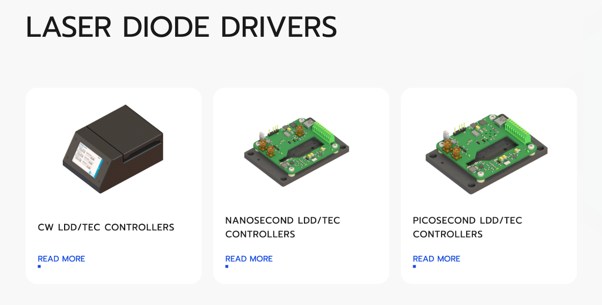
Feeding the wrong amount of current into a high-performance optical component is a fast ticket to an expensive hardware failure. Laser diodes notoriously despise current spikes, thermal fluctuations, and careless handling, turning subtle shifts in voltage into total operational instability. Solving this fragility requires specialized laser drivers capable of stabilizing current flows while actively managing thermal thresholds behind the scenes.
Engineers working across complex optical environments know that even the most advanced semiconductor cannot perform without robust, intelligent power regulation. Modern electronic architectures must deliver surgical precision whether handling continuous wave setups or ultra-short pulse generation.
Operational Modes and Engineering Adaptability
Different applications demand wildly divergent current profiles, pushing hardware manufacturers to design versatile control units. Contemporary systems must seamlessly switch between steady-state operation and high-speed temporal modulation without introducing noise.
- Constant current delivery ensuring stable, continuous optical output for sensitive measurements
- Nanosecond pulse optimization tailored for advanced LiDAR and distributed sensing arrays
- Picosecond modulation capabilities designed specifically for precise gain-switching applications
Ultimately, mastering this multi-mode adaptability guarantees that electronic controllers can support diverse optical architectures without sacrificing output stability.
Software Integration and Usability
Beyond raw power delivery, modern control units rely heavily on software ecosystems to simplify benchtop testing and system integration. Having direct access to graphical user interfaces, along with robust LabView and Python libraries, transforms how engineering teams calibrate their optical layouts.
Compact Architecture and Thermal Management
Packing complex circuitry into tight spaces often creates severe overheating issues that degrade laser lifetime. High-end controllers bypass this by utilizing integrated thermoelectric cooler architectures paired with compact 14-pin or 10-pin butterfly mounts. Modern engineering teams depend on sophisticated hardware layouts that seamlessly combine robust heat dissipation with advanced digital connectivity, ensuring uninterrupted performance under heavy workloads:
- All-in-one enclosures combining current regulation and TEC cooling into a single footprint
- Flexible communication interfaces including USB, RS-232, and CAN protocols
- Factory pre-assembled fiber-coupled options designed for immediate plug-and-play deployment
When your next optical setup demands absolute current stability, flexible software control, and rugged thermal management, Innolume GmbH delivers precision-engineered hardware built for demanding technical environments.


Leave a Comment
1 Comments