There is a specific kind of confidence that comes from shipping software you actually trust.
Not the confidence that comes from hoping nothing breaks. Not the confidence that comes from telling yourself the team reviewed the code carefully. The kind that comes from knowing the pipeline ran tests that would have caught the most likely failure modes before anything reached production.
That kind of confidence is not automatic. It does not come from having CI/CD in place. It does not come from having automated tests. It comes from having regression testing that is actually designed to catch what breaks, not just tests that run.
Most engineering teams have CI/CD. Fewer of them have regression testing that is doing what regression testing is supposed to do. The gap between those two things is where production incidents live.
What Regression Testing Is Actually For
The name gives away the purpose. Regression testing exists to catch regressions - changes that break behavior that was previously working correctly.
This sounds simple. In practice, it is the hardest category of failure to catch because regressions are by definition invisible at the time they are introduced. A developer changes the authentication flow. The change does what it is supposed to do. The new behavior works correctly. What the developer did not see - because they were not looking at it, because it was not in the scope of what they changed - is that the modification also altered something in the session handling that affects users who authenticate through a third-party provider.
The code ships. The CI pipeline passes. A week later, support starts receiving reports from a small segment of users who cannot log in.
That is a regression. And the specific characteristic of regressions that makes them expensive is that they are not caused by things that are broken in isolation - they are caused by interactions between things that each work correctly on their own. Unit tests, which validate components in isolation, are structurally not designed to catch this category of failure. Regression testing, which validates overall system behavior across scenarios that span multiple components, is.
Why CI/CD Makes Regression Testing More Important Not Less
When teams move to continuous delivery - deploying multiple times a day rather than weekly or monthly, the conventional intuition is that regression risk decreases because changes are smaller and more incremental.
The intuition is partially right. Individual changes are smaller. But deployment frequency is higher, which means the total surface area of change arriving in production per week has not decreased, it has often increased significantly. And in a continuous delivery environment, there is no pre-release regression cycle where someone sits down and manually validates that critical behaviors still work before code ships.
In a monthly release cycle, a team could absorb a regression testing process that took two days. In a continuous delivery environment where deployments happen daily or more frequently, a two-day regression cycle is not compatible with the delivery cadence. The regression safety net has to be automated, fast, and running in the pipeline rather than beside it.
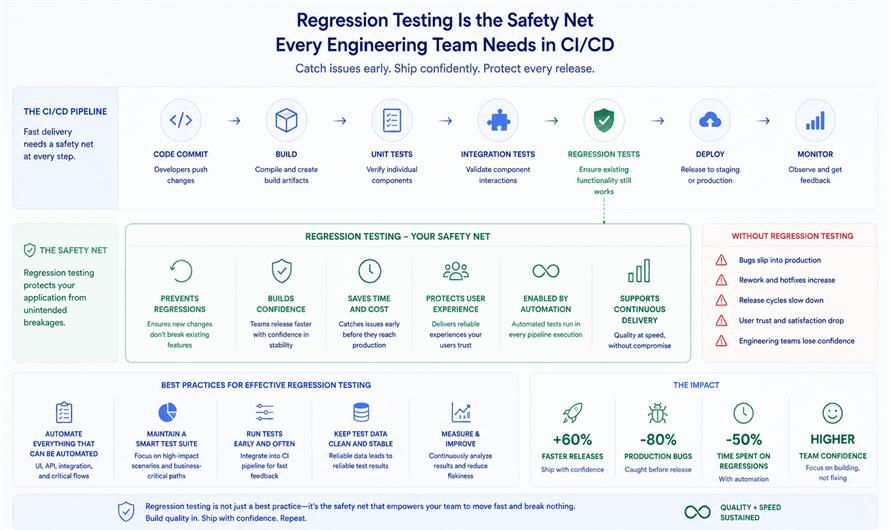
This is where teams that invested in genuine regression testing infrastructure have a significant advantage over teams that assumed CI/CD itself provides the safety net. CI/CD is a delivery mechanism. It automates the process of getting code to production. It does not, by itself, validate that what arrived in production still behaves correctly across all the scenarios that matter.
Regression testing is what validates that. And in a CI/CD environment, it has to be wired into the pipeline at the right stages to provide that validation at the pace the delivery system requires.
What Effective Regression Testing Covers
Not all regression testing is equal. A regression suite that covers the happy path for every feature is significantly less valuable than a regression suite designed around the scenarios most likely to break under realistic change conditions.
The scenarios that regression testing needs to cover fall into three categories that experienced teams learn to prioritize.
Integration points are where most regressions actually originate. When a service changes, the impact propagates to every other service that depends on it. Regression testing that covers these integration points - validating that services communicate correctly after changes, that API contracts are honored, that data flows correctly across service boundaries - catches the category of failure that is most common in distributed systems.
Edge cases that have broken production before are the next priority. Every engineering team has a mental list of things that have gone wrong in the past - specific input combinations that triggered unexpected behavior, timing conditions that caused data corruption, configuration states that produced failures under load. Regression tests that codify these scenarios are the most reliable protection against the same failure recurring.
State-dependent behaviors are the third category. Some behaviors only appear when the system is in a specific state, when a certain combination of data exists, when a background job has run, when a user has taken a specific sequence of actions. These are the hardest behaviors to test and the ones most likely to be missed by unit tests, which typically run against clean state.
How Regression Testing Fits Into the CI/CD Pipeline
Regression testing does not need to run entirely on every commit to provide its value. The pipeline architecture that keeps regression testing useful without slowing the delivery cadence down is staged.
Fast regression checks: covering the highest-risk integration points and the most commonly broken scenarios - run on every pull request. These finish in minutes. Developers wait for results. Failures here block the merge.
Broader regression coverage: covering the full scope of integration scenarios and state-dependent behaviors - runs before deployment. This stage takes longer, but it runs after the merge, not before, which keeps it from creating a bottleneck in the development workflow.
The combination keeps feedback loops short where speed matters most while maintaining comprehensive coverage before anything reaches production.
Modern tools like Keploy support this pipeline architecture by generating regression tests from real API traffic rather than from manually written specifications. When the team captures production traffic and uses it as the source for regression test cases, coverage reflects the actual scenarios the system encounters rather than the scenarios someone thought to write a test for. Those tests run in CI at the pull request stage, catching behavioral regressions before they merge, and at the pre-deployment stage, validating that nothing changed unexpectedly between merge and release.
The Safety Net Metaphor Is More Accurate Than It Sounds
A safety net in the physical world does not prevent falls. It catches them before they become catastrophic. A climber with a good safety net takes risks they would not take without one - not reckless risks, but calculated ones that are necessary to make progress.
Regression testing works the same way. It does not prevent developers from introducing regressions. It catches them before they reach production. And the confidence that comes from knowing there is a safety net changes how teams behave - they move faster, they make bolder changes, they refactor more aggressively, because they know that if something breaks, the pipeline will tell them before a user sees it.
The teams that ship fastest are not the ones that move carefully to avoid breaking things. They are the ones that move quickly and trust their regression testing to catch what breaks. Those two things - speed and confidence- are not in tension when the safety net is solid.
Building that safety net is what regression testing in CI/CD is actually for.


Leave a Comment