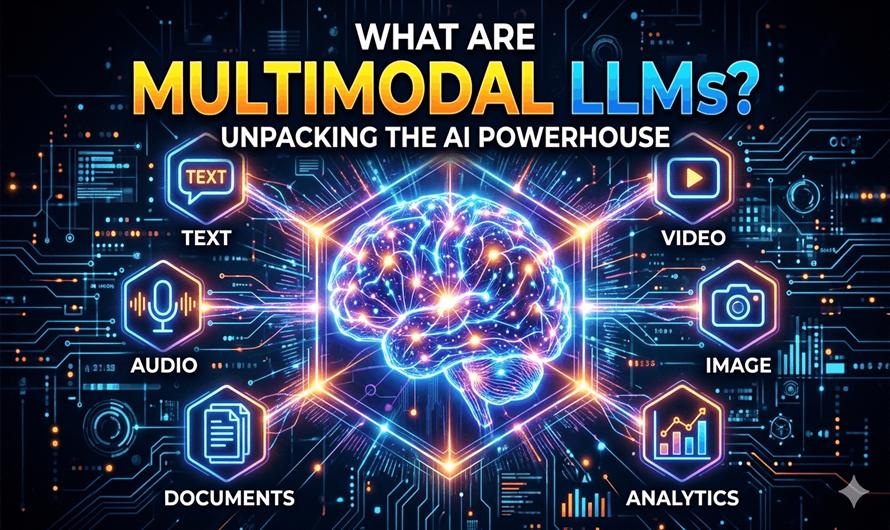
Artificial Intelligence has made remarkable progress in recent years, with Large Language Models (LLMs) such as ChatGPT, Claude, and Gemini transforming how people interact with machines. However, traditional LLMs primarily work with text. The next major advancement in AI is the development of Multimodal Large Language Models (Multimodal LLMs), which can understand and process multiple types of data simultaneously, including text, images, audio, video, and more.
In this article, we'll explore what multimodal LLMs are, how they work, their advantages, real-world applications, and why they represent the future of AI.
What Is a Multimodal LLM?
A Multimodal Large Language Model is an AI system capable of processing and understanding information from multiple data modalities. A modality refers to a specific type of input, such as:
- Text
- Images
- Audio
- Video
- Documents
- Charts and graphs
Unlike traditional language models that only analyze text, multimodal LLMs can combine information from different sources to generate more accurate and context-aware responses.
For example, instead of merely answering a text question, a multimodal model can:
- Analyze an uploaded image.
- Understand spoken instructions.
- Read a PDF document.
- Interpret charts and diagrams.
- Generate responses based on a combination of these inputs.
How Do Multimodal LLMs Work?
Multimodal LLMs use specialized encoders to convert different types of input data into a common representation that the model can understand.
The process typically follows these steps:
1. Input Processing
Different inputs are received:
- Text input
- Images
- Audio recordings
- Videos
2. Feature Extraction
Each modality is processed by a dedicated encoder:
- Text Encoder → Processes language
- Vision Encoder → Processes images
- Audio Encoder → Processes sound
- Video Encoder → Processes video frames
3. Unified Representation
The extracted features are converted into numerical embeddings and mapped into a shared representation space.
4. Cross-Modal Understanding
The model learns relationships between different modalities. For example, it can connect the image of a dog with the word "dog" and its associated sounds.
5. Response Generation
The language model combines all available information to produce an intelligent response.
Example of a Multimodal Interaction
Imagine a user uploads a photo of a damaged laptop and asks:
"Why is my laptop screen flickering?"
A multimodal LLM can:
- Analyze the image.
- Detect visible hardware issues.
- Combine image analysis with the user's text query.
- Provide troubleshooting recommendations.
- A traditional text-only model would not be able to inspect the image itself.
Key Features of Multimodal LLMs
Natural Understanding
These models process information similarly to humans by combining visual, auditory, and textual cues.
Enhanced Context Awareness
By utilizing multiple data sources, the model gains a richer understanding of the situation.
Improved Accuracy
Combining modalities often reduces ambiguity and improves response quality.
Flexible Interaction
Users can interact through:
- Text prompts
- Images
- Voice commands
- Videos
- Mixed inputs
Real-World Applications
Healthcare
Doctors can upload medical images along with patient notes to receive AI-assisted insights.
Education
Students can submit diagrams, screenshots, and questions to receive detailed explanations.
Customer Support
Businesses can allow customers to upload product images while describing issues.
Accessibility
Multimodal systems can help visually impaired users understand images and surroundings through AI-generated descriptions.
Content Creation
Creators can generate captions, summaries, scripts, and visual analysis from multimedia content.
E-commerce
AI can identify products from images and provide recommendations, pricing information, or comparisons.
Examples of Multimodal AI Systems
Several leading AI models have introduced multimodal capabilities:
- OpenAI GPT models with vision capabilities
- Google's Gemini models
- Anthropic's Claude models with image understanding
- Open-source multimodal models such as LLaVA and Qwen-VL
These systems can process text alongside visual inputs, enabling more advanced AI interactions.
Benefits of Multimodal LLMs
Better User Experience
Users can communicate naturally using multiple forms of information.
Richer Knowledge Processing
The model can interpret complex scenarios involving images, text, and audio together.
Increased Productivity
Tasks that previously required multiple specialized tools can now be handled by a single AI system.
Human-Like Reasoning
Multimodal models move closer to how humans perceive and understand the world.
Challenges and Limitations
Despite their advantages, multimodal LLMs face several challenges:
High Computational Requirements
Processing multiple modalities requires significant computing power and memory.
Data Quality Issues
Poor-quality images, noisy audio, or incomplete documents can affect performance.
Privacy Concerns
Handling images, videos, and voice recordings introduces additional privacy considerations.
Training Complexity
Collecting and aligning multimodal datasets is far more challenging than training text-only models.
The Future of Multimodal AI
The future of AI is increasingly multimodal. Researchers are working toward models that can seamlessly understand and generate information across text, images, audio, video, and even real-world sensory data.
Future systems may:
- Act as universal digital assistants.
- Understand live video streams.
- Analyze complex documents automatically.
- Interact naturally through speech and vision.
- Assist professionals across healthcare, education, engineering, and research.
As AI continues to evolve, multimodal LLMs are expected to become the standard architecture for intelligent systems, offering richer interactions and more human-like understanding.
Conclusion
Multimodal Large Language Models represent a major step forward in artificial intelligence. By combining text, images, audio, video, and other forms of data into a unified understanding, these models can solve problems that traditional text-only systems cannot.
As technology advances, multimodal AI will enable smarter digital assistants, improved accessibility, enhanced business applications, and more natural human-computer interactions. Organizations that understand and adopt this technology today will be better positioned to leverage the next generation of AI-powered solutions.


Leave a Comment