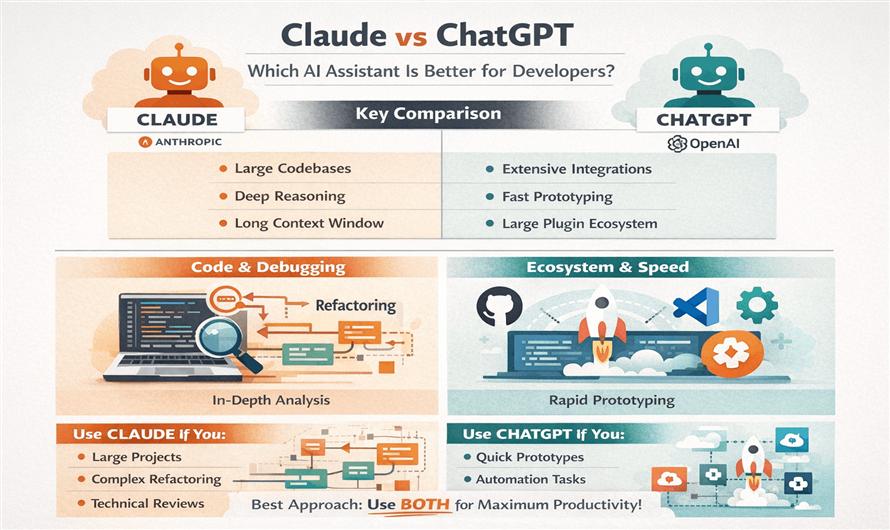
AI coding assistants have become a major part of modern software development. From generating code and debugging applications to reviewing pull requests and explaining complex architectures, tools like Claude AI and ChatGPT are changing how developers work.
But one question keeps coming up:
Which AI assistant is actually better for developers — Claude or ChatGPT?
The answer depends on your workflow, project size, coding style, and what you expect from an AI assistant.
What Is Claude?
Anthropic developed Claude AI with a strong focus on reasoning, safety, and long-context understanding.
Claude is especially popular among developers for:
- Multi-file code analysis
- Refactoring
- Long conversations
- Technical explanations
- Code reviews
Many developers describe Claude as behaving like a “senior engineer” during coding discussions.
What Is ChatGPT?
OpenAI created ChatGPT as a general-purpose AI assistant capable of:
- Coding
- Writing
- Automation
- Image understanding
- Tool usage
- Research
- Agent workflows
ChatGPT has one of the largest AI ecosystems available today, including:
- Custom GPTs
- API integrations
- Plugins/tools
- IDE integrations
- Automation workflows
For many developers, ChatGPT acts as an “all-in-one AI platform.”
Claude vs ChatGPT: Quick Comparison
| Feature | Claude | ChatGPT |
|---|---|---|
| Developer | Anthropic | OpenAI |
| Best For | Large codebases & reasoning | Ecosystem & fast workflows |
| Context Window | Very large | Large |
| Refactoring | Excellent | Very good |
| Debugging | Strong | Strong |
| Multi-file Understanding | Excellent | Good |
| IDE Integrations | Growing | Extensive |
| Plugins/Tools | Limited | Huge ecosystem |
| Writing Quality | More structured | More conversational |
| API Ecosystem | Smaller | Larger |
| Agent Workflows | Improving rapidly | Very mature |
1. Code Generation
Both tools generate high-quality code, but they behave differently.
Claude’s Approach
Claude tends to:
- Write cleaner architecture
- Follow instructions carefully
- Produce more readable code
- Handle larger implementations well
Developers often prefer Claude for:
- Backend systems
- Enterprise applications
- Refactoring
- Design-heavy logic
Several recent comparisons report Claude performing better in complex engineering tasks and SWE-bench evaluations.
ChatGPT’s Approach
ChatGPT is usually:
- Faster at generating snippets
- Better for quick prototyping
- Strong in algorithmic tasks
- Excellent for rapid iteration
It performs very well for:
- Small applications
- Frontend generation
- Quick fixes
- Automation scripts
- Learning new frameworks
Many developers use ChatGPT as a rapid coding assistant while using Claude for deeper reasoning tasks.
2. Debugging and Refactoring
This is where Claude often stands out.
Claude performs particularly well when:
- Reviewing large codebases
- Explaining bugs
- Refactoring legacy systems
- Understanding architecture dependencies
- Multiple developer reviews report Claude having stronger reasoning across multi-file projects.
ChatGPT is still excellent for debugging, especially:
- Isolated bugs
- Stack traces
- Small components
- Fast experimentation
- But for large-scale project reasoning, many developers currently prefer Claude.
3. Context Window and Long Conversations
One of Claude’s biggest strengths is handling extremely long context.
Claude can process very large codebases and documentation in a single session more effectively than many competitors.
This is valuable for:
- Enterprise applications
- Monorepos
- Large APIs
- Technical documentation
- Architecture discussions
ChatGPT also supports large context windows, but Claude is frequently praised for maintaining coherence across very long coding sessions.
4. IDE and Ecosystem Integrations
This is where ChatGPT has a major advantage.
ChatGPT integrates with:
- VS Code
- GitHub
- Automation tools
- APIs
- Custom GPTs
- External apps
- Productivity workflows
- OpenAI’s ecosystem is currently broader and more mature.
Claude’s ecosystem is growing rapidly, especially through Claude Code and API tooling, but OpenAI still leads in integration depth and developer tooling.
5. AI Coding Agents
AI agents are becoming a huge trend in software development.
Claude Code has gained strong attention for autonomous coding workflows and long-running engineering tasks.
Some developers believe Claude currently performs better for:
- Agentic coding
- Multi-step reasoning
- Autonomous refactoring
- Architecture-aware coding
However, ChatGPT’s Codex ecosystem remains extremely competitive and often offers better workflow integration.
6. Accuracy and Hallucinations
No AI coding assistant is perfect.
Both tools can:
- Generate incorrect code
- Invent APIs
- Produce security flaws
- Hallucinate functions/packages
However, many developers report Claude hallucinating fewer fake libraries in complex projects.
Still, neither tool should be trusted blindly for production deployment.
Research studies also show that AI coding tools still introduce substantial errors during long-running workflows.
7. Speed and Developer Experience
ChatGPT
Strengths:
- Faster interactions
- Better UI ecosystem
- More polished integrations
- Better multimodal tooling
Claude
Strengths:
- More thoughtful responses
- Better reasoning depth
- Cleaner explanations
- Stronger technical analysis
Some developers describe the difference like this:
- ChatGPT = fast coding partner
- Claude = senior engineer reviewer
8. Pricing and Usage Limits
Pricing changes frequently, but developers often discuss one major issue with Claude:
Claude Usage Limits
Heavy users sometimes hit Claude usage limits faster during coding sessions.
This can affect:
- Long coding sessions
- Large prompts
- Agent workflows
ChatGPT often provides more flexible usage for general coding workflows depending on the plan.
9. Community Opinions
Developer communities increasingly use both tools together instead of choosing only one.
Common workflow:
- Claude for reasoning and architecture
- ChatGPT for fast generation and integrations
- A recent research paper found that users often treat AI assistants as interchangeable tools depending on the task.
- That reflects real-world developer behavior today.
Which AI Assistant Should Developers Choose?
Choose Claude If You:
- Work with large codebases
- Need deep reasoning
- Refactor enterprise projects
- Analyze long documentation
- Want cleaner architectural thinking
- Prefer detailed explanations
Choose ChatGPT If You:
- Need broader integrations
- Want fast coding assistance
- Use automation heavily
- Build rapid prototypes
- Want multimodal workflows
- Need plugins and external tools
Final Verdict
There is no universal winner because both AI assistants excel in different areas.
Claude Wins For:
- Deep code reasoning
- Refactoring
- Multi-file understanding
- Long-context workflows
- Architecture discussions
ChatGPT Wins For:
- Ecosystem integrations
- Speed
- Automation
- Productivity workflows
- General-purpose developer tooling
For many professional developers, the best setup in 2026 is actually using both:
- Claude for engineering depth
- ChatGPT for speed and ecosystem convenience
AI coding assistants are evolving rapidly, and the gap between them continues to shrink. The best choice ultimately depends on your workflow, coding style, and development needs.


Leave a Comment