Introduction
Realism is one of the oldest and most important ideas in international relations. It helps us understand how countries act and make decisions in the global world. The theory is based on the ideas of thinkers like Thucydides, Machiavelli, and Hobbes, who believed that humans and therefore are mainly guided by self-interest and the desire for power. In my view, realism helps us see the world as it really is, full of competition and struggle for power, but it also shows that there is a little space for real cooperation and moral improvement among nations.
Core Principles
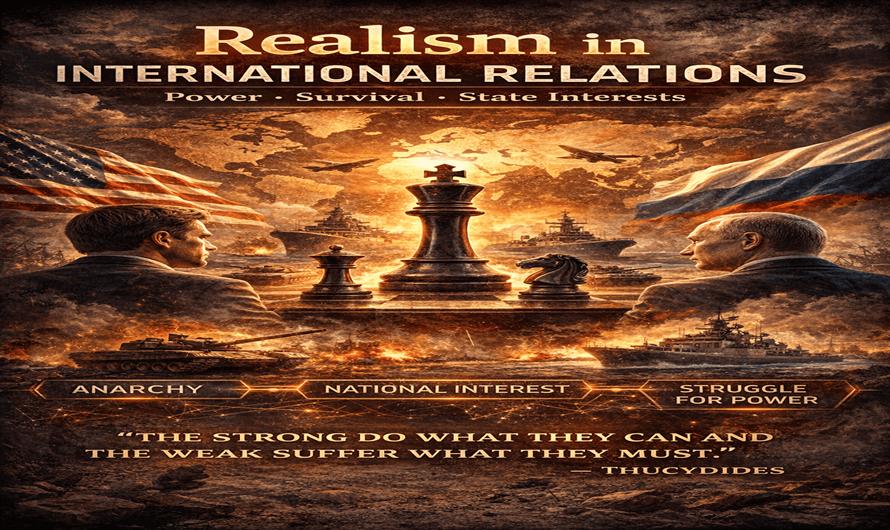
At its core, Realism is based on a simple but powerful idea: the world of international politics isanarchic. There is no world government to enforce laws or ensure peace among nations. Every country big or small must protect itself and act in its ownnational interest. This lack of an overarching authority makes survival the primary goal of every state. Countries cannot fully trust one another no matter how many treaties or peace agreements exist because circumstances can change at any time. This constant uncertainty creates competition, fear and a never-ending struggle for power.
Human Nature and Realism
Realism mirrors human nature. Just like individuals, nations too have desires, fears and ambitions. They form friendships when convenient and distance themselves when threatened. This doesn’t mean countries are evil, it means they are realistic. Realism accepts that humans are not purely moral beings and that nations will naturally act out of self-preservation as they are made by humans. Philosophers like Thucydides who wrote about the Peloponnesian War observed this truth thousands of years ago. Later, thinkers like Niccolo Machiavelli and Thomas Hobbes described the same idea that power and security come before morality when survival is at stake.
In modern times scholars like Hans Morgenthau built on these ideas and shaped what we now callclassical Realism. Hans Morgenthau argued that politics whether domestic or international is governed by objective laws rooted in human nature. He believed that nations pursue power because it is part of human instinct of the will to dominate and to survive. For me, Morgenthau’s perspective is both realistic and humbling. It reminds us that we cannot expect nations to behave like moral individuals. Just as hunger drives a person to seek food, insecurity drives a state to seek power.
For example, during the Cold War the United States and the Soviet Union constantly competed for power and influence. Each claimed to stand for peace and ideology but in reality, both were guided by national interest and the desire to maintain dominance. The formation of NATO and the Warsaw Pact were acts of Realism alliances built not on friendship but on fear and strategy. Even today, we can see Realist principles in the way countries act in global affairs. The tensions between the U.S. and China, the Russia-Ukraine conflict, or the military build-up in the South China Sea, all of these show how nations continue to act in ways that protect their power and position.
Strengths of Realism
One of realism’s biggest strengths is its truthfulness. It doesn’t make unrealistic promises about the world instead, it shows global politics as it really is full of competition, conflicts and the struggle for survival. By focusing onpower and security realism helps us understand why countries fight, form alliances or compete with each other.
Another strength is that realism encourages careful planning and strategic thinking. Since power is limited, countries cannot act recklessly. Historical examples like the Vietnam War or the Iraq War show how dangerous it is to overestimate a nation’s strength or ignore possible consequences. Realism teaches caution, preparation and awareness lessons that are useful not only for governments but also for everyday life.
Limitations of Realism
While Realism explains much about global politics, it has notable limitations. It often portrays the world as inherently conflictual and overlooks cooperation, morality, and shared progress. For example, the formation of the European Union and international efforts to combat climate change show that countries can work together effectively. Realism struggles to explain these positive developments fully.
Personally, I feel that Realism, if taken alone, can seem overly pessimistic. While it accurately describes why conflicts occur, it does not guide us toward long-term solutions or peace. Idealism and Liberalism, which emphasize trust, institutions, and ethical norms, are necessary complements.
Personal Analysis
While realism offers valuable insights into the role of power and security in international relations, I believe it is often too pessimistic and limiting. By assuming that conflict and competition are inevitable, realism underplays the potential for cooperation, trust-building and shared progress between states. In today’s interconnected world, many challenges like climate change, global health crises and cyber threats cannot be addressed through power politics alone. Therefore, I see realism as a useful starting point for understanding state behaviour, but it must be complemented by approaches that emphasize diplomacy, international law and collective problem-solving. Balancing caution with collaboration can create a more flexible and effective framework for navigating modern global politics.
Conclusion
Realism gives us a clear view of how international politics works by focusing on power, security, and national interests. It explains why countries often put survival and strategic advantage above ideals, and why conflict, competition, and alliances are common in world affairs. However, in today’s connected and interdependent world, realism alone is not enough. Issues like climate change, global health crises, terrorism, and cyber threats need countries to cooperate, negotiate, and follow international rules. A balanced approach is needed one that combines realism’s focus on power with diplomacy, collaboration, and international institutions. Knowing when to use power and when to build trust is key to maintaining stability and solving shared global problems. The future of international relations depends on understanding the limits of pure power politics while also finding ways for countries to work together, stay secure, and respond to global challenges in a fair and sustainable way.


Leave a Comment