Key Takeaways
- Platform engineering teams increasingly decide how AI agents work across the org, as well as how developers ship code.
- An agentic SDLC solution lets agents use the same catalog, standards and self-service actions developers use, with governance built in.
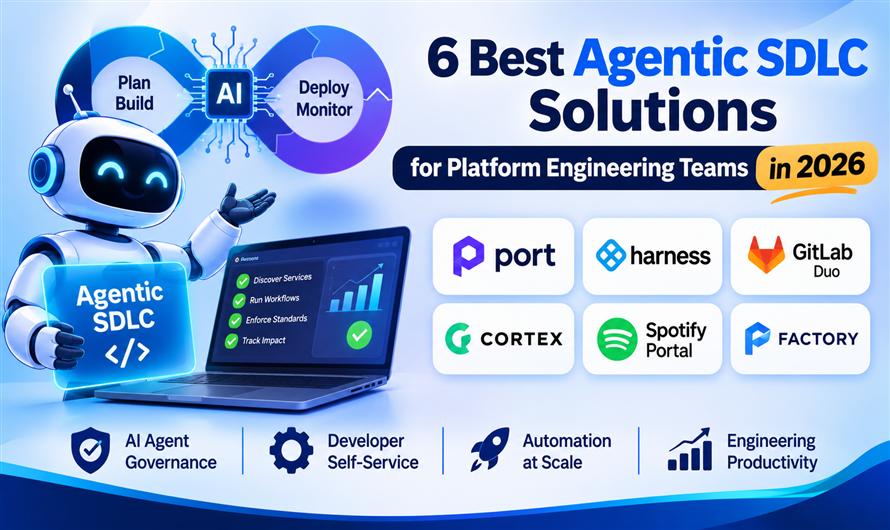
- Port is the strongest overall choice for platform teams. It extends the internal developer portal into a governed operating layer for agents, covering context, orchestration, approvals and measurement.
- The other five solutions are strong in narrower areas: pipeline-native agents, DevSecOps flows, standards and engineering intelligence, a Backstage-based portal, or autonomous coding at scale.
- Most platform teams will run one central control plane and connect it to the coding agents developers already prefer.
Platform teams spent years building golden paths so developers could ship without filing tickets. AI agents tend to walk around those paths. They write code without knowing who owns a service, skip scorecards, and call tools nobody approved. Blocking agents doesn't fix this, but giving them the same paved roads developers use, with the right context and approvals, does. The six agentic SDLC solutions below each take a different approach to that.
Capabilities Platform Teams Should Demand From Agentic SDLC Tools
Not every agentic SDLC tool gives agents a real path through the platform. We judged each solution on five capabilities. Fit with existing platform foundations counted most, since few platform teams want to rebuild their catalog or pipelines from scratch.
- A context model agents can query: services, owners, dependencies, environments and standards in one place.
- Self-service actions for agents: the same governed actions developers use, callable by agents through MCP or APIs.
- Standards enforcement: scorecards and policies that apply equally to human and agent changes.
- Agent and tool governance: control over which agents, MCP servers and skills run, plus approval points.
- Platform impact metrics: visibility into how agents affect delivery speed, reliability and cost.
Best Agentic SDLC Solutions for Platform Engineering Teams
1. Port
Port is the strongest choice for platform teams that want agents to work through the platform rather than around it. Port began as an internal developer portal and now describes itself as a platform to build, govern and operate the agentic SDLC. The catalog, scorecards and self-service actions platform engineers have already built become the foundation agents run on. At its center is the Context Lake, which turns Port's flexible data model into a live map of services, owners, dependencies, cloud resources, deployments and incidents. Agents query it the same way developers browse the catalog, so an agent changing a service knows who owns it, which standards apply and what depends on it.
On top of that context, Port gives platform teams the pieces to run agents at scale. AI Builder turns natural-language descriptions into agentic workflows. Workflow Orchestrator chains agent steps, self-service actions and human approvals across the tools teams already use. The MCP hub and Skills registry decide which MCP servers and skills agents can reach, and Port can auto-discover agents, MCPs and skills that teams adopted on their own. Governance runs through every step. Self-service actions keep the permissions and approval logic they already carry for developers, and scorecards apply to agent-made changes just as they do to human ones. An agent can't ship a service that fails production readiness without someone signing off.
The Metrics module measures AI's effect on engineering, so platform teams can show the value of their work in delivery terms instead of usage counts. Port also ships ready-made use cases, including autonomous ticket resolution, self-healing incidents, auto-fixing failed pipelines and org-wide upgrades, which let teams start with proven workflows. GitHub and dLocal are among the customers that have shared their move to agentic engineering on Port. The platform holds SOC 2 Type 2, ISO 27001, GDPR and CCPA compliance.
2. Harness
Harness suits platform teams whose biggest investment is in delivery pipelines. Its Autonomous Worker Agents became generally available in June 2026 and let any pipeline step run as a reasoning agent instead of a fixed script. The agents work from the Software Delivery Knowledge Graph, which links services, pipelines, deployments, infrastructure, incidents and security findings.
Agents follow the same policies that gate human deployments. Each one runs in a sandboxed container with its own scoped identity and a full audit trail. An LLM Gateway can block unapproved models from production, and token spend is tracked per agent and per pipeline. Developers can also hand tasks to these agents from Cursor or Claude Code through the Harness MCP Server, so platform teams can add AI without standing up a second automation system.
3. GitLab Duo Agent Platform
GitLab Duo Agent Platform, generally available since January 2026, brings agents into a single DevSecOps application. Platform teams that already standardize on GitLab get agents that work across source control, CI/CD and security scanning without extra integrations. Foundational Agentic Flows chain agents for platform-heavy tasks such as migrating projects to GitLab CI/CD, fixing failed pipelines, reviewing code and taking an issue through to a merge request. External agents such as Claude Code and Codex CLI can also connect with native GitLab access.
Platform teams will rely most on the AI Catalog, which lets them publish custom agents and flows that encode internal standards and share them across groups. Admins set access rules at the namespace level and choose which models teams can use. For stricter data control, they can run self-hosted models on Self-Managed instances. Usage data shows how agents contribute to work across the org, which helps when planning a phased rollout.
4. Cortex
Cortex is built around engineering standards and how teams measure up to them. Scorecards define what good looks like for production readiness, security or migration progress, and Initiatives push teams to close gaps by a deadline. Engineering Intelligence tracks delivery metrics such as PR cycle time, deployment frequency and change failure rate. Workflows add automation, and AI Impact and an AI readiness dashboard track how adoption is progressing across teams.
The Cortex MCP opens that data to AI assistants. A platform or engineering leader can ask why a group of services has rising MTTR and get back the scorecard gaps behind it, such as missing on-call integrations or incomplete runbooks. Cortex can also recommend scorecard changes, name the owners of services that are slowing a migration, and help draft a phased plan for the next quarter. For platform teams, that makes it a strong source of standards and insight for agents to draw on.
5. Spotify Portal for Backstage
Spotify Portal for Backstage is a managed product from the team that created Backstage. Platform teams get Backstage's plugin model without running the open-source framework themselves. Its agentic layer runs on MCP: each plugin registers its capabilities in an Actions Registry, and Portal exposes them all through a single MCP endpoint. AiKA (Spotify's assistant), Claude Code, Cursor and VS Code Copilot can all use those capabilities, including the Catalog, the Scaffolder for creating new software from templates, and Soundcheck for tech health checks.
Platform teams can add third-party MCP servers, such as GitHub or Linear, alongside Portal's built-in actions. For authentication, Portal supports static tokens for quick setup and CI. It also has an OAuth-based flow that lets agents sign in through Portal without preconfigured secrets. Organizations already invested in Backstage plugins and conventions get a route to agent access that builds on that work rather than replacing it.
6. Factory
Factory approaches the agentic SDLC from the coding side. Its Droids plan, build and validate code changes, while teams set the goals and policies. Droids run from desktop, terminal, web and CLI, and Droid Computers give them dedicated machines with persistent state. Automations run repetitive engineering work against shared context. Model Routing picks a model for each task based on quality, speed and cost, and AutoWiki keeps repository documentation current as code changes.
The features most useful to platform teams sit around the agents. Agent Readiness scores how prepared each repository is for agent work and tracks progress across the codebase, which gives platform teams a concrete list of fixes before they scale up. Mission Control monitors active work and execution logs. Analytics tracks adoption and token consumption per developer and team, with exportable reports. Customers include RBC, T-Mobile, Adyen and DoorDash.
Rolling Out Agentic SDLC Solutions Across Platform Teams
Before letting agents in, make sure the catalog is accurate, because agents will treat it as fact. Next, turn golden paths into actions agents can call, with the permissions and approvals developers already have, and hold every agent-made change to the same scorecards. Give each agent, MCP server and skill an owner and a defined scope. Start with toil the platform team already owns, such as pipeline fixes and dependency upgrades, and report the results in delivery terms like lead time and MTTR rather than agent usage.
Frequently Asked Questions
Can agentic SDLC tools replace an internal developer portal?
Not usually. Most agentic SDLC tools depend on the context an internal developer portal holds, such as service ownership, dependencies and standards. The stronger approach is to extend the portal so agents can use it, instead of building a separate source of truth just for AI.
Which team should own the agentic SDLC rollout?
Platform engineering is usually the natural owner, since it already runs the catalog, golden paths and self-service tooling. Security should co-own agent policies and approval rules, while product teams own the workflows agents run on their own services.
Can agentic SDLC solutions run in regulated environments?
Many can, but it depends on where context is stored and where model calls are processed. Teams in regulated industries should look for self-hosted or self-managed options, scoped agent identities, full audit trails and human approval on production changes.
Do agentic SDLC solutions work with Terraform and Kubernetes?
Most do, though depth varies. Some solutions provision infrastructure through existing Terraform modules or self-service actions, while others focus on fixing failed Kubernetes deployments or correcting configuration drift. Platform teams should check whether agents act through approved modules or write infrastructure code directly.
How should platform teams measure agentic SDLC ROI?
Start with a baseline for lead time, MTTR, change failure rate and hours spent on toil such as pipeline fixes and upgrades. Then compare workflows run by agents against that baseline. Tracking agent success rates and human override rates shows whether agents are actually saving time or just shifting work into review.

Leave a Comment