Small Language Models vs Large Language Models: Which Should Businesses Choose in 2026 ?

Artificial intelligence is becoming part of everyday business software. From customer support and document processing to enterprise automation, organizations increasingly rely on language models to improve how their systems operate.
But an important question remains: Should businesses use small language models or large language models?
In 2026, choosing between SLMs and LLMs is more than a technical preference. It affects infrastructure costs, response times, data governance, scalability, and long-term software maintenance.
The right choice depends on what the AI needs to accomplish—not simply how powerful the model appears.
What Are Small Language Models?
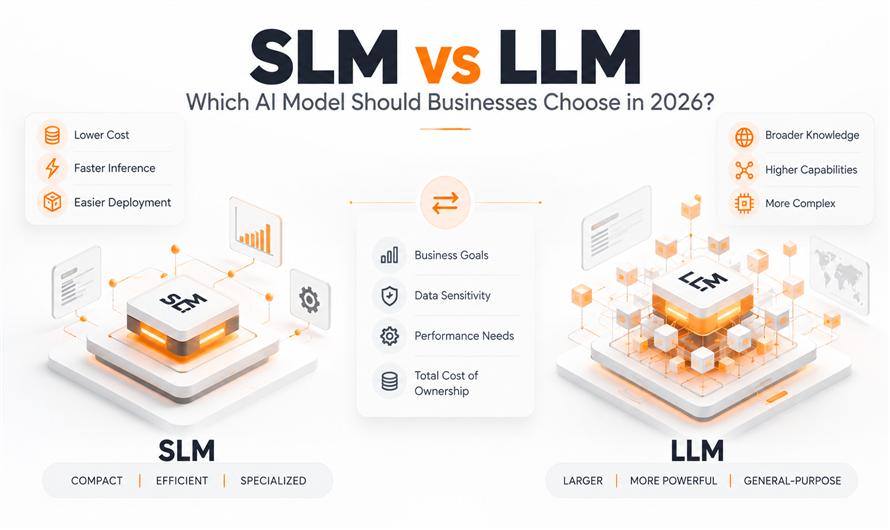
Small language models (SLMs) are relatively compact AI models designed to understand and generate language while using fewer computational resources than larger alternatives.
Like LLMs, they learn language patterns during training and generate responses by predicting tokens. Their smaller architecture often makes them easier to run on limited hardware.
Microsoft's Phi family and Google's Gemma family are well-known examples. Microsoft's own technical report describes phi-3-mini, a 3.8 billion parameter model small enough to deploy on a phone.
Benefits of Small Language Models
SLMs can be particularly useful for focused business applications.
- Lower resource requirements: Smaller models generally require less memory and computation.
- Potentially faster responses: Optimized local inference can reduce latency for appropriate workloads.
- Flexible deployment: Some models can operate on private servers, laptops, or edge devices.
- Task customization: Fine-tuning or structured prompting can help models follow specific business workflows.
Limitations of Small Language Models
- SLMs can struggle with unfamiliar problems, long multi-step reasoning, and tasks that need broad world knowledge. Results depend heavily on training data quality and how well the task is defined.
What Are Large Language Models?
Large language models (LLMs) are AI systems trained at substantial scale to perform a broad range of language-related tasks.
They can support advanced writing, software development, research assistance, document analysis, and multi-step reasoning.
Modern LLMs may also include multimodal capabilities, allowing applications to process combinations of text, images, audio, and other supported inputs.
Strengths of Large Language Models
- LLMs are valuable when business requirements change frequently or tasks cannot be reduced to predictable instructions.
- They include flexible language understanding, complex problem-solving, and broader task coverage.
Limitations of Large Language Models
- Sophisticated models can introduce higher inference expenses, infrastructure dependencies, operational complexity, and data governance considerations.
- Bigger is also not automatically more accurate. LLMs still hallucinate, misread instructions, and make reasoning errors, so retrieval, validation, and human review stay essential.
SLM vs LLM: Key Differences for Businesses
The following comparison summarizes common architectural trade-offs.
| Factor | Small Language Models | Large Language Models |
|---|---|---|
| Capabilities | Strong on focused, well-defined tasks | Broader reasoning and general knowledge |
| Inference cost | Often lower per request at volume | Often higher, especially for heavy workloads |
| Latency | Can be faster on suitable hardware | Depends on model size, hosting, and load |
| Infrastructure | Modest memory and compute needs | Hosted APIs or substantial GPU capacity |
| Customization | Fine-tuning is often practical | Options vary by provider; can be costly |
| Privacy | Supports local or private deployment | Depends on hosting terms and data controls |
| Deployment | Edge, on-prem, private cloud | Mostly cloud or large dedicated clusters |
| Maintenance | You own evaluation and operations | Provider-managed, or heavy self-hosting |
- These differences are directional, not guarantees. Hardware, quantization, request volume, and model quality can change the outcome, so test your own workload.
When Should Businesses Choose SLMs?
SLMs are worth considering when the application performs clearly defined tasks with predictable inputs and outputs.
- Structured and Repetitive Workflows
Businesses can evaluate SLMs for support ticket categorization, document classification, data extraction, and standardized response generation.
For example, an internal system might classify incoming customer requests and assign them to appropriate departments.
- Resource-Constrained Applications
SLMs may be suitable for applications with limited processing capacity, including certain mobile devices, edge systems, and locally deployed enterprise tools.
- Privacy-Sensitive Deployments
A self-hosted SLM can help organizations keep inference within controlled infrastructure.
However, privacy depends on the entire system, including logging, access permissions, training data handling, and security configuration—not model size itself.
NVIDIA researchers make a related argument for agentic systems: many language model calls are repetitive, specialized tasks where SLMs can be sufficient and more economical
When Should Businesses Choose LLMs?
LLMs become attractive when applications require broader interpretation, sophisticated reasoning, or flexible interaction.
- Complex Knowledge Work
An LLM may be appropriate for analyzing lengthy contracts, comparing technical requirements, or synthesizing information from multiple documents.
- Advanced AI Assistants
Enterprise assistants that interpret ambiguous requests, coordinate tools, and handle changing user objectives may benefit from more capable models.
- Broad Customer Interactions
Businesses serving diverse customer needs may require models capable of understanding varied language, unfamiliar questions, and complicated conversations.
Even then, retrieval systems, verification, permissions, and human oversight remain essential.
Can Businesses Combine SLMs and LLMs?
Yes, and for many teams this is the strongest design. A hybrid architecture places a router in front of multiple models.
Instead of sending everything to a potentially more expensive general-purpose model, an application can assign routine requests to an SLM and escalate difficult requests to an LLM.
Stanford researchers studying this pattern found that cascading across models can reduce inference cost while matching or improving accuracy, though results vary by task
Source: FrugalGPT: How to Use Large Language Models While Reducing Cost and Improving Performance
Example: Hybrid AI in Customer Support
Consider a hypothetical SaaS company receiving customer support requests.
An SLM could classify incoming tickets, identify relevant product categories, and draft simple responses using approved knowledge-base content.
Requests involving unclear technical problems, multiple account issues, or complex troubleshooting could be routed to a more capable LLM.
Sensitive actions, such as modifying billing information, would still require authenticated permissions and appropriate approval.
This architecture could balance cost and capability, provided routing accuracy and escalation behavior are tested.
Real Business Use Cases for SLMs and LLMs
- Customer Support
SLMs can handle request classification and routine knowledge-base assistance. LLMs can help address complex troubleshooting conversations and unusual customer questions.
- Enterprise Document Processing
SLMs may extract predefined fields from invoices or forms. LLMs can assist with interpreting complicated agreements, comparing documents, or explaining inconsistencies.
Both require validation before critical business records are updated.
- Intelligent Automation
Focused models can support repeatable workflow decisions, while larger models can help interpret ambiguous instructions across connected business systems.
- SaaS Applications
SaaS teams can use smaller models for frequently executed features and larger models for advanced copilots, contextual analysis, and sophisticated user assistance.
The decision should reflect product economics and user expectations.
Common AI Model Selection Mistakes
Selecting enterprise AI models requires more than comparing public benchmark rankings.
- Defaulting to the biggest model: Extra capability may not justify the operating cost.
- Ignoring real workload testing: Academic benchmarks may not reflect business-specific tasks.
- Overlooking total cost of ownership: Hosting, monitoring, evaluation, and upkeep all count.
- Assuming small models guarantee privacy: Deployment configuration determines how sensitive information is protected.
- Skipping failure design: Plan validation, escalation, and human review from day one.
A better approach is to evaluate representative tasks against accuracy, latency, reliability, security requirements, and total operating costs.
How to Evaluate AI Models Before Deployment
Selecting an appropriate model requires testing how well it handles real business tasks.
Organizations should begin by identifying their use cases, expected request volumes, data sensitivity, and acceptable response times.
A practical evaluation process includes:
- Define the workload: Identify the tasks the model must perform and the quality standards it needs to meet.
- Test representative examples: Evaluate SLMs and LLMs using realistic business inputs, including difficult and unusual cases.
- Measure operational performance: Compare response quality, latency, resource consumption, and total deployment costs.
- Review security requirements: Assess hosting options, access controls, data retention policies, and compliance obligations.
- Plan ongoing monitoring: Establish processes for identifying incorrect outputs, performance changes, and model updates.
Organizations should also consider whether retrieval-augmented generation (RAG), fine-tuning, or better prompt design can improve performance without requiring a larger model.
This evaluation-first approach supports more informed AI architecture decisions and reduces the risk of unnecessary infrastructure investment.
Conclusion: Which AI Model Should Your Business Choose?
The SLM vs LLM decision is not about identifying one universally superior technology.
- Choose an SLM when your workflow is focused, resources are constrained, and a compact model meets quality requirements.
- Choose an LLM when broader knowledge, flexible language understanding, or complex reasoning is essential.
- Consider a hybrid approach when your application contains both routine and demanding tasks.
In 2026, the most effective AI model selection strategy is to test actual business workloads, measure operating requirements, and design an architecture that can adapt as models improve.
Frequently Asked Questions
- What is the main difference between SLM and LLM?
SLMs are compact models suited to focused tasks, while LLMs offer broader capability at higher compute cost. - Are small language models cheaper than LLMs?
Often, but total cost depends on hardware, hosting, volume, optimization, and maintenance. - Can SLMs work for enterprise AI?
Yes, for well-defined workflows like classification, extraction, and internal assistants. - Are LLMs always more accurate?
No. Larger models tend to lead on complex tasks, but specialized smaller models can compete on narrow workloads - Can businesses use SLMs and LLMs together?
Yes. A router can send routine work to a small model and escalate hard cases to a larger one.

Leave a Comment