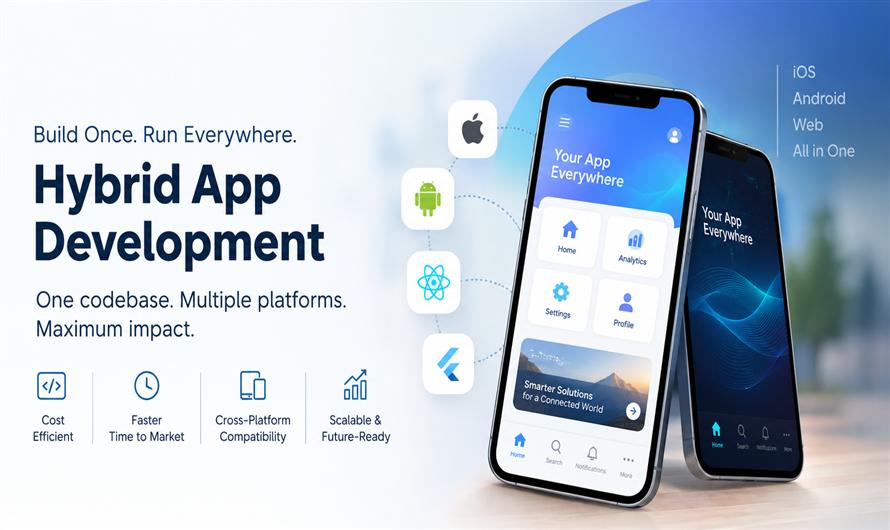
Mobile applications have become an important part of how businesses interact with customers, employees, and partners. However, developing separate applications for iOS and Android can require significant time, resources, and ongoing maintenance. Hybrid app development offers an alternative by allowing businesses to build applications that can operate across multiple platforms while sharing much of the underlying code.
What Is Hybrid App Development?
Hybrid app development combines web technologies with native mobile capabilities. Instead of creating completely separate applications for each operating system, developers can use a shared codebase and package the application within a native environment.
This approach can help businesses reach users across platforms while reducing duplication during development. Hybrid applications can also access device capabilities and integrate with APIs and existing enterprise systems.
Why Are Businesses Considering Hybrid Applications?
One of the biggest reasons organizations consider hybrid development is efficiency. Maintaining separate codebases for different operating systems can increase development and maintenance requirements.
A shared development approach can provide several potential benefits:
- Reduced development effort: A common codebase can reduce duplicated development work.
- Faster time to market: Teams can build and release applications for multiple platforms without developing everything independently.
- Simplified maintenance: Updates and improvements can often be managed through a common development structure.
- Broader platform reach: Applications can be made available to users across major mobile platforms.
- Integration flexibility: Hybrid applications can connect with APIs, backend systems, and third-party services.
For organizations working with limited development resources or tight delivery schedules, these factors can make hybrid development worth considering.
Hybrid vs. Native App Development
Native development remains useful when an application requires highly platform-specific functionality or maximum control over device capabilities. Hybrid development, on the other hand, can be suitable when businesses prioritize development efficiency, cross-platform availability, and maintainability.
The right choice depends on factors such as:
- Application complexity
- Required device functionality
- Performance requirements
- Target platforms
- Development budget
- Expected user base
- Long-term maintenance requirements
Rather than choosing a technology solely based on cost, organizations should evaluate the application's technical and business requirements before selecting an approach.
Popular Technologies for Hybrid Development
Modern mobile development offers several frameworks and technologies for building applications across platforms. Technologies used in the broader hybrid and cross-platform ecosystem include React Native, Flutter, Ionic, and Xamarin, among others. Kellton also highlights experience with technologies such as React, Ionic, PhoneGap, Sencha, Appcelerator, and Titanium.
The choice of framework depends on factors such as developer expertise, application requirements, existing technology infrastructure, and the capabilities needed from the final product.
Key Considerations When Building a Hybrid App
A successful hybrid application requires more than simply choosing a framework. Businesses should consider the complete application lifecycle.
1. Architecture
The application architecture should be designed around scalability, security, integrations, and expected user traffic.
2. User Experience
A shared codebase does not eliminate the need for platform-aware design. Navigation, layouts, interactions, and performance should provide a consistent and intuitive experience.
3. API and System Integration
Many enterprise applications need to communicate with CRM systems, payment platforms, analytics tools, databases, and other backend services. Integration capabilities should therefore be considered early in the development process.
4. Quality Assurance
Testing across different devices, operating systems, screen sizes, and network conditions is essential. Automated and manual testing can help identify compatibility and performance issues before deployment.
5. Maintenance and Optimization
Applications require ongoing updates after launch. Monitoring, bug fixes, security updates, performance improvements, and feature enhancements should be part of the long-term development plan.
Can Existing Native Apps Be Migrated to Hybrid?
Organizations with existing native applications may also consider migrating to a hybrid architecture. A migration can potentially help consolidate development efforts while retaining important application functionality.
However, migration should begin with an assessment of the existing application architecture, dependencies, integrations, technical debt, and platform-specific features. A phased migration can sometimes reduce operational disruption.
When Should a Business Consider Hybrid App Development?
Hybrid development can be worth considering when an organization needs to:
- Launch an application across multiple platforms
- Reduce duplicated development effort
- Accelerate product development
- Maintain a consistent application experience
- Integrate mobile applications with existing business systems
- Build an MVP before making a larger technology investment
For highly specialized applications that rely heavily on platform-specific hardware or capabilities, native development may be more appropriate.
Final Thoughts
Hybrid app development provides businesses with an approach to building mobile applications across multiple platforms while managing development effort and long-term maintenance. Its suitability depends on the application's functionality, performance requirements, target audience, and technology environment.
Organizations evaluating this approach should begin with their business and technical requirements rather than selecting a framework first. A well-planned architecture, strong UX, comprehensive testing, and ongoing maintenance can all contribute to a reliable hybrid mobile application.
For businesses exploring professional hybrid app development services, Kellton offers consulting, architecture, design and development, native-to-hybrid migration, quality assurance, and ongoing support and optimization.


Leave a Comment