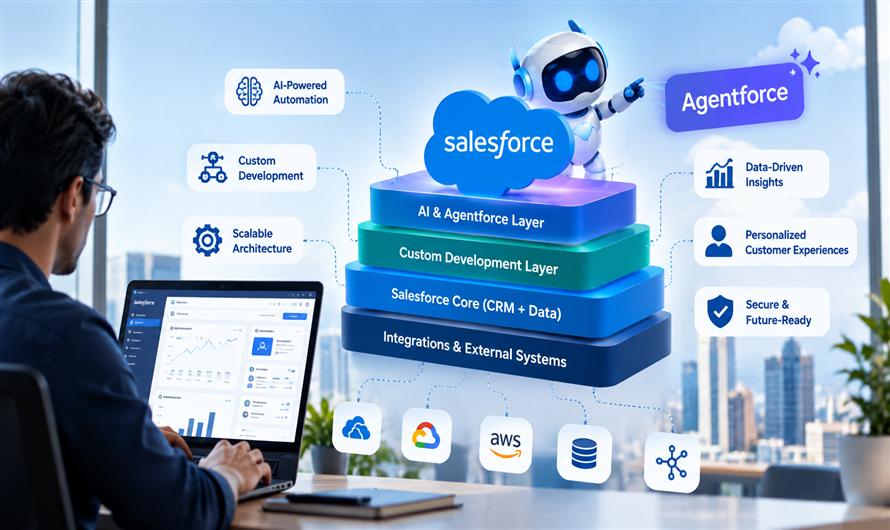
With the advent of artificial intelligence, the use of CRM platforms in businesses is evolving. Salesforce has evolved from conventional customer relationship management by introducing artificial intelligence agents, automation, analytics, and personalized experiences all on one platform.
In order to utilize AI technology in organizations, it is not sufficient to integrate AI technology in Salesforce. The architecture behind should be such that it supports reliable data, secure integration, automation, governance, and AI agents.
Here comes the role of Salesforce Agentforce development as well as custom development. Agentforce can take care of the AI agents while custom development caters to the business needs of the organization.
What Is an AI-Ready Salesforce Architecture?
AI-enabled Salesforce architecture refers to the CRM platform, which is built to ensure safe and effective use of artificial intelligence.
The following features are included:
- Customer and business data
- Salesforce applications
- Data Cloud
- Agentforce
- APIs and integrations
- Automation
- Custom applications
- Security and governance
- Analytics and reporting
The aim is to build an ecosystem, where AI would have access to necessary information, would understand business context and be able to act accordingly. This is important because the success of AI will be dependent on the data and processes that are available.
Salesforce says that currently, there are over 150,000 customers worldwide using the platform. This shows the scope of the implementation of Salesforce in business enterprises. The increased use of AI means that architectural planning has become even more important.
Why Does Your Salesforce Architecture Need to Be AI-Ready?
Classic CRM architectures tend to be based on people keying in data, generating reports, and following set workflows.AI brings a new way of doing things. An AI agent might have to consider past transactions from a customer, get information, provide recommendations, and take actions in several systems.
For instance, a customer service representative could potentially use an AI agent to review a customer’s history, discover why there is a request, get some information, and help take the next step. It needs more than just a chatbot. It needs data connection, business rules, security, and automation. The right Salesforce AI architecture would provide all that.
What Role Does Agentforce Play in an AI-Ready Salesforce Environment?
Agentforce is the Salesforce platform for creating AI agents that would be able to help employees and customers. Such agents could be developed for various roles within the business process, including:
- Customer support
- Sales support
- Marketing support
- Employee help desk
- Commerce
- Lead qualifying
- Case management
Rather than just producing the text, agents can be integrated into Salesforce data and business processes. This provides opportunities for using AI not as a separate application, but as an integral element of day-to-day processes. The Salesforce Agentforce development is centered on configuration, extension, and integration of agents to cover certain business needs.
How Should You Prepare Salesforce Data for AI?
Data preparation is something that needs to happen during the early stages of AI deployment.AI requires accurate and relevant data to provide helpful responses and recommendations. Begin by checking your existing data on Salesforce.
Here are the things to check:
- Duplicates
- Lack of data
- Outdated customer data
- Wrong formats
- Wrong relationships
- Unutilized fields
- Data not on Salesforce
Even Data Cloud can be a very useful tool in unifying customer data from various sources. For instance, data from Salesforce, websites, commerce, and external apps can be used to build customer data. Poor quality data can lead to inaccurate predictions even with the most sophisticated AI agent.
Which Salesforce Customizations Are Important for AI?
In most cases, implementation of the AI solution will be accompanied by some modifications to the current CRM setting. This is where Salesforce CRM customization comes into play.
A firm may need certain custom objects, fields, interfaces, workflows, permissions, and applications to implement AI-driven operations. For instance, one firm could design a custom process where the AI would recognize valuable leads and direct them to the correct sales representative.
Customization should be done for a certain reason.Unnecessary customization will make the Salesforce environment difficult to manage and expensive to develop in the future. The ideal situation would be customization when the standard Salesforce features fail to meet the business requirement.
Where Does Integration Fit Into an AI-Ready Architecture?
Most modern enterprises do not have all their information stored in Salesforce.They might be using ERP systems, payment systems, data warehouses, e-commerce solutions, communication systems, and internally developed software solutions.AI agents might require information from these systems in order to provide helpful assistance.
For instance, a sales agent will need customer data from Salesforce and inventory data from ERP.This makes Salesforce integration development a very important architectural piece.APIs, middleware, event-based integration, and Salesforce native integration technologies could be used in such cases.An architecture would need to determine which information AI agents have access to and what operations they could perform.
How Can You Build an AI-Ready Salesforce Architecture Step by Step?
Implementation of the concept may include the following steps.
Step 1: Setting Business Objectives
Focus on the problem of the company and not on the technology itself. Define the objectives to be achieved by the project such as decreasing the support workload, lead conversion rate, speeding up sales process, increasing efficiency of employees, etc.
Step 2: Performing Assessment of the Existing Salesforce Architecture
Assessment should include objects, quality of the data, integration, automation, customization, security issues and technical debt, which is present within the current architecture.It helps to identify limitations that might prevent using AI.
Step 3: Preparation and Unification of the Data
Preparation of existing data and identification of what new external sources have to be connected.Also, the access to customer data has to be defined.
Step 4: Select Use Cases for AI
Determine use cases for which AI will add value.Select use cases that will have considerable impact but are not overly large in scope.
Step 5: Determine Agent Actions
Define the actions that the agent can do such as read, recommend, produce, edit, and perform.
In the case of critical processes, human authorization must be obtained prior to execution of action.
Step 6: Integrate with Systems
Build integration with ERP, Analytics, Commerce, Support, and other systems.
Step 7: Custom Development
Need to add custom development in case Salesforce's native features are not supported.
Step 8: Testing
Perform testing with AI responses, integration, permissions, automation, and edge cases. Monitor its performance and feedback post-deployment.
How Can Businesses Future-Proof Their Salesforce AI Architecture?
The technology will keep on developing; therefore, it is necessary that the architecture remain flexible.It is not recommended to create such an environment where all the functionalities of AI depend on one fixed process or a customized component.
It is important to consider such options as modular integration, reusable data model, API definitions, automation, and governance.It is also important to periodically assess both AI agents and the business process.With new functionalities becoming available within Salesforce, some custom capabilities can be replaced by the standard functionalities.
Conclusion
Creating an AI-enabled Salesforce environment involves much more than just implementing an AI agent. The organization needs to have an excellent blend of good data, secure integration, automation, governance, and intelligent custom development.
Salesforce Agentforce can enable businesses to incorporate intelligent agents in their customer engagement processes as well as custom development to cater to their business requirements.
The best strategy would be to first set business objectives, then create a good database, implement AI slowly and consistently improve on the architecture.


Leave a Comment