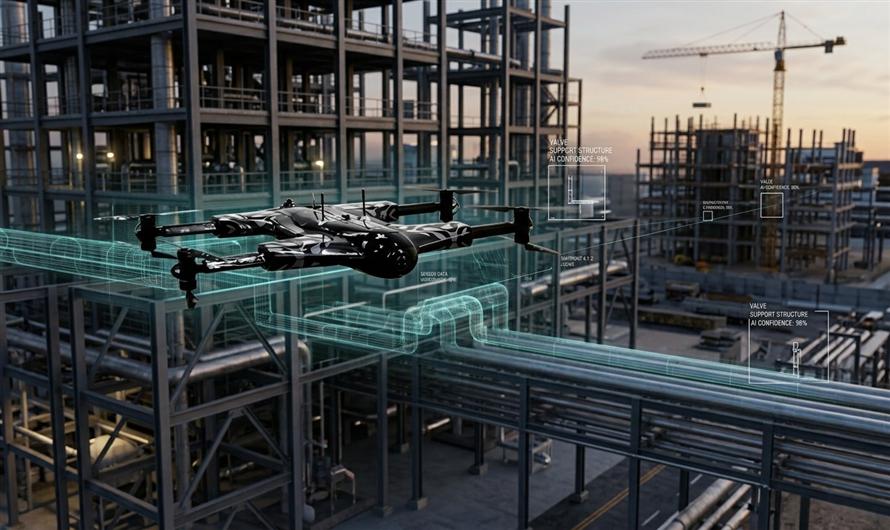
A drone that flies from one GPS coordinate to another is automated, but it is not necessarily intelligent. It may execute a flight plan accurately while knowing almost nothing about what is happening around it. Put an unexpected crane, vehicle, tree branch, or person in its path, and the difference between following instructions and interpreting an environment becomes important.
That distinction is at the center of AI in Drone Technology. Artificial intelligence is expanding what drones can do beyond executing commands issued by pilots or flight-control software. Depending on their sensors, computing hardware, software, and mission requirements, modern drones can increasingly recognize objects, combine different streams of sensor data, evaluate changing conditions, and adjust their behavior.
The result is not a sudden transition to completely independent aircraft. Instead, drones are progressing through different levels of autonomy, with AI taking responsibility for specific perception, navigation, analysis, and decision-support tasks.
Beyond Remote Control and Preprogrammed Flight
Early drone operations placed most intelligence outside the aircraft. A human pilot interpreted video, watched the surroundings, selected a route, and responded when conditions changed. Flight-control systems could stabilize the aircraft, but higher-level decisions remained largely human.
Automation reduced some of that workload. GPS waypoint missions, automated takeoff and landing, altitude control, and predefined flight patterns allowed drones to perform repeatable tasks without continuous manual steering.
Yet automation has an important limitation: predefined instructions work best when reality matches expectations.
A drone following a waypoint route may know where it is supposed to go without understanding what occupies the space between two coordinates. If an obstacle appears or the planned route becomes unsuitable, conventional automation may have limited ability to interpret the situation.
Autonomous drone technology adds another layer. AI can help the aircraft use sensor observations to determine what is happening and select an appropriate response. Instead of merely asking, “What instruction comes next?” an intelligent flight system can also evaluate, “What am I seeing, and does the original plan still make sense?”
Giving Aircraft a Machine View of the World
For a drone to respond intelligently, it first needs useful information about its surroundings. Cameras, depth sensors, inertial measurement units, satellite navigation receivers, radar, lidar, and other sensors can provide pieces of that information.
AI helps turn some of those raw measurements into meaningful representations.
Computer vision, for example, allows software to analyze camera images or video. Object detection models can identify and locate categories of objects within an image. Image-recognition systems can classify visual features, while other algorithms can follow objects across successive frames.
Consider an infrastructure inspection. A conventional drone may collect hundreds of images for specialists to examine later. An AI-assisted system could potentially identify areas that resemble known defect patterns during data collection, helping operators prioritize closer inspection. The AI is not automatically replacing an engineer's judgment; it is changing how quickly relevant information can be extracted.
Perception becomes more robust when multiple inputs are combined. This process, known as sensor fusion, can reconcile information from cameras, positioning systems, motion sensors, and ranging equipment. A camera might provide rich visual detail while another sensor contributes distance measurements. Together, they can provide a more useful environmental model than either source alone.
That ability to convert sensor readings into situational awareness is one of the most important contributions of artificial intelligence in drones.
Navigation Becomes a Dynamic Problem
Autonomous navigation is sometimes confused with waypoint flying. They are not the same.
A waypoint mission tells an aircraft to travel through predetermined geographic positions. The drone's flight controller handles the mechanics of getting there. True autonomous behavior becomes more demanding when the aircraft must interpret obstacles, determine whether its route remains safe, and make adjustments as conditions change.
AI can contribute to obstacle detection by analyzing visual or ranging data for hazards. Navigation software can then use that information when planning a path. If a route becomes blocked, a sufficiently capable system may calculate an alternative rather than waiting for a pilot to manually intervene.
Complex environments make this especially challenging. Buildings can obstruct signals, moving objects can change the scene rapidly, and narrow spaces require more precise spatial awareness than open-air waypoint missions.
For this reason, AI drone systems usually involve several interacting technologies rather than one all-purpose intelligence model. Perception identifies relevant features, localization estimates the aircraft's position, planning determines a suitable route, and flight-control software converts decisions into physical movement.
AI therefore does not replace the entire flight stack. It makes particular layers of that stack more capable of responding to information.
Machine Learning Adds Pattern Recognition
Much of the intelligence associated with modern drones comes from models trained to recognize patterns in data.
Machine learning in drones can support tasks such as distinguishing objects, identifying unusual visual features, classifying terrain, estimating movement, or recognizing conditions relevant to a particular mission. Instead of engineers writing an explicit rule for every possible image, a trained model learns statistical patterns from examples.
That approach is powerful, but its limitations matter.
A model's performance depends heavily on the quality and relevance of its training data. A vision system trained primarily on clear daytime imagery may perform differently in rain, fog, shadows, glare, or low light. Unusual objects, unfamiliar landscapes, damaged sensors, or unexpected viewing angles can also create situations the model handles poorly.
This is one reason AI autonomy should not be treated as machine infallibility. Intelligent systems operate with uncertainty. Responsible designs need mechanisms for detecting low-confidence situations, falling back to safer behaviors, and involving human operators when circumstances exceed the system's capabilities.
Why Intelligence Is Moving Onboard
Sending every camera frame to a remote server for analysis sounds convenient until a drone enters an area with weak connectivity or needs to respond immediately to an obstacle.
That is where edge computing becomes important.
By placing capable processors onboard the aircraft, developers can run selected AI models close to the sensors producing the data. Local real-time processing reduces dependence on a continuous network connection and can shorten the time between detecting something and responding to it.
This matters for navigation in particular. An aircraft approaching an obstacle cannot always afford to transmit sensor data to a distant server, wait for processing, receive a response, and then change direction.
Onboard computing introduces its own engineering trade-offs. More processing capability can require additional electrical power and may add weight or generate heat. Those requirements compete with propulsion, communications, sensors, and battery capacity.
Designing AI-powered drones therefore involves balancing intelligence against the strict energy and payload constraints of an aircraft.
What Intelligent Drones Can Do in the Field
The practical value of AI becomes clearer when perception and autonomy are connected to specific tasks.
In agriculture, aerial systems can analyze imagery to highlight variations across fields, helping specialists identify areas that may require closer examination. Automated navigation can also support repeatable surveys over large areas.
For infrastructure inspection, computer vision can help organize visual data from bridges, towers, roofs, pipelines, or other assets. Rather than treating every captured image equally, software can flag potentially significant features for human review.
Construction and mining environments can benefit from repeated mapping, progress monitoring, stockpile observation, and site analysis. AI can assist with recognizing objects or changes between surveys, while autonomous flight functions reduce the manual effort required for repetitive data collection.
During emergency response, intelligent perception may help search imagery for relevant objects or navigate areas that are difficult for people to access. Environmental monitoring can similarly use pattern recognition to examine vegetation, terrain, waterways, or wildlife observations.
Logistics presents another autonomy challenge. Reliable movement between locations requires more than following a line on a map. Landing-zone assessment, obstacle awareness, changing conditions, and coordination with operational systems can all become part of the problem.
Across these applications, the common benefit is not simply unmanned flight. It is the ability to connect aerial sensing with faster interpretation and more adaptive behavior.
Autonomy Still Has Hard Limits
Increasing intelligence does not remove the physical and operational constraints of drones.
Battery capacity remains fundamental. AI processors, cameras, ranging sensors, and communications equipment all consume energy, while additional hardware can increase aircraft weight.
Sensors are another limitation. Dirt on a camera, poor visibility, rain, changing light, signal interference, or inaccurate measurements can affect the information an autonomous system receives. Even a capable AI model cannot make reliable decisions from consistently unreliable inputs.
Cybersecurity becomes more important as aircraft depend on software, communications, positioning, and data-processing systems. Protecting control channels, stored information, software updates, and connected infrastructure is therefore part of designing dependable autonomous systems.
Privacy also requires attention when drones use cameras and automated recognition. What information is collected, how it is processed, where it is stored, and who can access it can matter as much as the aircraft's flight capabilities.
Regulation adds another boundary. The technical ability to perform a highly autonomous mission does not automatically mean that operation is permitted in every location or circumstance.
Most importantly, autonomy does not eliminate the need for human oversight. The appropriate level of supervision depends on the mission, environment, risk, system reliability, and applicable rules. In many cases, the strongest model is not “human versus AI” but carefully defined cooperation between operators and automated systems.
The Next Stage Is More Context-Aware Flight
Future progress is likely to come from improving individual capabilities and connecting them more effectively.
More efficient onboard AI could allow sophisticated perception without excessive power consumption. Better sensor fusion could help aircraft maintain useful situational awareness when one source of information becomes unreliable. Navigation systems may become better at reasoning about dynamic environments rather than treating obstacles as static points.
AI-assisted mission planning could also make operations more adaptive. Instead of creating a complete plan before takeoff, systems could update priorities as new information is collected.
Another important direction is integration. Drones increasingly function as parts of larger digital workflows rather than isolated flying cameras. Information collected in the air can feed mapping platforms, inspection systems, operational dashboards, or other automated machines. Over time, drones may coordinate more closely with ground robots and other autonomous systems while human operators supervise broader objectives.
These advances will still depend on reliability, testing, computing efficiency, and sensible operational limits.
Intelligence Changes What Flight Means
The significant development in drone autonomy is not simply that aircraft require fewer joystick inputs. Automation has been reducing manual flight tasks for years.
AI changes the nature of the problem by giving drones greater ability to extract meaning from what their sensors observe. Computer vision can help them perceive. Sensor fusion can improve their understanding of surroundings. Machine learning can recognize patterns. Edge computing can bring analysis closer to the point where decisions must be made.
Together, these technologies can enable higher levels of autonomy while still leaving important roles for human judgment and oversight.
The evolution of AI in Drone Technology is therefore best understood as a progression from remote control, through automation, toward systems that can increasingly perceive, interpret, adapt, and support decisions. The aircraft may still be flying, but much of the technological progress now lies in what it can understand while it is in the air.

Leave a Comment