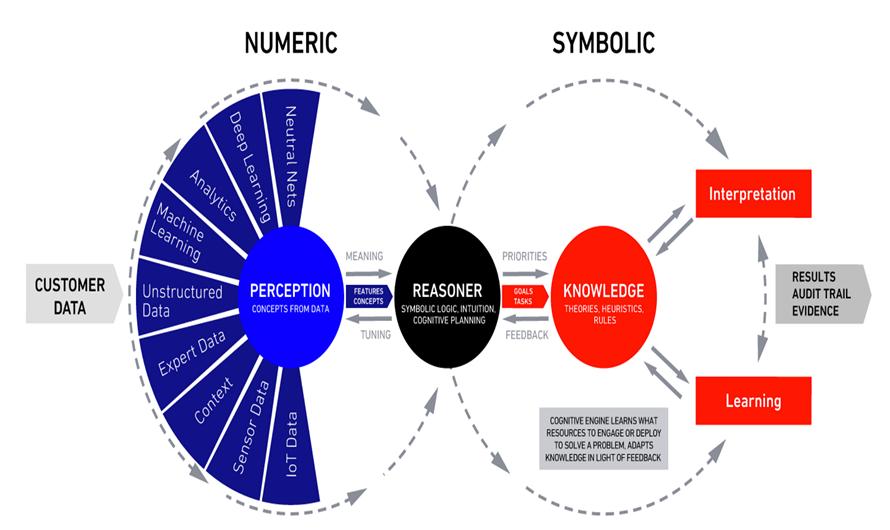
Large Language Models (LLMs) can exhibit behaviors that resemble abstract thinking, yet whether they truly possess abstract reasoning in the same way humans do remains an open research question.
What Is Abstract Thinking?
Abstract thinking involves the ability to:
- Understand concepts beyond concrete examples.
- Recognize patterns and analogies.
- Generalize knowledge to new situations.
- Reason about hypothetical scenarios.
- Manipulate symbols and ideas that don't directly correspond to physical objects.
For example:
"A government is to a country as a brain is to a body."
Understanding this analogy requires abstract reasoning.
What LLMs Can Already Do
Modern models can perform surprisingly sophisticated forms of abstraction.
1. Pattern Generalization
LLMs can learn relationships from vast amounts of text and apply them to new contexts.
Example:
Dog : Puppy :: Cat : ?
The model correctly answers:
Kitten
This indicates some ability to understand abstract relationships.
2. Analogical Reasoning
LLMs often perform well on analogies:
Teacher : School :: Doctor : ?
Answer:
Hospital
This requires identifying relational patterns rather than memorizing exact examples.
3. Conceptual Abstraction
LLMs can explain ideas like:
- Democracy
- Justice
- Infinity
- Consciousness
They can discuss these concepts in sophisticated ways because they have learned patterns of how humans talk and reason about them.
4. Cross-Domain Transfer
A strong indicator of abstraction is applying knowledge from one domain to another.
Example:
How is debugging software similar to medical diagnosis?
LLMs can generate meaningful comparisons:
- Symptoms → Bugs
- Tests → Diagnostics
- Root cause analysis → Debugging process
Where LLMs Still Struggle
Despite impressive abilities, there are limitations.
1. Novel Abstract Problems
Truly novel reasoning tasks that differ substantially from training data can still challenge LLMs.
They may:
- Produce inconsistent answers.
- Follow superficial patterns.
- Fail to identify deeper principles.
2. Grounded Understanding
Humans develop abstract concepts through:
- Physical experiences
- Sensory interactions
- Social learning
- LLMs primarily learn from text.
As a result, their abstractions may lack the grounded understanding humans possess.
3. Long Chains of Reasoning
Complex abstract problems often require:
- Planning
- Working memory
- Iterative reasoning
LLMs can struggle when reasoning chains become long or require multiple intermediate abstractions.
4. Building New Theories
Humans can invent entirely new conceptual frameworks.
Examples:
- Calculus
- Relativity
- Evolution by natural selection
Current LLMs are better at recombining and extending existing ideas than generating fundamentally new scientific paradigms.
Can LLMs Improve Their Abstract Thinking?
Probably yes.
Several approaches are already improving reasoning capabilities.
Larger Context Windows
More context enables models to:
Track relationships.
Build hierarchical representations.
Reason over larger problems.
Tool Use
By using:
Calculators
Search engines
Simulations
Code execution
LLMs can perform forms of reasoning beyond pure text prediction.
Test-Time Reasoning
Techniques like:
Chain-of-thought prompting
Self-reflection
Multiple reasoning paths
significantly improve abstract problem solving.
World Models
Researchers are exploring systems that build internal representations of:
Physics
Causality
Human behavior
These could lead to stronger abstract reasoning capabilities.
The Big Debate
Researchers generally fall into three camps.
View 1: LLMs Already Have Primitive Abstract Reasoning
They argue that abstraction naturally emerges from large-scale learning.
View 2: LLMs Simulate Abstraction
They produce outputs that look like abstract thinking without possessing genuine understanding.
View 3: LLMs Are an Intermediate Step
They have partial abstract reasoning abilities, but additional architectures and learning methods are needed for human-level abstraction.
My Assessment
Current LLMs demonstrate functional abstract thinking:
- They can generalize.
- They can reason analogically.
- They can manipulate concepts.
- They can solve many abstract tasks.
However, they still appear limited in:
- Grounded understanding
- Robust novel reasoning
- Autonomous theory creation
- Deep causal abstraction
So the answer is:
Yes, LLMs can develop meaningful abstract thinking capabilities, and they already exhibit early forms of it. But whether this constitutes human-like abstract understanding remains unresolved and is one of the central questions in AI research today.


Leave a Comment