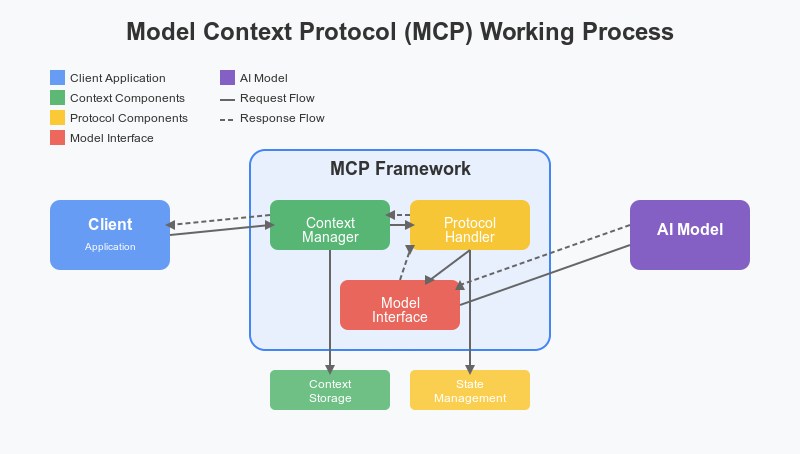
Artificial Intelligence is becoming increasingly powerful, but one major limitation has always existed: AI models cannot automatically access your files, applications, databases, or business systems. To perform useful work, they need a standardized way to communicate with external tools and data sources.
This is where MCP (Model Context Protocol) comes in.
Introduced by Anthropic, MCP is an open standard that enables AI assistants like Claude to securely connect with external tools, data sources, and applications. It acts as a universal bridge between AI models and the systems they need to access to complete tasks.
As AI agents become more capable, MCP is emerging as one of the foundational technologies powering the next generation of intelligent assistants.
What is MCP (Model Context Protocol)?
Model Context Protocol (MCP) is an open protocol that standardizes how AI models communicate with external systems.
Think of MCP as a USB-C port for AI applications.
Just as USB-C allows various devices to connect using a common standard, MCP allows AI models to connect with different tools and services through a consistent interface.
Instead of building separate integrations for every application, developers can create an MCP server once and make it accessible to AI assistants that support the protocol.
Why Was MCP Created?
Before MCP, connecting AI models to external tools was often complicated.
Every integration required:
- Custom APIs
- Proprietary connectors
- Additional maintenance
- Separate authentication mechanisms
- Unique implementation logic
As the number of tools increased, managing integrations became increasingly difficult.
MCP solves this problem by providing a universal communication framework between AI models and external systems.
How MCP Works in Claude
The basic workflow looks like this:
User Request
      ↓
Claude Understands Intent
      ↓
MCP Server is Invoked
      ↓
External Tool Returns Data
      ↓
Claude Processes Information
      ↓
Final Response Generated
The protocol enables Claude to retrieve information and perform actions without requiring users to manually copy and paste data.
Core Components of MCP
1. MCP Host
The host is the AI application that users interact with.
In this case:
- Claude Desktop
- AI-powered applications
- Enterprise AI platforms
The host initiates communication with MCP servers.
2. MCP Client
The client manages the connection between Claude and external services.
Its responsibilities include:
- Sending requests
- Receiving responses
- Managing sessions
- Handling communication protocols
3. MCP Server
The server exposes capabilities to Claude.
These capabilities may include:
- Reading files
- Searching databases
- Querying APIs
- Accessing documentation
- Performing business operations
Why MCP Is Important for Claude
- Access to Real-Time Information
- Claude's training data has limits. MCP enables access to live information from connected systems.
- Better Context
- Claude can retrieve relevant documents, code, or business data as needed.
- Workflow Automation
- AI can perform actions instead of simply generating text.
- Reduced Development Complexity
- Developers can create one MCP integration that works across multiple AI applications.
Common Use Cases of MCP in Claude
1. Connecting Claude to GitHub
Claude can:
- Read repositories
- Review code
- Analyze pull requests
- Generate documentation
- Search project files
2. Connecting Claude to Google Drive
Claude can:
- Read documents
- Analyze reports
- Summarize files
- Search knowledge bases
3. Database Access
Claude can:
- Query databases
- Generate reports
- Analyze business information
- Answer data-related questions
4. Internal Business Systems
Organizations can connect Claude to:
- CRM platforms
- Support systems
- Project management tools
- Analytics platforms
Example Workflow Using MCP
Imagine a product manager asking:
"Create a weekly engineering report."
The workflow might look like this:
Claude
    ↓
GitHub MCP Server
    ↓
Project Management MCP Server
    ↓
Documentation MCP Server
    ↓
Generate Report
Instead of manually gathering information from multiple applications, Claude automatically retrieves and combines the necessary data.
MCP and Agentic AI
MCP is a critical technology for the rise of Agentic AI.
AI agents need three essential capabilities:
- Reasoning
- Memory and context
- Tool usage
MCP provides the standardized mechanism for tool usage and context retrieval.
Without protocols like MCP, building sophisticated AI agents would require countless custom integrations.
Benefits of MCP in Claude
Standardized Integrations
One protocol can connect AI models with many systems.
Improved Productivity
Users spend less time moving data between applications.
Better Decision-Making
Claude can access the latest information when answering questions.
Scalability
Organizations can easily add new tools and services.
Future-Proof Architecture
Open standards simplify long-term AI integration strategies.
Security Considerations
Since MCP allows access to external systems, organizations should implement:
- Authentication and authorization
- Role-based permissions
- Data access controls
- Audit logging
- Human approval for sensitive actions
Security and governance remain essential when deploying AI-powered workflows.
The Future of MCP
As AI assistants become more autonomous, protocols like MCP will become increasingly important.
Future AI systems will:
- Connect to dozens of applications simultaneously.
- Perform complex multi-step workflows.
- Act as digital teammates.
- Retrieve information and execute actions across organizations.
- MCP provides the foundation that makes these capabilities possible.
Final Thoughts
MCP (Model Context Protocol) is one of the most important innovations in the AI ecosystem because it enables AI assistants like Claude to securely interact with external tools and data sources.
By standardizing integrations, reducing development complexity, and enabling powerful AI workflows, MCP is helping transform Claude from a conversational chatbot into an intelligent, action-oriented assistant.
As businesses continue adopting AI and Agentic workflows, understanding MCP will become increasingly valuable for developers, organizations, and anyone looking to build the next generation of AI-powered applications.


Leave a Comment