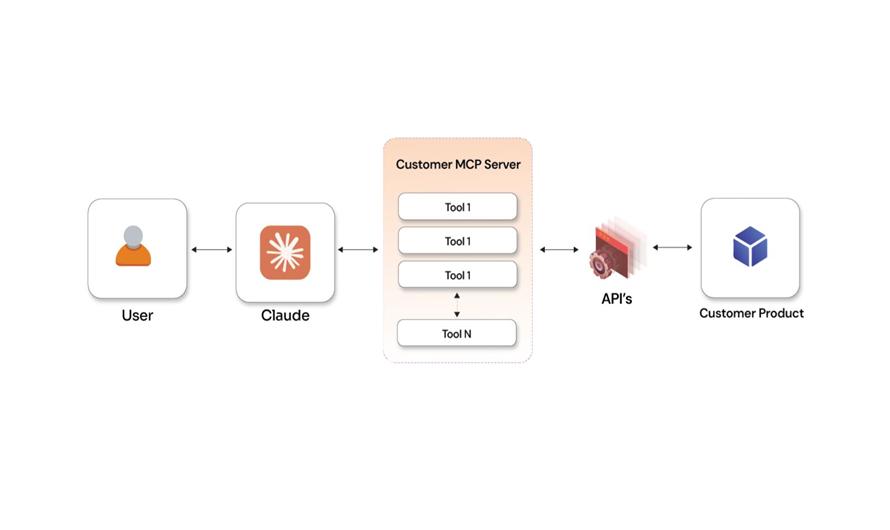
Large Language Models (LLMs) have transformed the way organizations build intelligent applications. From AI-powered chatbots and virtual assistants to code generation tools and business automation systems, LLMs are becoming a critical component of modern software ecosystems. However, integrating these models with external tools, databases, APIs, and enterprise systems has traditionally been complex and inconsistent.
The Model Context Protocol (MCP) addresses this challenge by providing a standardized framework for connecting LLMs with external resources. By establishing a common communication protocol, MCP simplifies integrations, enhances scalability, and improves the overall effectiveness of AI-powered applications.
Understanding MCP
Model Context Protocol (MCP) is an open standard designed to enable seamless communication between AI models and external systems. Rather than creating custom integrations for every application, developers can use MCP to establish a uniform method for accessing tools, data sources, and services.
MCP functions as a bridge between an LLM and the resources it needs to perform tasks effectively. These resources may include:
- Databases
- File systems
- APIs
- Knowledge bases
- Cloud services
- Development platforms
- Business applications
By standardizing these interactions, MCP eliminates the need for repetitive integration work and creates a more flexible AI ecosystem.
Challenges of Traditional LLM Integrations
Before MCP, developers typically built custom connectors for each system an AI application needed to access. This approach introduced several problems:
1. Integration Complexity
Every external service required its own API implementation, authentication mechanism, and communication logic. As the number of connected services increased, integration complexity grew significantly.
2. High Maintenance Costs
Changes in APIs, authentication methods, or service structures often required continuous updates to integration code, increasing development and maintenance efforts.
3. Limited Portability
Many integrations were tightly coupled to a specific LLM provider or application architecture. Migrating to another model often required rebuilding integrations from scratch.
4. Inconsistent User Experiences
Different integrations behaved differently, making it difficult to provide reliable and predictable AI-assisted workflows.
How MCP Improves LLM Integrations
Standardized Communication
One of MCP's most significant advantages is the introduction of a common protocol for AI interactions. Instead of building separate integrations for every service, developers can connect through MCP-compatible servers.
This standardization allows AI applications to discover and interact with tools using a consistent interface, reducing development complexity and improving interoperability.
Faster Development Cycles
With MCP, developers spend less time building custom connectors and more time creating valuable AI experiences.
Benefits include:
- Reduced integration effort
- Faster deployment timelines
- Simplified testing processes
- Improved development productivity
Organizations can rapidly connect LLMs to multiple systems without creating unique implementations for each service.
Enhanced Tool Discovery
MCP enables dynamic tool discovery, allowing AI models to identify available capabilities automatically.
For example, an MCP server may expose:
- Data retrieval functions
- Document search tools
- Database query operations
- Workflow automation actions
The LLM can discover and use these tools without requiring extensive hardcoded instructions.
Better Context Management
LLMs perform best when they have access to relevant context. MCP helps models obtain accurate, real-time information from external systems instead of relying solely on training data.
Examples include:
- Retrieving customer records from a CRM
- Accessing current inventory data
- Reading project documentation
- Searching enterprise knowledge bases
- This capability significantly improves response accuracy and task completion.
Improved Security and Governance
Security is a major concern when connecting AI systems to enterprise resources. MCP introduces a structured approach to permissions and access control.
Organizations can:
- Restrict tool access
- Define authorization policies
- Monitor tool usage
- Audit AI interactions
This governance framework reduces security risks while maintaining operational flexibility.
Model Independence
A major advantage of MCP is that it is model-agnostic. Integrations built using MCP are not tied to a specific AI provider.
Organizations can:
- Switch between LLM vendors
- Use multiple models simultaneously
- Upgrade AI systems without rebuilding integrations
- This flexibility helps future-proof AI infrastructure investments.
Scalability Across Applications
An MCP server can serve multiple AI applications simultaneously.
For example, a single MCP server connected to a company database can support:
- Customer support chatbots
- Internal knowledge assistants
- Sales automation tools
- Analytics agents
This reusability reduces infrastructure duplication and improves operational efficiency.
Real-World Use Cases
Enterprise Knowledge Assistants
Organizations can connect LLMs to internal documentation systems through MCP, allowing employees to retrieve accurate information quickly.
AI-Powered Development Tools
Development assistants can access:
- Source code repositories
- Issue trackers
- Documentation platforms
This enables more context-aware coding assistance and project management support.
Customer Service Automation
AI agents can retrieve customer information, order histories, and support records through MCP-enabled integrations, resulting in faster and more accurate customer support.
Business Process Automation
MCP allows LLMs to interact with enterprise software systems, enabling automated workflows such as:
- Ticket creation
- Data entry
- Report generation
- Approval processes
MCP Architecture Overview
A typical MCP implementation includes three components:
Host Application
The AI-powered application that users interact with.
MCP Client
Responsible for communicating between the host application and MCP servers.
MCP Server
Provides access to tools, resources, and services that the LLM can use.
This architecture creates a clean separation between AI logic and external integrations, making systems easier to maintain and extend.
Future of MCP in AI Ecosystems
As organizations increasingly deploy AI across their operations, the need for standardized integration frameworks continues to grow. MCP is emerging as a foundational technology that enables interoperability between AI models and enterprise systems.
Its ability to simplify integrations, improve security, enhance context retrieval, and support model independence positions it as a key component in the next generation of AI infrastructure.
Conclusion
Model Context Protocol (MCP) significantly improves LLM integrations by introducing a standardized, secure, and scalable method for connecting AI models with external tools and data sources. It reduces development complexity, improves maintainability, enhances context awareness, and enables greater flexibility across AI platforms.
As the adoption of AI continues to expand, MCP is becoming an essential framework for building intelligent applications that can effectively interact with the real-world systems and information they depend on.


Leave a Comment