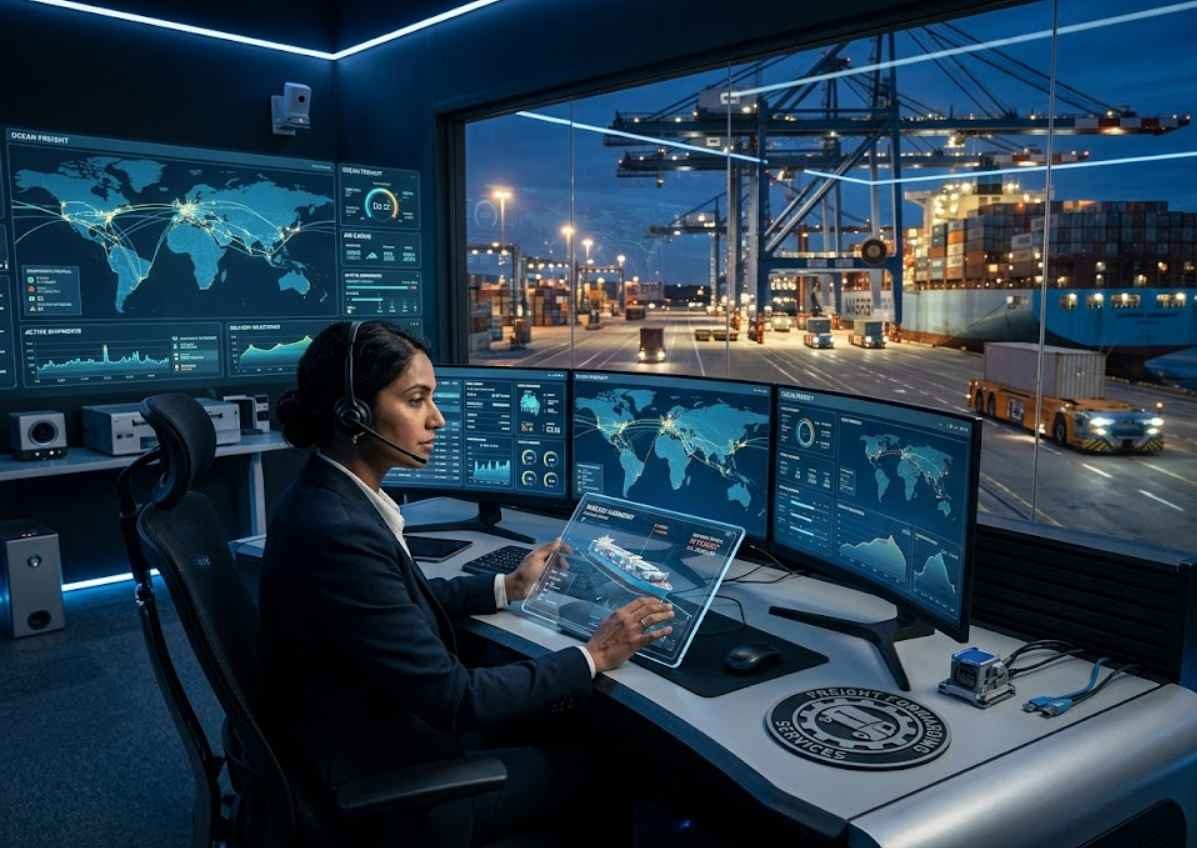
How Digital Innovation Is Reshaping Freight Forwarding Services
The global supply chain is undergoing a structural transformation. For decades, the movement of goods across borders relied on heavy paperwork, fragmented communication, and reactive crisis management. Today, unpredictable delays, volatile logistics costs, and regional trade shifts have turned planning based on historical stability into a strategic error.
To survive in this permanently unstable environment, the industry is turning toward intelligent execution. Logistics is no longer just about moving physical boxes from one point to another; it is about managing the digital data that shadows those boxes. At the center of this revolution are modern freight forwarding services, which are being completely reinvented by advanced technology. From artificial intelligence to automated document processing, technology in logistics has shifted from an optional upgrade to a fundamental requirement for global trade.
1. The Real-Time Visibility Revolution
For years, tracking an international shipment felt like looking into a black box. A shipper would hand over cargo to a provider offreight forwarding services and receive an estimated time of arrival. If a storm disrupted an ocean lane or a port became congested, the realization often came days after the event occurred, leading to missed production deadlines and unexpected storage fees.
The integration of the Internet of Things and digital twins has changed this dynamic entirely. By placing connected sensors on pallets, containers, and delivery vehicles, logistics providers can stream real-time data regarding geographic coordinates, ambient temperature, humidity, and shock impacts.
Technical Definition: According to definitions maintained by Google, an Internet of Things network consists of physical objects embedded with sensors, processing ability, and software that connect and exchange data with other devices and systems over communications networks.
When this sensor data is fed into a digital twin, a virtual replica of the physical supply chain is created. Logistics managers can monitor operations as they happen, allowing teams to react to exceptions immediately. If a refrigerated container carrying pharmaceuticals experiences a temperature spike, an automated alert triggers an immediate maintenance response before the cargo spoils.
Real-time visibility also transforms how companies handle transportation disruptions. Instead of waiting for yesterday's problem report, automated logistics platforms continuously calculate scenarios based on live demand signals and weather patterns. If an Asian port faces sudden congestion, an AI-driven system can identify the bottleneck early, allowing teams to redirect freight to alternative routes or adjusting inventory levels across regional warehouses before downstream operations are affected.
2. Automating the Core Workflows of Freight Forwarding
The administrative burden of international trade has traditionally been a major source of operational friction. A single maritime shipment can require dozens of unique documents, including bills of lading, commercial invoices, packing lists, and customs declarations. Historically, processing these files meant manual data entry, a slow method highly prone to human error.
Modern software systems have introduced workflow automation directly into the daily operations offreight forwarding services. Through advanced optical character recognition and machine learning algorithms, unstructured data from scanned paperwork is automatically extracted, verified, and synchronized across internal platforms.
Key Workflow Automations in Modern Freight Forwarding
Instant Quoting and Booking: Automated rate engines allow forwarders to analyze spot and contract rates across multiple ocean, air, and road carriers instantly. This eliminates the traditional multi-day delay associated with requesting manual quotes for standard lanes.
Smart Documentation and Compliance: Automated systems generate digital shipping documents, validate trade compliance rules, and flag potential customs mismatches before papers are submitted to border authorities, reducing the risk of administrative delays.
Milestone Synchronization: Instead of forcing customer service teams to manually check carrier portals and draft status updates, integrated platforms push automated tracking notifications directly to clients and partner systems via secure application programming interfaces.
By removing repetitive manual tasks, automation lowers the overall cost to serve. It minimizes processing errors, accelerates clearing processes at customs checkpoints, and significantly reduces secondary expenses such as demurrage and detention fees, which often accrue when physical goods move faster than their corresponding paperwork.
3. Artificial Intelligence and Predictive Logistics
The shift from reactive operations to anticipatory management is being driven by machine learning. In the past, logistics planning relied heavily on historical averages to forecast future demand and schedule capacity. However, in a volatile market where trade flows are rapidly shifting due to regionalization and nearshoring, historical data alone is no longer an accurate guide.
Artificial intelligence excels at finding subtle patterns within massive, fragmented datasets. By analyzing historical shipping patterns alongside real-time variables like global economic indicators, seasonal retail trends, weather patterns, and geopolitical developments, predictive analytics engines can forecast short-term demand shifts with remarkable precision.
According to research insights tracked via Google News, the latest logistics implementations focus heavily on shifting AI from long-range forecasting to real-time operational execution. This means using predictive algorithms to solve daily operational bottlenecks before they cause service failures.
For instance, predictive models can analyze port performance metrics to forecast coming congestion days before it becomes critical. This allows a provider offreight forwarding services to proactively secure space on alternative carriers or shift cargo to secondary ports. Similarly, machine learning models optimize warehouse slotting and labor allocation by predicting incoming order volumes, ensuring that distribution centers are staffed appropriately without overextending operational budgets. This capability allows supply chains to absorb unexpected shocks smoothly, turning unpredictability into a manageable variable.
4. Warehouse Robotics and the Autonomous Frontier
While digital workflows optimize the movement of data, physical automation is redefining how goods are handled inside fulfillment centers and logistics hubs. Faced with persistent labor shortages and rising storage costs, companies are investing heavily in smart warehouse technologies to maintain high throughput speeds.
Autonomous mobile robots and collaborative robots, often called cobots, are now standard fixtures in modern distribution centers. Unlike older automation systems that required fixed infrastructure and rigid layouts, these modern units use onboard sensors and artificial intelligence to navigate dynamic environments safely alongside human workers.
Comparison of Traditional vs. Technology-Enabled Warehousing
| Operational Metric | Traditional Warehousing | Tech-Enabled Warehousing (Robotics & WMS) |
|---|---|---|
| Inventory Tracking | Periodic cycle counts, manual scanning | Real-time tracking via IoT and computer vision |
| Picking Accuracy | Dependent on human verification, higher error rates | Guided by software, automated sorting minimises mistakes |
| Space Utilization | Fixed shelving layouts with wide aisles for forklifts | Dynamic slotting, high-density automated storage systems |
| Adaptability | Hard to scale quickly during sudden demand surges | Scalable robotic fleets easily adjusted for peak seasons |
In advanced facilities, warehouse management systems orchestrate these robotic fleets to automate end-to-end workflows. High-speed shuttle systems retrieve items from high-density storage racks and deliver them to robotic arms or sorting conveyors. Computer vision tools inspect packages for damage, verify dimensions, and update inventory logs simultaneously.
This level of physical automation ensures that the velocity of warehouse operations matches the digital speed of automatedfreight forwarding services, creating a seamless link between stationary storage and global transportation networks.
Conclusion and Strategic Next Steps
The integration of technology into the logistics sector has fundamentally changed how the world trades. The days of siloed systems, manual documentation, and blind spots in the supply chain are coming to an end. Businesses that leverage advancedfreight forwarding services backed by real-time visibility, automated workflows, predictive artificial intelligence, and smart warehousing are building a distinct competitive advantage. They carry lower safety stock, experience fewer delivery exceptions, and can pivot their strategies quickly when global disruptions occur.
In a marketplace where supply chain resilience directly dictates profitability, standing still is equivalent to falling behind. For a detailed strategic perspective on how global enterprise leaders are restructuring their supply chain investments to adapt to these digital realities, explore the executive insights available on Forbes.


Leave a Comment