Introduction
The role of delivery in the restaurant industry has expanded significantly in recent years. What was once an optional service is now a primary revenue channel for many businesses. Customers expect timely deliveries, accurate order handling, and clear visibility throughout the process.
As order volumes increase, managing deliveries becomes operationally complex. Restaurants often face issues such as unstructured order assignment, limited visibility into active deliveries, delays during peak hours, and inefficient coordination with drivers. These challenges directly affect service quality and consistency.
Additionally, when delivery operations are handled manually, it becomes difficult to maintain control over timing, accuracy, and overall execution.
To solve these challenges, restaurants are moving toward structured systems that help organize and control delivery operations more efficiently.
What Is a Restaurant Delivery Management System?
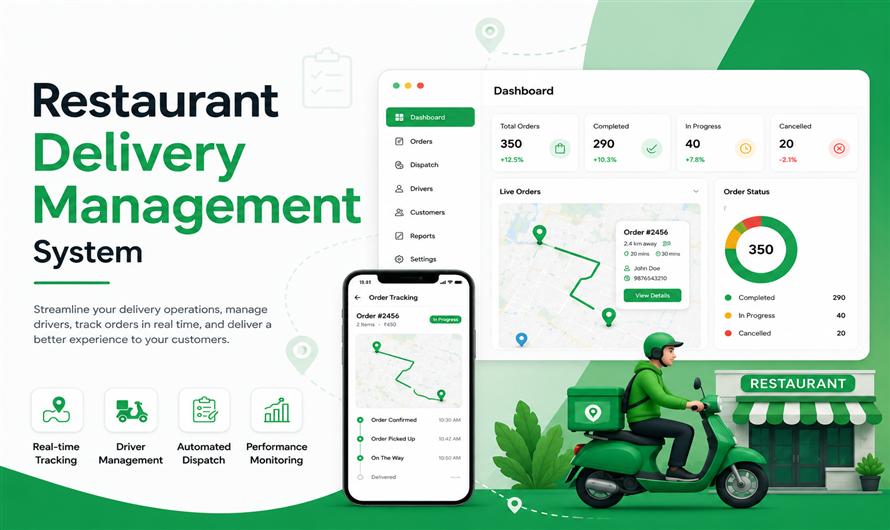
A restaurant delivery management system is a software solution that manages and organizes the entire delivery workflow from order assignment to final delivery completion.
It ensures that incoming orders are assigned to available drivers, tracked in real time, and completed in a structured sequence without manual coordination.
The system helps maintain consistency in delivery operations by standardizing how orders are assigned, monitored, and completed as order volume grows.
Why Delivery Management Matters for Modern Restaurants
Delivery performance directly impacts customer satisfaction and repeat business. Even small inefficiencies in delivery execution can affect overall service quality.
1. Order Completion Consistency
Every order must be delivered without delays or confusion. Unstructured processes increase the chances of missed assignments, delayed pickups, and incorrect sequencing.
2. Time Management During Peak Hours
High order volume during peak hours creates pressure on both kitchen and delivery teams. Without proper coordination, orders may wait longer before dispatch or get delayed in transit.
3. Operational Visibility
Restaurants need clear visibility into delivery status at all times, including which orders are active, assigned, or delayed. Without this, decision-making becomes reactive instead of controlled.
4. Process Standardization
A structured system ensures every delivery follows the same workflow, reducing dependency on individual handling and minimizing operational errors.
5. Performance Measurement
Tracking delivery time, order completion rate, and driver activity helps restaurants identify inefficiencies and improve operations over time.
Key Features of a Restaurant Delivery Management System
A restaurant delivery management system is designed to streamline delivery operations by automating key tasks and reducing manual effort. It brings all delivery-related functions into a single controlled system.
Real-Time Delivery Tracking
The system continuously tracks active deliveries, allowing restaurants to monitor driver movement and order status in real time. This improves visibility and helps manage delays more effectively.
Driver Management System
It maintains complete control over driver availability, assignments, and activity. Restaurants can ensure that the right driver is assigned to each order based on operational needs.
Automated Order Dispatch
Orders are automatically assigned to available drivers based on factors like location and workload. This reduces manual intervention and speeds up order processing.
Delivery Zone Configuration
Restaurants can define and manage specific delivery areas. This helps control service boundaries, delivery coverage, and operational efficiency.
Performance Monitoring
The system tracks delivery performance metrics such as delivery time, order completion rate, and driver efficiency. This data helps improve overall delivery operations.
Key Takeaway
Each feature works together to simplify delivery management by improving speed, reducing manual work, and ensuring better control over the entire delivery process.
Common Challenges in Restaurant Delivery Operations
- Inefficient order assignment during peak hours
- Delays in order dispatch and delivery completion
- Lack of real-time visibility into active deliveries
- Poor communication between staff and delivery drivers
- Inconsistent delivery processes across orders
- Difficulty tracking driver performance and activity
- No structured system for managing delivery zones
- Limited data for analyzing delivery efficiency
- Increased operational errors due to manual handling
- Reduced control over end-to-end delivery workflow
A restaurant delivery management system is no longer just an operational upgrade—it has become a necessity for restaurants that want to scale efficiently and maintain consistent service quality. By bringing structure to order assignment, delivery tracking, and driver coordination, it helps reduce manual errors and improves overall delivery performance.
As order volumes continue to grow, having a centralized system ensures better control, faster deliveries, and improved customer satisfaction. It also allows restaurants to operate with greater transparency and measurable efficiency across their delivery network.
If you want to explore how this works in detail, you can check Ressto Restaurant Delivery Management System for a complete overview of the solution.
Explore a Free demo with Ressto and see how it can transform your restaurant delivery operations.


Leave a Comment