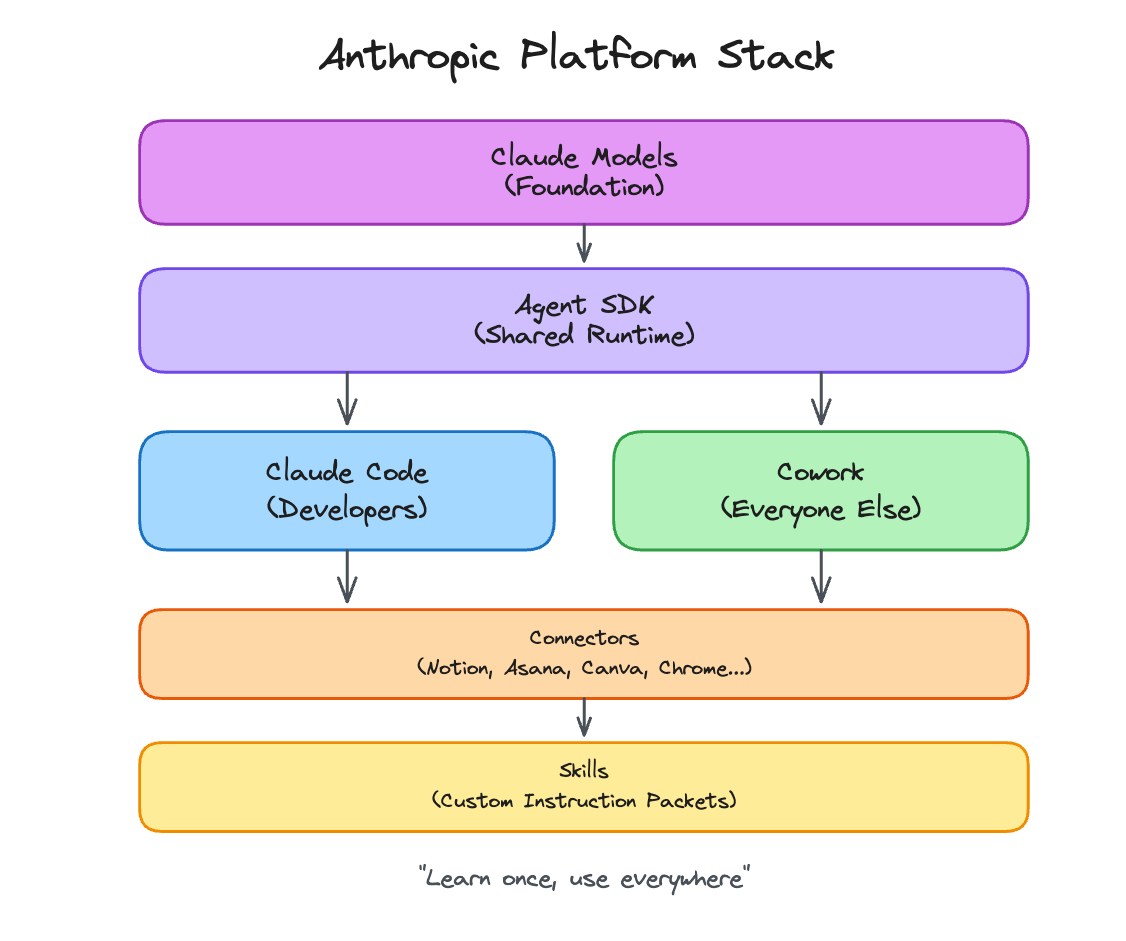
What is Claude CoWork?
Claude CoWork (often referred to as collaborative workflows in Anthropic’s ecosystem) is a concept where multiple AI agents powered by Claude AI work together like a team to complete complex tasks.
Instead of a single prompt → single response flow, CoWork enables:
- Task decomposition
- Parallel execution
- Context sharing between agents
- Iterative refinement
Think of it as building a mini AI team inside your application.

Why use Claude CoWork?
1. Handle Complex Tasks
- Break large problems into smaller subtasks
Example: Blog → Research + Outline + Writing + SEO
2. Better Output Quality
- Each “agent” specializes in one job
3. Automation at Scale
Useful for:
- Content generation systems
- Code generation pipelines
- Data processing workflows
4. Production-Ready AI Systems
- Moves you beyond simple chatbot usage
How Claude CoWork Works (Concept)
Typical flow:
- Orchestrator Agent
- Receives user input
- Splits task into steps
- Worker Agents
- Each handles a specific task
- Example:
- Research Agent
- Writer Agent
- Reviewer Agent
- Shared Context
- Output of one agent → input to next
- Final Aggregation
- Combine results into final output
Example Use Case
Auto Blogging System
Flow:
- Topic Input
- Research Agent → collects info
- Outline Agent → structures content
- Writer Agent → writes article
- SEO Agent → optimizes keywords
- Publisher → posts to website
How to Implement Claude CoWork
You’ll implement this using the Claude API.
Step 1: Setup API
npm install axiosStep 2: Basic Claude API Call
const axios = require("axios");

async function callClaude(prompt) {
    const response = await axios.post(
        "https://api.anthropic.com/v1/messages",
        {
            model: "claude-3-opus-20240229",
            matokens: 1000,
            messages: [
                { role: "user", content: prompt }
            ]
        },
        {
            headers: {
                "x-api-key": "YOUR_API_KEY",
                "anthropic-version": "2023-06-01",
                "content-type": "application/json"
            }
        }
    );

    return response.data.content[0].text;
}
Step 3: Create Multiple Agents
1. Research Agent
async function researchAgent(topic) {
    return await callClaude(`Do deep research on: ${topic}`);
}
2. Outline Agent
async function outlineAgent(research) {
    return await callClaude(`Create structured outline from:\n${research}`);
}
3. Writer Agent
async function writerAgent(outline) {
    return await callClaude(`Write full blog based on:\n${outline}`);
}
4. Reviewer Agent
async function reviewAgent(content) {
    return await callClaude(`Improve and proofread:\n${content}`);
}
Step 4: Orchestrator (CoWork Engine)
async function runCoWork(topic) {
    const research = await researchAgent(topic);
    const outline = await outlineAgent(research);
    const draft = await writerAgent(outline);
    const final = await reviewAgent(draft);

    return final;
}
Step 5: Run It
runCoWork("SQL Server Jobs").then(console.log);
Advanced CoWork Architecture
For production systems:
- Add Parallel Execution
- Run multiple agents at once
- Add Memory Layer
- Store intermediate outputs (DB/Cache)
- Add Retry Logic
- Handle API failures
- Add Role Prompts
- Make each agent specialized
Example:
"You are a senior SEO expert..."
"You are a technical writer..."
Real-World Use Cases
- Auto blogging platforms
- Social media automation
- AI coding assistants
- Customer support bots
- Data analysis pipelines
Key Insight
Claude CoWork is not a built-in product — it’s a design pattern for orchestrating multiple AI calls using Anthropic models.
Conclusion
If you're building advanced AI systems, CoWork is the next step beyond simple prompts.
It allows you to:
- Scale AI workflows
- Improve output quality
- Build production-grade automation


Leave a Comment