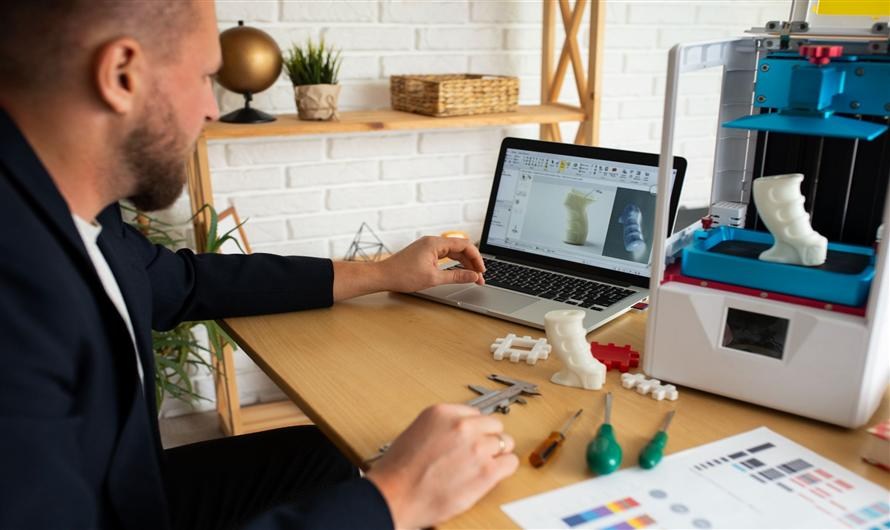
3D printing is no longer just for prototypes; it’s changing how entire industries build and innovate. In 2026, companies are using advanced 3D printing to move faster, cut costs, and create designs that were once impossible. From healthcare to aerospace, this technology is helping businesses stay competitive in a fast-moving world. But which industries are seeing the biggest impact right now? And why are they investing so heavily in it? In this article, we’ll explore the top industries leading the way and how 3D printing is shaping their future in practical, real-world ways.
Industries Thriving with 3D Printing in 2026
The industries benefiting from additive manufacturing span an almost surprising range, from classified defense programs to consumer smartwatches rolling out at scale. If you're trying to figure out where the real ROI lives, understanding which sectors are gaining the most traction helps you invest with confidence rather than guesswork.
For businesses looking to stay ahead, the right manufacturing partner changes everything. Serving over 5,000 American companies, RapidMade 3D printing services based in Tualatin, Oregon, have earned a reputation as a dependable domestic partner, backed by ISO 9001 certification and ITAR registration, with deep experience across aerospace, medical, automotive, electronics, and industrial applications.
With that context in place, let's get into the specific industries turning this technology into a genuine competitive weapon.
Aerospace and Defense Lightweight, High-Performance Components
Few industries demand as much from their materials and processes as aerospace. Engineers here aren't experimenting; they're printing flight-ready components from PEKK and high-temperature polymers, all under strict traceability requirements that leave no margin for error.
Formnext 2025 was telling. Hardware like the FUNMAT PRO 310 APOLLO, built explicitly for multi-material, high-temperature production, signaled that certified, precision-grade additive manufacturing has officially crossed from prototyping territory into full production environments. That's a meaningful line to cross.
Healthcare and Medical Devices Custom, Biocompatible Production
Healthcare, much like aerospace, operates under unforgiving compliance standards. But what makes medical 3D printing especially remarkable is how personal the output gets. We're talking biocompatible implants, patient-specific surgical guides, and sterilization-resistant devices built to exact anatomical specifications.
Breakthroughs like xolography a volumetric printing method developed at the University of Melbourne, are enabling living tissue constructs and functional organoids. And MXene-infused conductive filaments? They're opening real pathways for embedding sensor functionality directly into wearable medical devices. What's happening here feels less like manufacturing and more like the beginning of something genuinely transformative.
Automotive and Mobility From Rapid Prototyping to End-Use Parts
Not long ago, "automotive 3D printing" essentially meant concept models sitting on a shelf. That's no longer the case. EV battery housings, custom mounting brackets, and on-demand replacement components manufacturers are now running production-ready parts off additive systems rather than treating them as a prototyping novelty.
The U.S. rapid prototyping and services sector is projected to reach $4.3 billion in revenue in 2025, with a sustained ~17.2% CAGR over the past five years. That growth reflects actual capital deployment, not inflated enthusiasm.
Construction and Architecture Large-Scale, Sustainable Building
Here's where the scale really shifts. Construction's projected CAGRs approach an astonishing 54% in certain market segments, numbers that, frankly, seem hard to believe until you see large-format concrete printing moving from experimental showcase to operational job site.
Modular housing production is transitioning fast. Printed structures consume dramatically less raw material than poured concrete alternatives, and complex facade geometries that would once require expensive custom molds are now economically accessible. Sustainability isn't just the bonus here; it's a primary driver of adoption.
Consumer Electronics and Wearables Agile Iteration and Customization
Speed is the currency of consumer electronics. You're not winning in this space by being thoughtful and slow; you're winning by iterating faster than your competition. Startups can now move from a CAD revision to a physical prototype of a smartwatch enclosure in under 48 hours. That kind of cycle time used to be fantasy.
Co-development partnerships with manufacturing firms are letting electronics brands run tight feedback loops, testing ergonomics, fit, and assembly tolerances before a single tooling dollar gets committed. That's a risk profile that used to be unavailable to smaller teams.
Industrial Equipment and Tooling Durable, Custom Tools On-Demand
Tooling doesn't always get the spotlight, but the operational impact is enormous. Binder jetting and metal alloy printing are replacing traditional machining for short-run jigs, weld fixtures, and custom clamps, and the timeline compression alone justifies the investment.
Lead times that once stretched three weeks now compress to two or three days. For manufacturers running lean, that's not a convenience improvement. That's a structural advantage.
Energy, Semiconductor, and Electronics Infrastructure Precision Production
These sectors don't advertise their additive manufacturing adoption loudly, but activity is accelerating. Embedded electronics, ultra-precise flow components, heat-resistant housings the applications are quietly multiplying. High-reliability standards mean rigorous QA documentation isn't optional here. Certified domestic partners who can provide full compliance traceability aren't a preference; they're a requirement.
Emerging Trends Powering 3D Printing-Driven Industries
Three forces are consistently amplifying results across every sector above: AI-enabled design optimization, advanced material science expanding printable substances, and supply chain reshoring driving demand for domestic precision manufacturing. If you're evaluating where to invest in additive technology, these trends are worth tracking closely. They're reshaping the ROI math across the board.
FAQs
1. What industries benefit most from 3D printing?
Healthcare, aerospace, automotive, and consumer goods see the biggest benefits due to speed, customization, and cost savings.
2. Why is 3D printing important in manufacturing?
It helps reduce costs, speeds up production, and allows easy design changes.
3. Can 3D printing be used for mass production?
Yes, modern 3D printing supports both prototyping and large-scale production for many applications.
Final Thoughts on 3D Printing's Industry Impact in 2026
Advanced 3D printing isn't carving out a niche anymore; it's becoming central infrastructure for how serious companies manufacture. Across aerospace, healthcare, automotive, construction, electronics, and industrial sectors, the businesses pulling ahead aren't watching this unfold from the sidelines. They're already using additive manufacturing to cut waste, compress timelines, and build things that were previously unbuildable. The technology is ready. The question worth asking yourself is simply this: Is your business ready to use it?


Leave a Comment
1 Comments