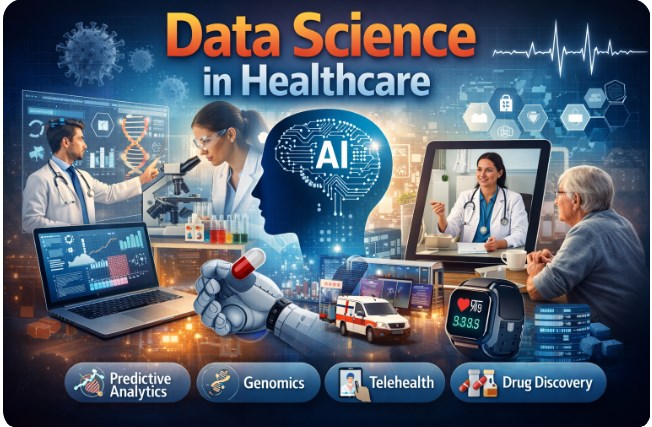
Recently I have completed a course on data science in healthcare, medicine, and public health. Hopefully I have learned some really useful things I want to share you.
Data Science in Healthcare, Medicine, and Public Health
Data science is an enormously powerful set of tools in the life and death matters of health and medicine.
The principles and practices of data science can be used to help healthcare professionals predict risks for illnesses and epidemics, take proactive and preventive measures, better understand the nature of illness, and develop exciting new ways to treat diseases.
Data science can even help make healthcare more accessible and more affordable and give people a greater voice in their own wellbeing.
Data Science and the Pandemic
COVID impacted pretty much everything everywhere and data science is no exception.
Data science was important in tracking COVID, mapping the prevalence of the disease across places and across time, and helping develop and distribute vaccines.
Predictive models developed before the pandemic were no longer valid and many organizations went back to descriptive models to understand what they were dealing with right now.
Measuring Health and Disease
To do data science with health data, you first have to measure things.
Mortality is usually expressed as the number of deaths per 100,000.
Years lived with disability (YLD) is an attempt at quantifying the effects of living with disabilities.
Disability-adjusted life years (DALY) combine years lost to early death and years lost to disability.
These measures function as a way of getting a very big picture and allow you to compare the relative health of populations by time and by place.
Researching Diseases in Populations
Electronic health records have opened the possibilities for research with large standardized datasets.
Researchers can also get health-related information from search engines, social media, and other public data sources.
The most productive approaches combine data sources and include experts to get a more complete and accurate picture.
Genetic Data and Healthcare
Genetic data has extraordinary volume, velocity, and variety.
Genomics has enormous promise in diagnosis, treatment, and gene editing.
Data science is in an ideal position to help realize the potential and promises waiting in genomics.
Diagnosing Diseases
Medical diagnosis can be seen as a form of classification.
Algorithms can read complex data, make work more efficient, and provide new insights for diagnosis.
The algorithms serve as tools to aid, not replace doctors, nurses, and caregivers.
Drug Discovery
Drug development is very difficult, time consuming, expensive, and not guaranteed.
AI-enabled discovery allows machine learning algorithms to analyze the results of millions of automated trials and accelerate drug discovery.
Predicting the Outcomes
Predictive analytics can be predict future events and also counterfactual outcomes.
Measured associations can be used for prediction even if they do not have the causal relationship.
Models must be tested, adapted, and repeated to ensure they work in new circumstances.
Treatments and ROI
An ounce of prevention is worth a pound of cure.
Return on investment can help inform decisions when resources are limited.
Data-informed decision-making helps ensure better health and wellness for a greater number of people.
Telehealth and Digital Healthcare
Telehealth utilization stabilized at levels 38 times higher than before the pandemic.
Data science helps with secure online visits, secure data transfer, and combining data sources into accessible formats.
Wearables and Health Monitoring
Wearables gather data such as steps, heart rate, blood oxygen, blood pressure, and sleep quality.
These tools allow people to monitor their own health and guide them toward healthier lives.
Patient Experience and Self-Serve Healthcare
Patients who report positive interactions demonstrate greater self-management skills and better health outcomes.
Self-service systems make it easier to gather and use data and reduce waiting times and workload.
Administrative Burden and the Blockchain
Administrative burden adds significant costs to healthcare.
Data science helps through secure the data sharing, natural language processing and the unstructured data analysis.
Blockchain offers decentralized, verifiable, and immutable to health data.
Data Ethics in Healthcare
You must have consent to use personal data and respect privacy.
Justice and equity are important because technical work has a tremendous impact on health outcomes.
Responsible data use allows work to have maximum impact.
Preparing for the Future
Prediction is hard, especially when it is about the future.
We need to be flexible, open to learning, and ready to respond quickly.
The goal remains the same: making healthcare more effective, efficient, and accessible to more people.


Leave a Comment