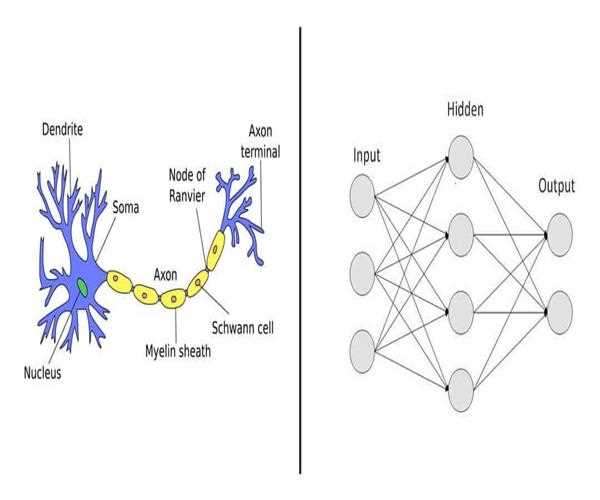
Biological Neurons Vs Artificial Neurons?
- Biological neurons are the basic building blocks of the neurological system, whereas the artificial neurons are the neuron, also referred to as a perceptron, is a mathematical model used in artificial neural networks.
Although it functions in a computational environment, it mimics the way that biological neurons behave. - Biological neurons uses chemical messages and electrical impulses whereas artificial neurons uses mathematical trained model.
Neural Networks in AI
1. Basic Structure:
Neural network can be defined as a layers of interconnected nodes, or neurons.
There are the three types of layers in this network:
- Input layer: Data is received by the input layer and then it is forwarded to the hidden layer
- Hidden Layers: Receives the data from the input layer and then after recognize patterns by processing data.
- Output layer: Receives the processed result from hidden layer and generates the final product
2. Forward Propagation:
- Information travels from the input layer to the output layer via hidden layers.
- Each neuron uses the activation function, weights, and biases to process information.
- These calculations are what produce the outcome.
3. Activation Functions:
- By introducing nonlinearity, these functions enable NNs to pick up intricate patterns.
- Typical activation mechanisms:
1. Sigmoid: Converts inputs into a 0–1 range.
2. ReLU, or Rectified Linear Unit, outputs 0 otherwise and the input if it is affirmative.
3. The hyperbolic tangent, or tanh, maps inputs to a range of -1 to 1.
4. Backpropagation:
- The network modifies its weights and biases while it is being trained.
- Errors in the expected and actual outputs spread in a backward direction.
- For better performance, the network iteratively adjusts its settings.
5. Training:
- Neural Networks are trained using labeled data, or pairings of input and output.
- Prediction error is measured by loss functions (e.g., mean squared error).
- Weights are changed by optimization methods, such as gradient descent, in order to reduce loss.
6. Uniqueness and Deep Learning:
- Deep Learning: Multi-layered neural networks are the deep architectures and directly implements deep learning.
- Originality or Feature extraction: From unprocessed data, Neural Networks automatically extract pertinent features and learn from it automatically.
- Generalization: They adapt easily to new situations.
- End-to-End Learning: Without the need for human feature engineering, Neural Networks learn straight from input to output.
8. Uses:
- Image Recognition: Neural Networks are quite good at recognizing things in pictures.
- RNNs are used in Natural Language Processing (NLP) to process sequences, such as text and speech.
- They also play a vital role in the field of Finance, healthcare, recommendation systems, and other areas.
Conclusion:
Neural networks can be recalled as the connected puzzle pieces that all contribute to the larger image of artificial intelligence.


Leave a Comment